Kim Jaehee, Shen Wei, Gallagher Dympna, Jones Alfredo, Wang Zimian, Wang Jack, Heshka Stanley, Heymsfield Steven B
Obesity Research Center, St Luke's-Roosevelt Hospital, College of Physicians and Surgeons, Columbia University, New York, NY, USA.
Am J Clin Nutr. 2006 Nov;84(5):1014-20. doi: 10.1093/ajcn/84.5.1014.
Skeletal muscle (SM) is an important compartment but is difficult to quantify in children and adolescents.
We investigated the potential of dual-energy X-ray absorptiometry (DXA) for measuring total-body SM in pediatric subjects.
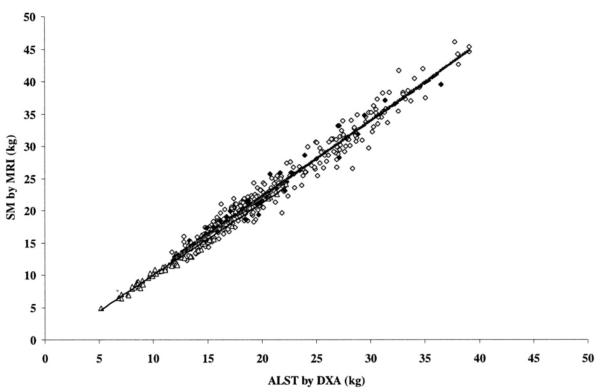
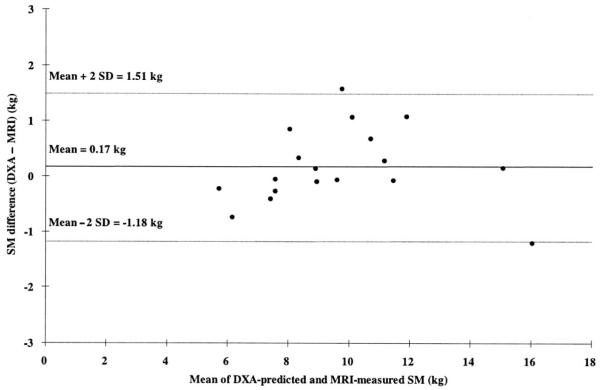
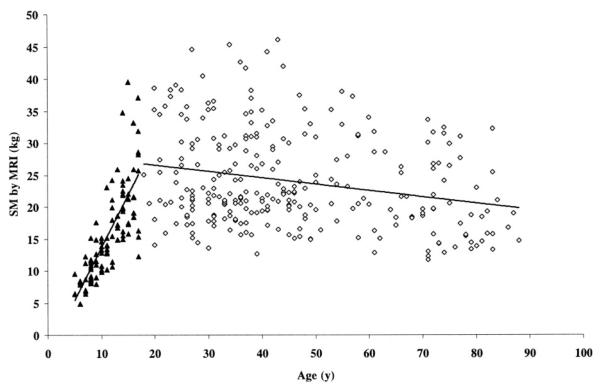
A previously published adult DXA SM prediction formula was evaluated in children and adolescents aged 5-17 y (n = 99) who varied in pubertal maturation stage. SM estimated by whole-body magnetic resonance imaging (MRI) was used as the reference. The adult SM model was not accurate for subjects below Tanner stage 5 (n = 65; aged 5-14 y). New pediatric SM prediction models were therefore developed and validated in a separate group (n = 18).
The adult DXA SM prediction model was valid in subjects at Tanner stage 5 but significantly (P < 0.001) overestimated SM in subjects below Tanner stage 5. New SM prediction formulas were developed with appendicular lean soft tissue (ALST) estimates by DXA as the main predictor variable (eg, model 1, ALST alone: R(2) = 0.982, SEE = 0.565 kg, P < 0.001). The new models were validated by the leave-one-out method and were cross-validated in a separate validation group.
A previously reported adult DXA SM prediction model is applicable in children and adolescents late in pubertal development (Tanner stage 5). A new DXA SM prediction model was developed for prepubertal and pubertal subjects (Tanner stage </=4) aged >/=5 y. DXA thus provides an important opportunity for quantifying total-body SM mass across most of the human life span.
骨骼肌(SM)是一个重要部分,但在儿童和青少年中难以量化。
我们研究了双能X线吸收法(DXA)测量儿童受试者全身SM的潜力。
在99名年龄5至17岁、青春期成熟阶段各异的儿童和青少年中评估了先前发表的成人DXA SM预测公式。以全身磁共振成像(MRI)估计的SM作为参考。成人SM模型对坦纳分期低于5期的受试者(n = 65;年龄5至14岁)不准确。因此,开发了新的儿童SM预测模型,并在另一组(n = 18)中进行了验证。
成人DXA SM预测模型在坦纳5期受试者中有效,但在坦纳分期低于5期的受试者中显著高估了SM(P < 0.001)。以DXA估计的四肢去脂软组织(ALST)作为主要预测变量,开发了新的SM预测公式(例如,模型1,仅ALST:R² = 0.982,SEE = 0.565 kg,P < 0.001)。新模型通过留一法进行验证,并在一个单独的验证组中进行交叉验证。
先前报道的成人DXA SM预测模型适用于青春期发育后期(坦纳5期)的儿童和青少年。为5岁及以上青春期前和青春期(坦纳分期≤4期)受试者开发了新的DXA SM预测模型。因此,DXA为在人类大部分生命阶段量化全身SM质量提供了重要机会。