Gouze Jean-Noël, Gouze Elvire, Popp Mick P, Bush Marsha L, Dacanay Emil A, Kay Jesse D, Levings Padraic P, Patel Kunal R, Saran Jeet-Paul S, Watson Rachael S, Ghivizzani Steven C
Department of Orthopaedics and Rehabilitation, Gene Therapy Laboratory, University of Florida, College of Medicine, PO Box 100137, Gainesville, FL 32610-0137, USA.
Arthritis Res Ther. 2006;8(6):R173. doi: 10.1186/ar2082.
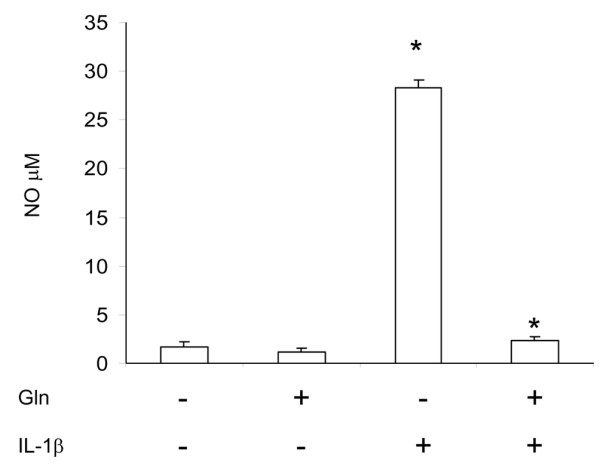
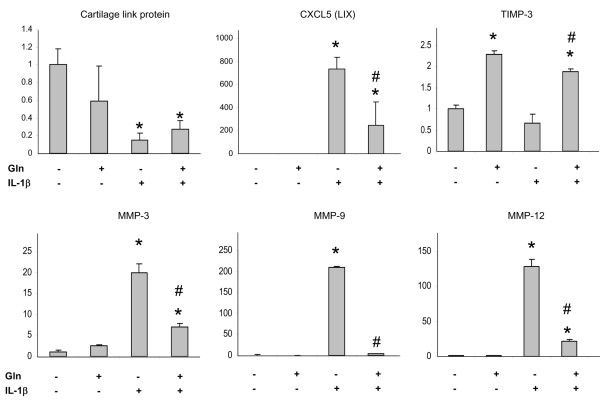
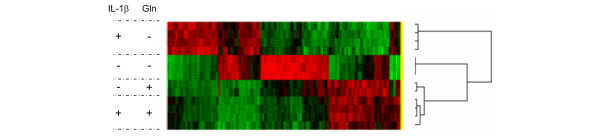
The effects of exogenous glucosamine on the biology of articular chondrocytes were determined by examining global transcription patterns under normal culture conditions and following challenge with IL-1beta. Chondrocytes isolated from the cartilage of rats were cultured in several flasks either alone or in the presence of 20 mM glucosamine. Six hours later, one-half of the cultures of each group were challenged with 10 ng/ml IL-1beta. Fourteen hours after this challenge, RNA was extracted from each culture individually and used to probe microarray chips corresponding to the entire rat genome. Glucosamine alone had no observable stimulatory effect on the transcription of primary cartilage matrix genes, such as aggrecan, collagen type II, or genes involved in glycosaminoglycan synthesis; however, glucosamine proved to be a potent, broad-spectrum inhibitor of IL-1beta. Of the 2,813 genes whose transcription was altered by IL-1beta stimulation (P < 0.0001), glucosamine significantly blocked the response in 2,055 (approximately 73%). Glucosamine fully protected the chondrocytes from IL-1-induced expression of inflammatory cytokines, chemokines, and growth factors as well as proteins involved in prostaglandin E2 and nitric oxide synthesis. It also blocked the IL-1-induced expression of matrix-specific proteases such as MMP-3, MMP-9, MMP-10, MMP-12, and ADAMTS-1. The concentrations of IL-1 and glucosamine used in these assays were supraphysiological and were not representative of the arthritic joint following oral consumption of glucosamine. They suggest, however, that the potential benefit of glucosamine in osteoarthritis is not related to cartilage matrix biosynthesis, but is more probably related to its ability to globally inhibit the deleterious effects of IL-1beta signaling. These results suggest that glucosamine, if administered effectively, may indeed have anti-arthritic properties, but primarily as an anti-inflammatory agent.
通过在正常培养条件下以及用白细胞介素-1β(IL-1β)刺激后检测整体转录模式,来确定外源性氨基葡萄糖对关节软骨细胞生物学特性的影响。从大鼠软骨分离出的软骨细胞在多个培养瓶中单独培养或在含有20 mM氨基葡萄糖的条件下培养。6小时后,每组培养物的一半用10 ng/ml IL-1β刺激。刺激后14小时,从每个培养物中单独提取RNA,并用于探测对应于整个大鼠基因组的微阵列芯片。单独的氨基葡萄糖对主要软骨基质基因如聚集蛋白聚糖、II型胶原蛋白或参与糖胺聚糖合成的基因的转录没有可观察到的刺激作用;然而,氨基葡萄糖被证明是一种有效的、广谱的IL-1β抑制剂。在因IL-1β刺激而转录发生改变的2813个基因中(P < 0.0001),氨基葡萄糖显著阻断了其中2055个基因(约73%)的反应。氨基葡萄糖完全保护软骨细胞免受IL-1诱导的炎性细胞因子、趋化因子和生长因子以及参与前列腺素E2和一氧化氮合成的蛋白质的表达。它还阻断了IL-1诱导的基质特异性蛋白酶如基质金属蛋白酶-3(MMP-3)、基质金属蛋白酶-9(MMP-9)、基质金属蛋白酶-10(MMP-10)、基质金属蛋白酶-12(MMP-12)和含血小板反应蛋白基序的解聚素样金属蛋白酶-1(ADAMTS-1)的表达。这些实验中使用的IL-1和氨基葡萄糖的浓度高于生理水平,并不代表口服氨基葡萄糖后关节炎关节的情况。然而,它们表明氨基葡萄糖在骨关节炎中的潜在益处与软骨基质生物合成无关,而更可能与其全面抑制IL-1β信号有害作用的能力有关。这些结果表明,如果有效给药,氨基葡萄糖可能确实具有抗关节炎特性,但主要作为一种抗炎剂。