Fulford Laura G, Reis-Filho Jorge S, Ryder Ken, Jones Chris, Gillett Cheryl E, Hanby Andrew, Easton Douglas, Lakhani Sunil R
Breakthrough Breast Cancer Research Centre, The Institute of Cancer Research, Fulham Road, London, SW3 6JB, UK.
Breast Cancer Res. 2007;9(1):R4. doi: 10.1186/bcr1636.
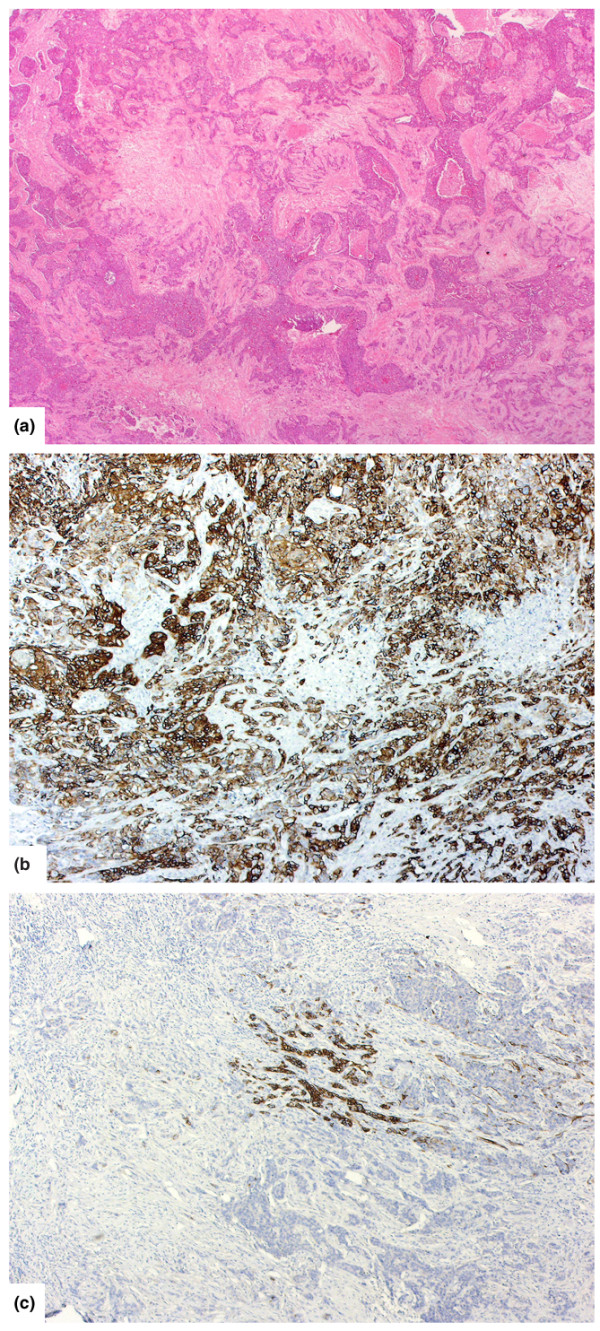
Cytokeratin (CK) 14, one of several markers expressed in normal myoepithelial/basal cells, is also expressed in a proportion of breast carcinomas. Previous studies have suggested that expression of such 'basal' markers predicts different biological behaviour, with more frequent lung and brain metastases and poorer prognosis than other carcinomas.
We performed CK14 immunohistochemistry on 443 grade III invasive ductal carcinomas with extended clinical follow-up (mean 116 months), and we correlated CK14 immunopositivity (basal-like phenotype) with clinicopathological criteria.
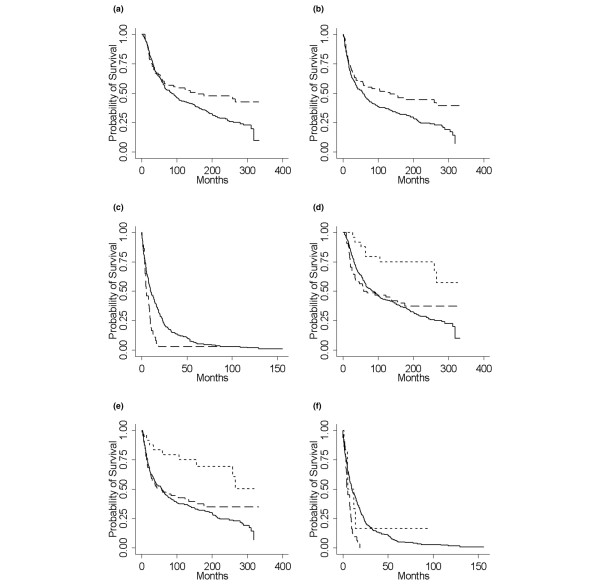
Eighty-eight of 443 (20%) tumours showed CK14 expression. CK14-positive tumours were more likely to be oestrogen receptor-negative (p < 0.0001) and axillary node-negative (p = 0.001) than were CK14-negative cases. CK14-positive cases developed less bone and liver metastases (hazard ratio [HR] 0.49, p = 0.01, and HR 0.53, p = 0.035, respectively) but more frequent brain metastases (HR 1.92, p = 0.051). In patients without metastatic disease, disease-free survival in CK14-positive cases was significantly better than in CK14-negative cases (HR 0.65, p = 0.005). In patients with metastatic disease, however, CK14 positivity was associated with a poorer prognosis (HR 1.84, p = 0.001). The overall survival in CK14-positive and -negative patients was similar at 5 years (60% and 59%, respectively), but the long-term survival was better in CK14-positive patients (HR 0.69, p = 0.02).
These results demonstrate that basal-like tumours differ in their biological behaviour from other tumours, with a distinct pattern of metastatic spread. Compared to other grade III tumours, basal-like tumours appear to have a relatively good long-term survival but survival after metastases is poor.
细胞角蛋白(CK)14是在正常肌上皮/基底细胞中表达的几种标志物之一,在一部分乳腺癌中也有表达。先前的研究表明,此类“基底”标志物的表达预示着不同的生物学行为,与其他类型的癌相比,发生肺转移和脑转移更为频繁,预后更差。
我们对443例III级浸润性导管癌进行了CK14免疫组化检测,并进行了延长的临床随访(平均116个月),我们将CK14免疫阳性(基底样表型)与临床病理标准进行了关联分析。
443例肿瘤中有88例(20%)显示CK14表达。与CK14阴性病例相比,CK14阳性肿瘤更可能为雌激素受体阴性(p < 0.0001)和腋窝淋巴结阴性(p = 0.001)。CK14阳性病例发生骨转移和肝转移较少(风险比[HR]分别为0.49,p = 0.01和HR 0.53,p = 0.035),但脑转移更为频繁(HR 1.92,p = 0.051)。在无转移性疾病的患者中,CK14阳性病例的无病生存期明显优于CK14阴性病例(HR 0.65,p = 0.005)。然而,在有转移性疾病的患者中,CK14阳性与较差的预后相关(HR 1.84,p = 0.001)。CK14阳性和阴性患者的5年总生存率相似(分别为60%和59%),但CK14阳性患者的长期生存率更好(HR 0.69,p = 0.02)。
这些结果表明,基底样肿瘤的生物学行为与其他肿瘤不同,具有独特的转移扩散模式。与其他III级肿瘤相比,基底样肿瘤似乎具有相对较好的长期生存率,但发生转移后的生存率较差。