Ho S A, Hoyle J A, Lewis F A, Secker A D, Cross D, Mapstone N P, Dixon M F, Wyatt J I, Tompkins D S, Taylor G R
Department of Pathology, University of Leeds, United Kingdom.
J Clin Microbiol. 1991 Nov;29(11):2543-9. doi: 10.1128/jcm.29.11.2543-2549.1991.
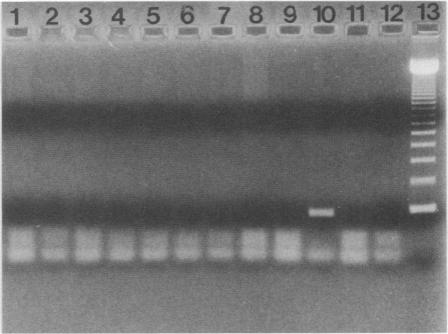
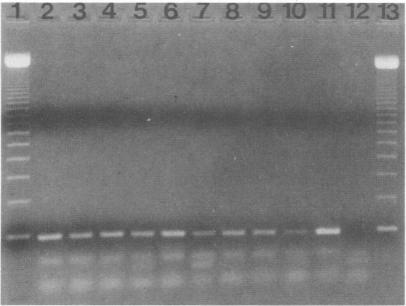
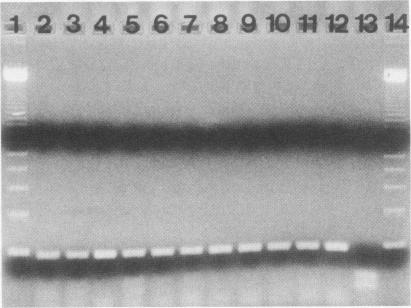
We designed a polymerase chain reaction (PCR) for amplifying the Helicobacter pylori gene encoding 16S rRNA. Primers for the specific detection of H. pylori were designed for areas of the 16S rRNA gene in which there is the least sequence homology between H. pylori and its closest relatives. The specificity of detection was confirmed by ensuring that the primers did not amplify DNA extracts from the campylobacters H. cinaedi, H. mustelae, and Wolinella succinogenes, which are the closest relatives of H. pylori, as determined by 16S rRNA sequencing. Serial dilution experiments revealed the detection of as little as 0.1 pg of DNA by PCR and 0.01 pg by nested PCR. H. pylori DNA was detected successfully in clinical paraffin-embedded and fresh gastric biopsy specimens from patients positive for the bacterium and also in fecal suspensions seeded with the organism. The DNA from the nonculturable coccoid form of H. pylori was also identified by the primers. Universal primers designed for highly conserved areas on the 16S rRNA gene enabled large amplification products to be produced for direct sequencing analysis. Gastric bacteria resembling H. pylori have been isolated from animals. DNA of these animal gastric bacteria amplified with H. pylori-specific primers yielded PCR products identical to those from human isolates of H. pylori, as confirmed by the use of a 20-base radiolabelled probe complementary to an internal sequence flanked by the H. pylori-specific primers. The results of PCR amplification and partial 16S rRNA gene sequence analysis strongly support the contention that the gastric organisms previously recovered from a pig, a baboon, and rhesus monkeys are H. pylori.
我们设计了一种聚合酶链反应(PCR),用于扩增编码幽门螺杆菌16S rRNA的基因。针对幽门螺杆菌特异性检测的引物,是在16S rRNA基因中幽门螺杆菌与其最亲近的亲属之间序列同源性最低的区域设计的。通过确保引物不会扩增来自弯曲杆菌属的嗜辛那弯曲菌、鼬弯曲菌和琥珀酸沃林氏菌的DNA提取物,来确认检测的特异性,这些弯曲杆菌是通过16S rRNA测序确定的与幽门螺杆菌最亲近的亲属。系列稀释实验显示,PCR可检测低至0.1 pg的DNA,巢式PCR可检测低至0.01 pg的DNA。在临床石蜡包埋和新鲜的胃活检标本中,成功检测到了幽门螺杆菌DNA,这些标本来自该细菌呈阳性的患者,并且在接种了该菌的粪便悬液中也检测到了。幽门螺杆菌不可培养的球形形式的DNA也能被这些引物识别。针对16S rRNA基因高度保守区域设计的通用引物,能够产生用于直接测序分析的大片段扩增产物。已从动物中分离出类似幽门螺杆菌的胃细菌。用幽门螺杆菌特异性引物扩增这些动物胃细菌的DNA,产生的PCR产物与来自人类幽门螺杆菌分离株的产物相同,这通过使用与幽门螺杆菌特异性引物侧翼的内部序列互补的20碱基放射性标记探针得以证实。PCR扩增和部分16S rRNA基因序列分析的结果有力地支持了以下观点:先前从猪、狒狒和恒河猴中分离出的胃细菌是幽门螺杆菌。