Boutron Isabelle, Guittet Lydia, Estellat Candice, Moher David, Hróbjartsson Asbjørn, Ravaud Philippe
INSERM, U738, Paris, France.
PLoS Med. 2007 Feb;4(2):e61. doi: 10.1371/journal.pmed.0040061.
Blinding is a cornerstone of treatment evaluation. Blinding is more difficult to obtain in trials assessing nonpharmacological treatment and frequently relies on "creative" (nonstandard) methods. The purpose of this study was to systematically describe the strategies used to obtain blinding in a sample of randomized controlled trials of nonpharmacological treatment.
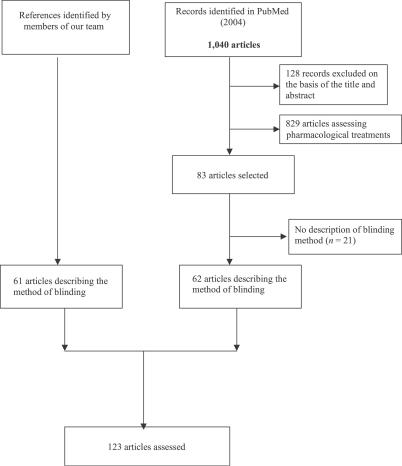
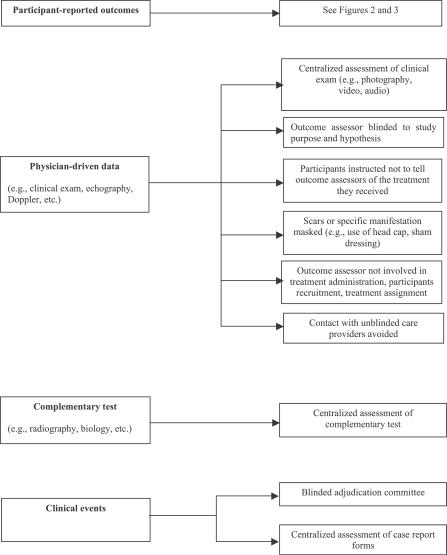
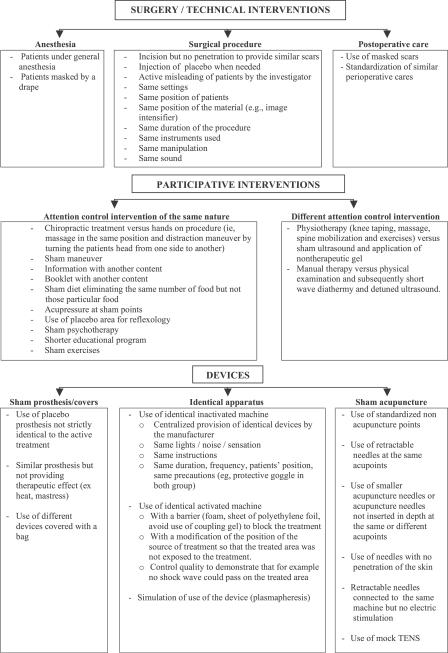
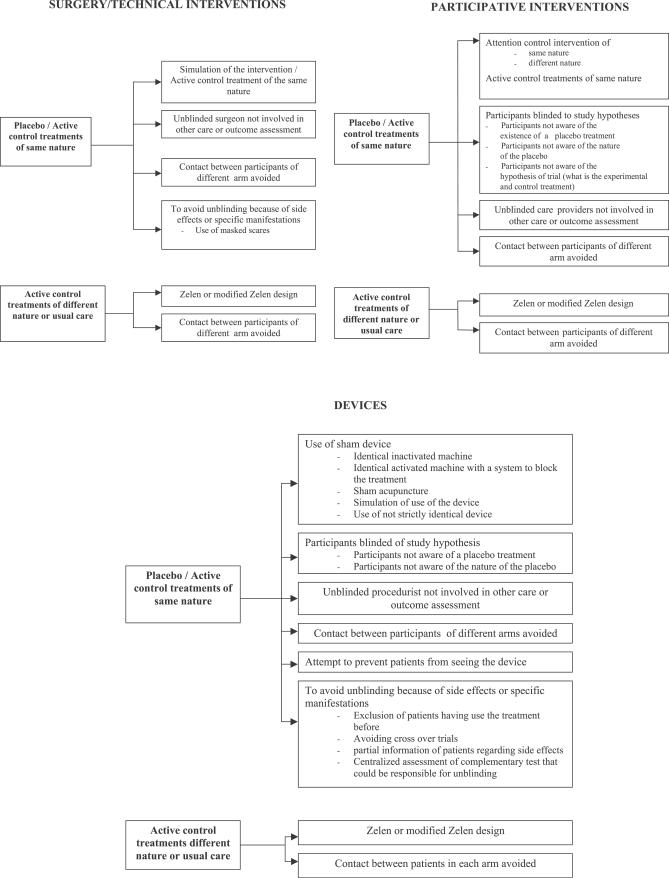
We systematically searched in Medline and the Cochrane Methodology Register for randomized controlled trials (RCTs) assessing nonpharmacological treatment with blinding, published during 2004 in high-impact-factor journals. Data were extracted using a standardized extraction form. We identified 145 articles, with the method of blinding described in 123 of the reports. Methods of blinding of participants and/or health care providers and/or other caregivers concerned mainly use of sham procedures such as simulation of surgical procedures, similar attention-control interventions, or a placebo with a different mode of administration for rehabilitation or psychotherapy. Trials assessing devices reported various placebo interventions such as use of sham prosthesis, identical apparatus (e.g., identical but inactivated machine or use of activated machine with a barrier to block the treatment), or simulation of using a device. Blinding participants to the study hypothesis was also an important method of blinding. The methods reported for blinding outcome assessors relied mainly on centralized assessment of paraclinical examinations, clinical examinations (i.e., use of video, audiotape, photography), or adjudications of clinical events.
This study classifies blinding methods and provides a detailed description of methods that could overcome some barriers of blinding in clinical trials assessing nonpharmacological treatment, and provides information for readers assessing the quality of results of such trials.
设盲是治疗评估的基石。在评估非药物治疗的试验中更难实现设盲,且常常依赖“创造性的”(非标准的)方法。本研究的目的是系统描述在一组非药物治疗的随机对照试验样本中用于实现设盲的策略。
我们在Medline和Cochrane方法学注册库中系统检索了2004年期间发表在高影响因子期刊上的评估非药物治疗且采用设盲的随机对照试验(RCT)。使用标准化提取表提取数据。我们识别出145篇文章,其中123篇报告描述了设盲方法。使参与者和/或医疗保健提供者和/或其他护理人员设盲的方法主要是使用假手术程序,如模拟外科手术、类似的注意力控制干预措施,或用于康复或心理治疗的不同给药方式的安慰剂。评估器械的试验报告了各种安慰剂干预措施,如使用假假体、相同的仪器(如相同但未激活的机器或使用有屏障阻挡治疗的激活机器),或模拟使用器械。使参与者对研究假设不知情也是一种重要的设盲方法。报告的使结果评估者设盲的方法主要依赖于对辅助临床检查、临床检查(即使用视频、录音带、摄影)或临床事件判定的集中评估。
本研究对设盲方法进行了分类,并详细描述了可克服评估非药物治疗的临床试验中设盲障碍的方法,为读者评估此类试验结果的质量提供了信息。