• 文献检索
  • 文档翻译
  • 深度研究
  • 学术资讯
  • Suppr Zotero 插件Zotero 插件
  • 邀请有礼
  • 套餐&价格
  • 历史记录
应用&插件
Suppr Zotero 插件Zotero 插件浏览器插件Mac 客户端Windows 客户端微信小程序
定价
高级版会员购买积分包购买API积分包
服务
文献检索文档翻译深度研究API 文档MCP 服务
关于我们
关于 Suppr公司介绍联系我们用户协议隐私条款
关注我们

Suppr 超能文献

核心技术专利:CN118964589B侵权必究
粤ICP备2023148730 号-1Suppr @ 2026

文献检索

告别复杂PubMed语法,用中文像聊天一样搜索,搜遍4000万医学文献。AI智能推荐,让科研检索更轻松。

立即免费搜索

文件翻译

保留排版,准确专业,支持PDF/Word/PPT等文件格式,支持 12+语言互译。

免费翻译文档

深度研究

AI帮你快速写综述,25分钟生成高质量综述,智能提取关键信息,辅助科研写作。

立即免费体验

3至6岁儿童用力呼气量和肺流量的参考值:一项横断面研究。

Reference values of Forced Expiratory Volumes and pulmonary flows in 3-6 year children: a cross-sectional study.

作者信息

Piccioni Pavilio, Borraccino Alberto, Forneris Maria Pia, Migliore Enrica, Carena Carlo, Bignamini Elisabetta, Fassio Stefania, Cordola Giorgio, Arossa Walter, Bugiani Massimiliano

机构信息

SC Pneumologia CPA ASL 4 Torino--Strada dell'arrivore 25/A--10154 Torino, Italy.

出版信息

Respir Res. 2007 Feb 22;8(1):14. doi: 10.1186/1465-9921-8-14.

DOI:10.1186/1465-9921-8-14
PMID:17316433
原文链接:https://pmc.ncbi.nlm.nih.gov/articles/PMC1810252/
Abstract

BACKGROUND

The aims of this study were to verify the feasibility of respiratory function tests and to assess their validity in the diagnosis of respiratory disorders in young children.

METHODS

We performed spirometry and collected information on health and parents' lifestyle on a sample of 960 children aged 3-6.

RESULTS

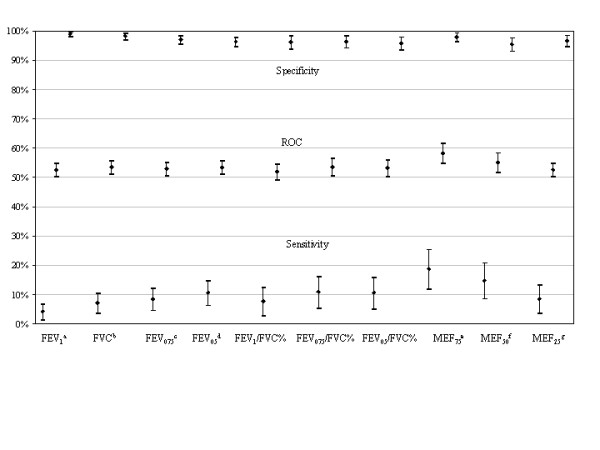
The cooperation rate was 95.3%. Among the valid tests, 3 or more acceptable curves were present in 93% of cases. The variability was 5% within subjects in 90.8% of cases in all the parameters. We propose regression equations for FVC (Forced Vital Capacity), FEV1, FEV0.5, FEV0.75 (Forced Expiratory Volume in one second, in half a second and in 3/4 of a second), and for Maximum Expiratory Flows at different lung volume levels (MEF75, 50, 25). All parameters are consistent with the main reference values reported in literature. The discriminating ability of respiratory parameters versus symptoms always shows a high specificity (>95%) and a low sensitivity (<20%) with the highest OR (10.55; CI 95% 4.42-25.19) for MEF75. The ability of FEV0.75 to predict FEV1 was higher than that of FEV0.50: FEV0.75 predicts FEV1 with a determination coefficient of 0.95.

CONCLUSION

Our study confirms the feasibility of spirometry in young children; however some of the current standards are not well suited to this age group. Moreover, in this restricted age group the various reference values have similar behaviour.

摘要

背景

本研究的目的是验证呼吸功能测试的可行性,并评估其在幼儿呼吸系统疾病诊断中的有效性。

方法

我们对960名3至6岁的儿童进行了肺活量测定,并收集了有关健康状况和父母生活方式的信息。

结果

合作率为95.3%。在有效测试中,93%的病例有3条或更多可接受的曲线。所有参数中,90.8%的病例受试者内变异性为5%。我们提出了用力肺活量(FVC)、第一秒用力呼气容积(FEV1)、半秒用力呼气容积(FEV0.5)、四分之三秒用力呼气容积(FEV0.75)以及不同肺容积水平的最大呼气流量(MEF75、50、25)的回归方程。所有参数均与文献报道的主要参考值一致。呼吸参数与症状的鉴别能力始终显示出高特异性(>95%)和低敏感性(<20%),MEF75的最高比值比为10.55(95%置信区间4.42 - 25.19)。FEV0.75预测FEV1的能力高于FEV0.50:FEV0.75预测FEV1的决定系数为0.95。

结论

我们的研究证实了肺活量测定在幼儿中的可行性;然而,目前的一些标准并不完全适用于这个年龄组。此外,在这个年龄范围有限的群体中,各种参考值表现相似。
https://cdn.ncbi.nlm.nih.gov/pmc/blobs/2615/1810252/3727fe7d24c4/1465-9921-8-14-1.jpg

相似文献

1
Reference values of Forced Expiratory Volumes and pulmonary flows in 3-6 year children: a cross-sectional study.3至6岁儿童用力呼气量和肺流量的参考值:一项横断面研究。
Respir Res. 2007 Feb 22;8(1):14. doi: 10.1186/1465-9921-8-14.
2
Forced expiratory parameters in healthy preschool children (3-6 years of age).健康学龄前儿童(3至6岁)的用力呼气参数。
Pediatr Pulmonol. 2003 Mar;35(3):200-7. doi: 10.1002/ppul.10265.
3
Spirometry in an unselected group of 6-year-old children: the DARC birth cohort study.未筛选的6岁儿童群体的肺活量测定:DARC出生队列研究
Pediatr Pulmonol. 2008 Aug;43(8):806-14. doi: 10.1002/ppul.20871.
4
[Respiratory resistance measured by interrupter technique in asthmatic children. Correlation with spirometry].[采用间断技术测量哮喘儿童的呼吸阻力。与肺量计检查结果的相关性]
Pneumologia. 2003 Jul-Dec;52(3-4):217-20.
5
[Feasibility and predicted equations of spirometry in Shenzhen preschool children].[深圳学龄前儿童肺功能检查的可行性及预测方程]
Zhonghua Er Ke Za Zhi. 2005 Nov;43(11):843-8.
6
Spirometric standards for healthy Nigerian children and adolescents.尼日利亚健康儿童和青少年的肺功能测定标准。
East Afr Med J. 1991 Oct;68(10):812-9.
7
Spirometric pulmonary function in 3- to 5-year-old children.3至5岁儿童的肺量计肺功能
Pediatr Pulmonol. 2007 Mar;42(3):263-71. doi: 10.1002/ppul.20564.
8
[Normograms of spirometric values for the city of Buenos Aires].[布宜诺斯艾利斯市肺活量测定值的正常图谱]
Medicina (B Aires). 1998;58(2):141-6.
9
[Evaluation of respiratory tract function in healthy women in the last month of uncomplicated pregnancy].[未合并并发症的健康孕妇妊娠最后一个月呼吸道功能评估]
Ann Acad Med Stetin. 2002;48:331-50.
10
Pulmonary function between 40 and 80 years of age.40至80岁之间的肺功能。
J Physiol Pharmacol. 2005 Sep;56 Suppl 4:127-33.

引用本文的文献

1
Development and validation of predictive equations for spirometry in Portuguese children.葡萄牙儿童肺活量测定预测方程的开发与验证
J Allergy Clin Immunol Glob. 2023 Feb 8;2(2):100084. doi: 10.1016/j.jacig.2023.100084. eCollection 2023 May.
2
Standardization of Spirometry 2019 Update. An Official American Thoracic Society and European Respiratory Society Technical Statement.肺功能测定标准化 2019 修订版。美国胸科学会和欧洲呼吸学会官方技术声明。
Am J Respir Crit Care Med. 2019 Oct 15;200(8):e70-e88. doi: 10.1164/rccm.201908-1590ST.
3
Evaluation of Food Insecurity in Adults and Children With Cystic Fibrosis: Community Case Study.

本文引用的文献

1
Standardisation of spirometry.肺活量测定法的标准化
Eur Respir J. 2005 Aug;26(2):319-38. doi: 10.1183/09031936.05.00034805.
2
General considerations for lung function testing.肺功能测试的一般注意事项。
Eur Respir J. 2005 Jul;26(1):153-61. doi: 10.1183/09031936.05.00034505.
3
Assessing respiratory function in young children: Developmental considerations.评估幼儿的呼吸功能:发育方面的考虑因素。
囊性纤维化成人和儿童食物不安全状况评估:社区案例研究
Front Public Health. 2018 Nov 26;6:348. doi: 10.3389/fpubh.2018.00348. eCollection 2018.
4
Comparison of spirometric results obtained from the sitting and standing position in children participating in an epidemiological study.对参与一项流行病学研究的儿童在坐姿和站姿下获得的肺功能测定结果进行比较。
Postepy Dermatol Alergol. 2018 Jun;35(3):314-316. doi: 10.5114/ada.2018.75434. Epub 2018 Apr 24.
5
Spirometry in Asthma Care: A Review of the Trends and Challenges in Pediatric Practice.哮喘护理中的肺功能测定:儿科实践中的趋势与挑战综述。
Clin Med Insights Pediatr. 2017 Jul 19;11:1179556517720675. doi: 10.1177/1179556517720675. eCollection 2017.
6
Bronchodilator response cut-off points and FEV 0.75 reference values for spirometry in preschoolers.学龄前儿童肺量计检查中支气管扩张剂反应的临界点及第0.75秒用力呼气量(FEV₀.₇₅)参考值
J Bras Pneumol. 2016 Sep-Oct;42(5):326-332. doi: 10.1590/S1806-37562015000000216.
7
Lung function changes from childhood to adolescence: a seven-year follow-up study.从儿童期到青春期的肺功能变化:一项为期七年的随访研究。
BMC Pulm Med. 2015 Apr 3;15:31. doi: 10.1186/s12890-015-0028-9.
8
Impulse oscillometry in the evaluation of diseases of the airways in children.脉冲振荡法在儿童气道疾病评估中的应用。
Ann Allergy Asthma Immunol. 2011 Mar;106(3):191-9. doi: 10.1016/j.anai.2010.11.011. Epub 2011 Jan 6.
9
Clinically useful spirometry in preschool-aged children: evaluation of the 2007 American Thoracic Society Guidelines.学龄前儿童临床实用肺量计:对2007年美国胸科学会指南的评估
J Asthma. 2010 Sep;47(7):762-7. doi: 10.3109/02770903.2010.485664.
10
Spirometry.肺量测定法。
Clin Rev Allergy Immunol. 2009 Dec;37(3):137-52. doi: 10.1007/s12016-009-8128-z. Epub 2009 Apr 4.
J Allergy Clin Immunol. 2005 Apr;115(4):657-66; quiz 667. doi: 10.1016/j.jaci.2004.12.1112.
4
Classifying asthma severity in children: mismatch between symptoms, medication use, and lung function.儿童哮喘严重程度的分类:症状、药物使用与肺功能之间的不匹配。
Am J Respir Crit Care Med. 2004 Aug 15;170(4):426-32. doi: 10.1164/rccm.200308-1178OC. Epub 2004 Jun 1.
5
Quality control for spirometry in preschool children with and without lung disease.患有和未患有肺部疾病的学龄前儿童肺活量测定的质量控制
Am J Respir Crit Care Med. 2004 May 15;169(10):1152-9. doi: 10.1164/rccm.200310-1453OC. Epub 2004 Mar 17.
6
Childhood wheezing syndromes and healthcare data.儿童喘息综合征与医疗保健数据。
Pediatr Pulmonol. 2003 Aug;36(2):131-6. doi: 10.1002/ppul.10312.
7
Airway infections in infancy and the presence of allergy and asthma in school age children.婴儿期的气道感染与学龄儿童的过敏和哮喘情况
Arch Dis Child. 2003 Jul;88(7):566-9. doi: 10.1136/adc.88.7.566.
8
Spirometry in young children: should computer-animation programs be used during testing?幼儿肺功能测定:测试期间应使用计算机动画程序吗?
Eur Respir J. 2003 May;21(5):872-5. doi: 10.1183/09031936.03.00059902.
9
Sensitivity of spirometric measurements to detect airway obstruction in infants.肺活量测定法测量在检测婴儿气道阻塞方面的敏感性。
Am J Respir Crit Care Med. 2003 May 1;167(9):1283-6. doi: 10.1164/rccm.200204-339OC. Epub 2003 Feb 13.
10
Forced expiratory parameters in healthy preschool children (3-6 years of age).健康学龄前儿童(3至6岁)的用力呼气参数。
Pediatr Pulmonol. 2003 Mar;35(3):200-7. doi: 10.1002/ppul.10265.