Tawfik-Shukor Ali R, Klazinga Niek S, Arah Onyebuchi A
Department of Social Medicine, Academic Medical Center, University of Amsterdam, PO Box 22700, 1100 DE Amsterdam, The Netherlands.
BMC Health Serv Res. 2007 Feb 23;7:25. doi: 10.1186/1472-6963-7-25.
Given the proliferation and the growing complexity of performance measurement initiatives in many health systems, the Netherlands and Ontario, Canada expressed interests in cross-national comparisons in an effort to promote knowledge transfer and best practise. To support this cross-national learning, a study was undertaken to compare health system performance approaches in The Netherlands with Ontario, Canada.
We explored the performance assessment framework and system of each constituency, the embeddedness of performance data in management and policy processes, and the interrelationships between the frameworks. Methods used included analysing governmental strategic planning and policy documents, literature and internet searches, comparative descriptive tables, and schematics. Data collection and analysis took place in Ontario and The Netherlands. A workshop to validate and discuss the findings was conducted in Toronto, adding important insights to the study.
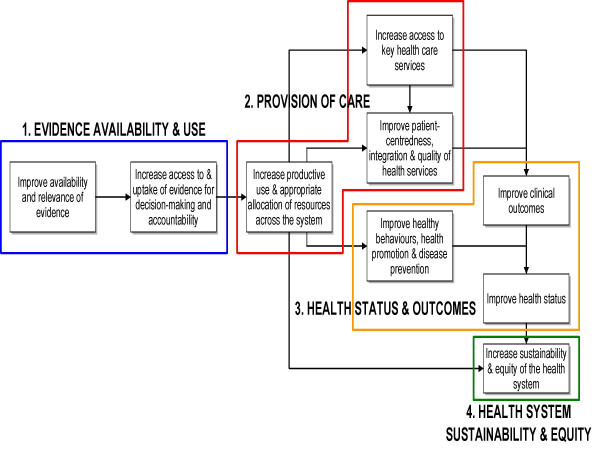
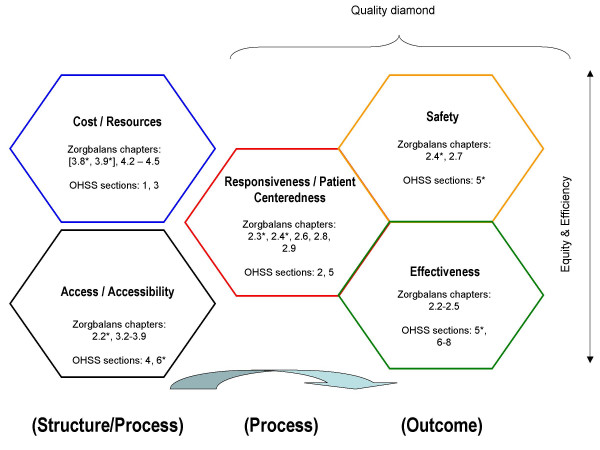
Both Ontario and The Netherlands conceive health system performance within supportive frameworks. However they differ in their assessment approaches. Ontario's Scorecard links performance measurement with strategy, aimed at health system integration. The Dutch Health Care Performance Report (Zorgbalans) does not explicitly link performance with strategy, and focuses on the technical quality of healthcare by measuring dimensions of quality, access, and cost against healthcare needs. A backbone 'five diamond' framework maps both frameworks and articulates the interrelations and overlap between their goals, themes, dimensions and indicators. The workshop yielded more contextual insights and further validated the comparative values of each constituency's performance assessment system.
To compare the health system performance approaches between The Netherlands and Ontario, Canada, several important conceptual and contextual issues must be addressed, before even attempting any future content comparisons and benchmarking. Such issues would lend relevant interpretational credibility to international comparative assessments of the two health systems.
鉴于许多卫生系统中绩效衡量举措的不断增加和日益复杂,荷兰和加拿大安大略省表示有兴趣进行跨国比较,以促进知识转移和最佳实践。为支持这种跨国学习,开展了一项研究,比较荷兰与加拿大安大略省的卫生系统绩效方法。
我们探讨了每个地区的绩效评估框架和系统、绩效数据在管理和政策过程中的嵌入情况以及框架之间的相互关系。使用的方法包括分析政府战略规划和政策文件、文献及互联网搜索、比较描述性表格和示意图。数据收集和分析在安大略省和荷兰进行。在多伦多举办了一次验证和讨论研究结果的研讨会,为该研究增添了重要见解。
安大略省和荷兰都在支持性框架内构想卫生系统绩效。然而,它们的评估方法有所不同。安大略省的记分卡将绩效衡量与战略联系起来,旨在实现卫生系统整合。荷兰的《医疗保健绩效报告》(Zorgbalans)没有明确将绩效与战略联系起来,而是通过对照医疗保健需求衡量质量、可及性和成本等维度,侧重于医疗保健的技术质量。一个主干“五钻石”框架描绘了这两个框架,并阐明了它们的目标、主题、维度和指标之间的相互关系和重叠之处。该研讨会产生了更多背景见解,并进一步验证了每个地区绩效评估系统的比较价值。
要比较荷兰和加拿大安大略省的卫生系统绩效方法,在甚至尝试未来的任何内容比较和基准测试之前,必须解决几个重要的概念和背景问题。这些问题将为这两个卫生系统的国际比较评估提供相关的解释可信度。