Hiyama E, Hiyama K
Division of Life Science Research, Natural Science Center for Basic Research and Development, Hiroshima University, 1-2-3, Kasumi, Minami-ku, Hiroshima 734-8551, Japan.
Br J Cancer. 2007 Apr 10;96(7):1020-4. doi: 10.1038/sj.bjc.6603671. Epub 2007 Mar 13.
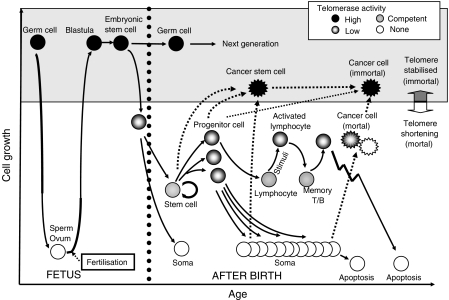
Telomeres, guanine-rich tandem DNA repeats of the chromosomal end, provide chromosomal stability, and cellular replication causes their loss. In somatic cells, the activity of telomerase, a reverse transcriptase that can elongate telomeric repeats, is usually diminished after birth so that the telomere length is gradually shortened with cell divisions, and triggers cellular senescence. In embryonic stem cells, telomerase is activated and maintains telomere length and cellular immortality; however, the level of telomerase activity is low or absent in the majority of stem cells regardless of their proliferative capacity. Thus, even in stem cells, except for embryonal stem cells and cancer stem cells, telomere shortening occurs during replicative ageing, possibly at a slower rate than that in normal somatic cells. Recently, the importance of telomere maintenance in human stem cells has been highlighted by studies on dyskeratosis congenital, which is a genetic disorder in the human telomerase component. The regulation of telomere length and telomerase activity is a complex and dynamic process that is tightly linked to cell cycle regulation in human stem cells. Here we review the role of telomeres and telomerase in the function and capacity of the human stem cells.
端粒是染色体末端富含鸟嘌呤的串联DNA重复序列,可提供染色体稳定性,而细胞复制会导致其丢失。在体细胞中,端粒酶(一种可延长端粒重复序列的逆转录酶)的活性通常在出生后降低,因此端粒长度会随着细胞分裂而逐渐缩短,并引发细胞衰老。在胚胎干细胞中,端粒酶被激活并维持端粒长度和细胞永生;然而,大多数干细胞中端粒酶活性水平较低或不存在,无论其增殖能力如何。因此,即使在干细胞中,除胚胎干细胞和癌症干细胞外,端粒缩短也会在复制性衰老过程中发生,其速率可能比正常体细胞慢。最近,对先天性角化不良(一种人类端粒酶成分的遗传疾病)的研究突出了端粒维持在人类干细胞中的重要性。端粒长度和端粒酶活性的调节是一个复杂而动态的过程,与人类干细胞中的细胞周期调节紧密相关。在此,我们综述端粒和端粒酶在人类干细胞功能和能力中的作用。