Grande David, Asch David A, Armstrong Katrina
Robert Wood Johnson Health and Society Scholars Program, University of Pennsylvania, Philadelphia, PA 19104-6218, USA.
J Gen Intern Med. 2007 May;22(5):585-9. doi: 10.1007/s11606-007-0105-8.
Organizational leaders and scholars have issued calls for the medical profession to refocus its efforts on fulfilling the core tenets of professionalism. A key element of professionalism is participation in community affairs.
To measure physician voting rates as an indicator of civic participation.
Cross-sectional survey of a subgroup of physicians from a nationally representative household survey of civilian, noninstitutionalized adult citizens.
A total of 350,870 participants in the Current Population Survey (CPS) November Voter Supplement from 1996-2002, including 1,274 physicians and 1,886 lawyers; 414,989 participants in the CPS survey from 1976-1982, including 2,033 health professionals.
Multivariate logistic regression models were used to compare adjusted physician voting rates in the 1996-2002 congressional and presidential elections with those of lawyers and the general population and to compare voting rates of health professionals in 1996-2002 with those in 1976-1992.
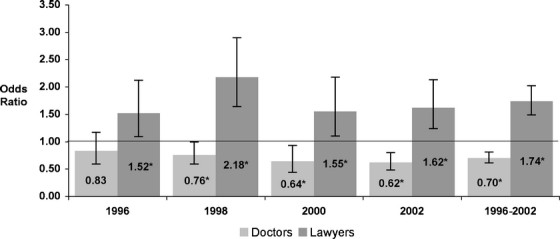
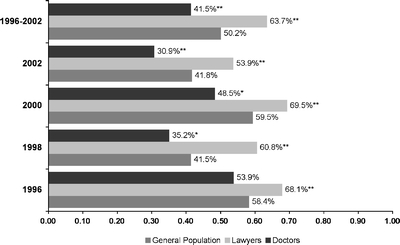
After multivariate adjustment for characteristics known to be associated with voting rates, physicians were less likely to vote than the general population in 1998 (odds ratio 0.76; 95% confidence interval [CI] 0.59-0.99), 2000 (odds ratio 0.64; 95% CI 0.44-0.93), and 2002 (odds ratio 0.62; 95% CI 0.48-0.80) but not 1996 (odds ratio 0.83; 95% CI 0.59-1.17). Lawyers voted at higher rates than the general population and doctors in all four elections (P < .001). The pooled adjusted odds ratio for physician voting across the four elections was 0.70 (CI 0.61-0.81). No substantial changes in voting rates for health professionals were observed between 1976-1982 and 1996-2002.
Physicians have lower adjusted voting rates than lawyers and the general population, suggesting reduced civic participation.
组织领导者和学者呼吁医学专业重新将工作重点放在践行专业精神的核心原则上。专业精神的一个关键要素是参与社区事务。
将医生的投票率作为公民参与度的一项指标进行衡量。
对来自一项具有全国代表性的非机构化成年公民家庭调查中的一个医生亚组进行横断面调查。
1996 - 2002年《当前人口调查》(CPS)11月选民补充调查中的350,870名参与者,包括1,274名医生和1,886名律师;1976 - 1982年CPS调查中的414,989名参与者,包括2,033名卫生专业人员。
使用多变量逻辑回归模型,比较1996 - 2002年国会选举和总统选举中经调整后的医生投票率与律师及普通人群的投票率,并比较1996 - 2002年卫生专业人员的投票率与1976 - 1992年的投票率。
在对已知与投票率相关的特征进行多变量调整后,1998年(优势比0.76;95%置信区间[CI]0.59 - 0.99)、2000年(优势比0.64;95%CI 0.44 - 0.93)和2002年(优势比0.62;95%CI 0.48 - 0.80)医生投票的可能性低于普通人群,但1996年并非如此(优势比0.83;95%CI 0.59 - 1.17)。在所有四次选举中,律师的投票率均高于普通人群和医生(P <.001)。四次选举中医生投票的合并调整后优势比为0.70(CI 0.61 - 0.81)。1976 - 1982年与1996 - 2002年期间,未观察到卫生专业人员投票率有实质性变化。
医生经调整后的投票率低于律师和普通人群,表明其公民参与度降低。