Christley Scott, Alber Mark S, Newman Stuart A
Department of Computer Science, University of Notre Dame, Notre Dame, Indiana, United States of America.
PLoS Comput Biol. 2007 Apr 27;3(4):e76. doi: 10.1371/journal.pcbi.0030076. Epub 2007 Mar 8.
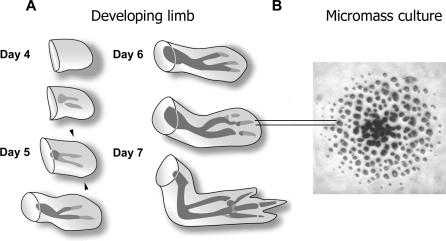
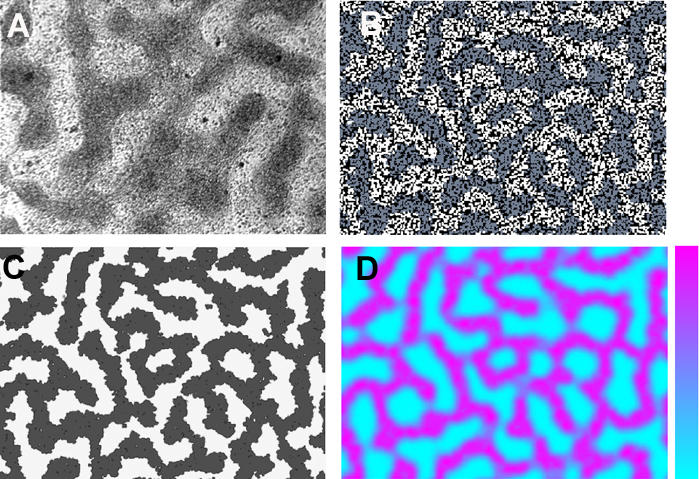
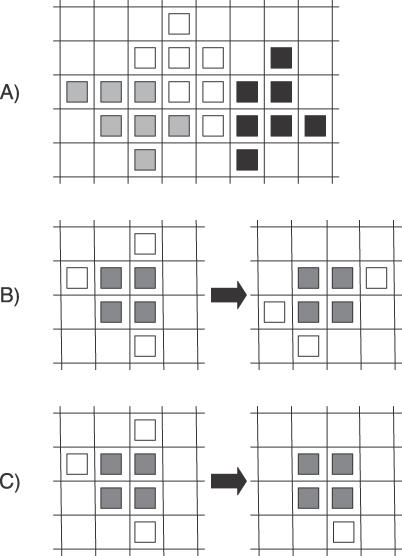
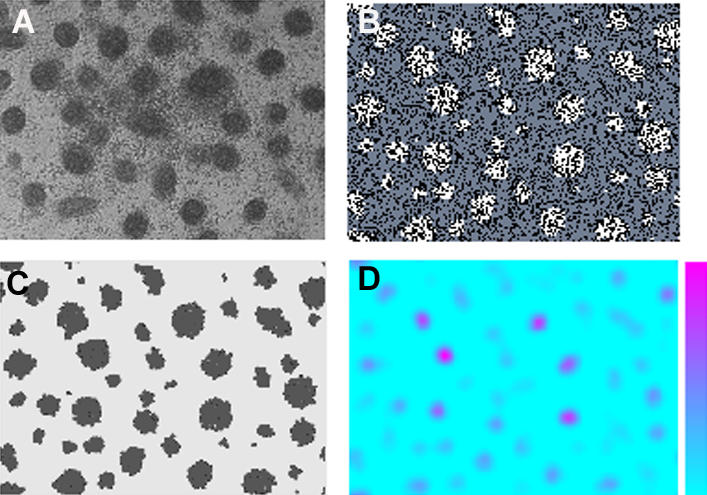
Cells of the embryonic vertebrate limb in high-density culture undergo chondrogenic pattern formation, which results in the production of regularly spaced "islands" of cartilage similar to the cartilage primordia of the developing limb skeleton. The first step in this process, in vitro and in vivo, is the generation of "cell condensations," in which the precartilage cells become more tightly packed at the sites at which cartilage will form. In this paper we describe a discrete, stochastic model for the behavior of limb bud precartilage mesenchymal cells in vitro. The model uses a biologically motivated reaction-diffusion process and cell-matrix adhesion (haptotaxis) as the bases of chondrogenic pattern formation, whereby the biochemically distinct condensing cells, as well as the size, number, and arrangement of the multicellular condensations, are generated in a self-organizing fashion. Improving on an earlier lattice-gas representation of the same process, it is multiscale (i.e., cell and molecular dynamics occur on distinct scales), and the cells are represented as spatially extended objects that can change their shape. The authors calibrate the model using experimental data and study sensitivity to changes in key parameters. The simulations have disclosed two distinct dynamic regimes for pattern self-organization involving transient or stationary inductive patterns of morphogens. The authors discuss these modes of pattern formation in relation to available experimental evidence for the in vitro system, as well as their implications for understanding limb skeletal patterning during embryonic development.
处于高密度培养状态的胚胎脊椎动物肢体细胞会经历软骨形成模式的形成过程,这会导致产生规则间隔的软骨“岛”,类似于发育中肢体骨骼的软骨原基。在体外和体内,这个过程的第一步是“细胞凝聚”的产生,在此过程中,软骨前体细胞在软骨将要形成的部位变得更加紧密地聚集。在本文中,我们描述了一个关于体外肢体芽软骨前间充质细胞行为的离散随机模型。该模型使用具有生物学动机的反应扩散过程和细胞 - 基质黏附(趋触性)作为软骨形成模式形成的基础,由此以自组织方式产生具有生化差异的凝聚细胞以及多细胞凝聚物的大小、数量和排列。在对同一过程早期的晶格气表示进行改进后,它是多尺度的(即细胞和分子动力学发生在不同尺度上),并且细胞被表示为可以改变其形状的空间扩展对象。作者使用实验数据对模型进行校准,并研究对关键参数变化的敏感性。模拟揭示了模式自组织的两种不同动态机制,涉及形态发生素的瞬态或稳态诱导模式。作者结合体外系统的现有实验证据讨论了这些模式形成方式,以及它们对理解胚胎发育过程中肢体骨骼模式形成的意义。