McCarty Carolyn A, Vander Stoep Ann, McCauley Elizabeth
University of Washington, Seattle, WA 98195, USA.
J Clin Child Adolesc Psychol. 2007 Apr-Jun;36(2):147-58. doi: 10.1080/15374410701274926.
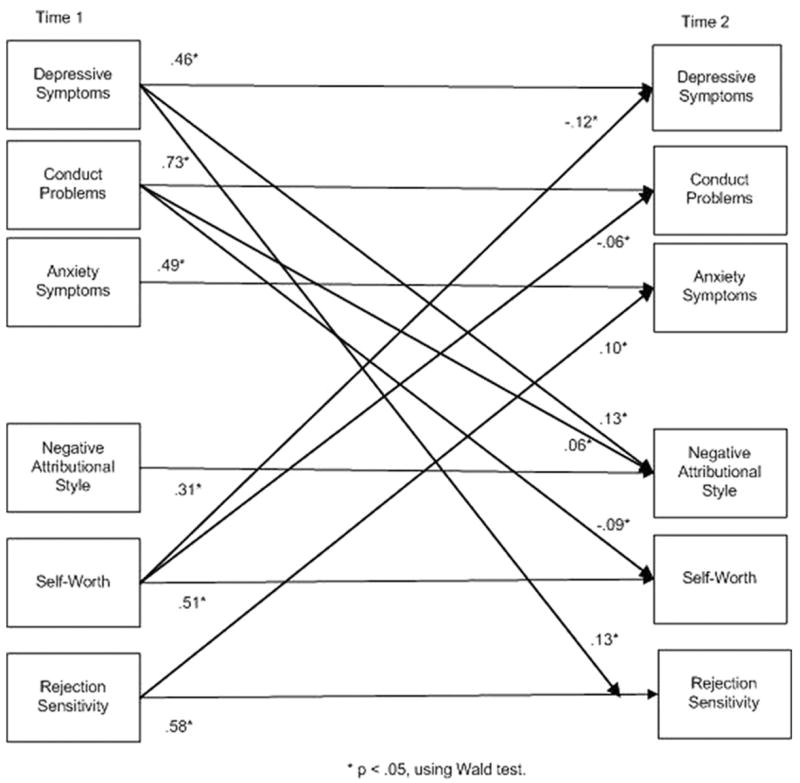
In this study we examined cognitive features that have been posited to contribute to depressive vulnerability in adolescents. Using a longitudinal sample of 331 young adolescents followed from 6th to 7th grade, cross-lagged structural equation analyses were conducted. Controlling for baseline levels of depressive, conduct, and anxiety symptoms, low self-worth was associated with a vulnerability to both depressive symptoms and conduct problems, whereas rejection sensitivity was uniquely predictive of increases in anxiety. In support of cognitive "scar" models, baseline depressive and conduct problems were both predictive of a more negative attributional style. Depressive symptoms also predicted more rejection sensitivity, whereas conduct problems predicted lower self-esteem.
在本研究中,我们考察了那些被认为会导致青少年抑郁易感性的认知特征。我们使用了一个从六年级到七年级对331名青少年进行追踪的纵向样本,进行了交叉滞后结构方程分析。在控制了抑郁、品行和焦虑症状的基线水平后,低自尊与抑郁症状和品行问题的易感性都有关联,而拒绝敏感性则是焦虑增加的唯一预测因素。支持认知“创伤”模型的是,基线抑郁和品行问题都能预测更消极的归因方式。抑郁症状也能预测更高的拒绝敏感性,而行品问题则能预测更低的自尊。