Djouaka Rousseau F, Bakare Adekunle A, Bankole Honore S, Doannio Julien M C M C, Kossou Hortense, Akogbeto Martin C
Centre de Recherche Entomologique de Cotonou, 06 BP 2604, Republic of Benin.
Malar J. 2007 May 8;6:56. doi: 10.1186/1475-2875-6-56.
The emergence of Anopheles populations capable of withstanding lethal doses of insecticides has weakened the efficacy of most insecticide based strategies of vector control and, has highlighted the need for developing new insecticidal molecules or, improving the efficacy of existing insecticides or abandoning those to which resistance has emerged. The use of petroleum products (PP) against mosquito larvae had an immense success during early programmes of malaria control, but these compounds were abandoned and replaced in the 1950s by synthetic insecticides probably because of the high performances given by these new products. In the current context of vector resistance, it is important to elucidate the empirical use of PP by quantifying their efficiencies on resistant strains of Anopheles.
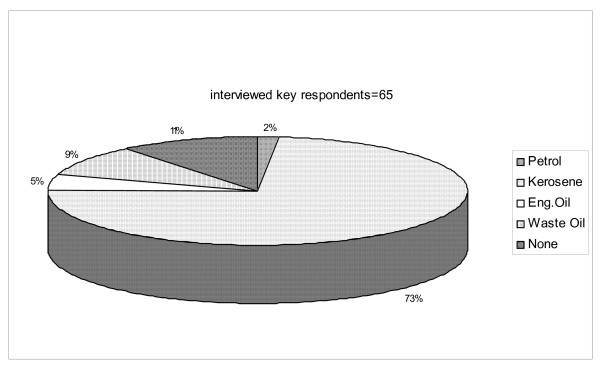
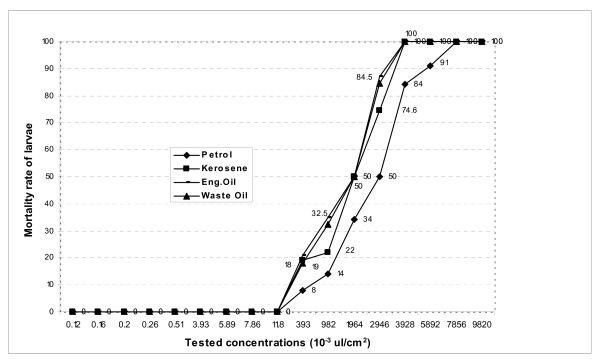
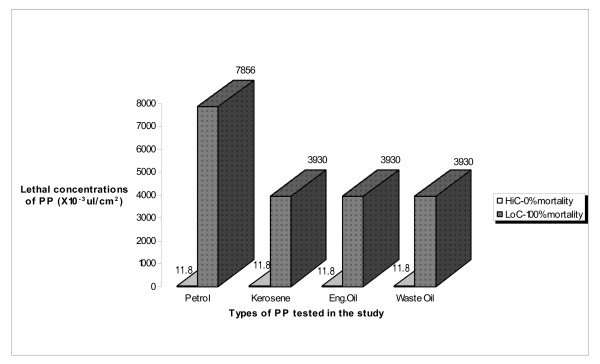
Larvae of Anopheles Ladji a local resistant strain were exposed to increasing concentrations of various PP (kerosene, petrol and engine oils) for 24 hours and the lethal activities recorded. The highest concentration (HiC) having no lethal activity (also referred as the NOEL or no effect level) and the lowest concentration (LoC100) yielding 100% mortality were rated for each PP on the Ladji strain. Prior to laboratory analysis, KAP studies were conducted in three traditional communities were insecticide resistance is clearly established to confirm the use of PP against mosquitoes.
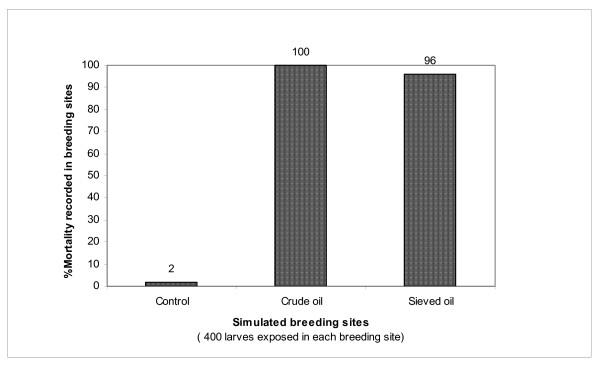
Laboratory analysis of petrol, kerosene and engine oils, clearly established their lethal activities on resistant strains of Anopheles larvae. Contrary to existing references, this research revealed that exposed larvae of Anopheles were mostly killed by direct contact toxicity and not by suffocation as indicated in some earlier reports.
This research could serve as scientific basis to backup the empirical utilisation of PP on mosquito larvae and to envisage possibilities of using PP in some traditional settings where Anopheles have developed resistance to currently used insecticides.
能够耐受致死剂量杀虫剂的按蚊种群的出现,削弱了大多数基于杀虫剂的病媒控制策略的效果,并凸显出开发新的杀虫分子、提高现有杀虫剂的效果或摒弃已出现抗性的杀虫剂的必要性。在早期疟疾控制项目中,使用石油产品(PP)防治蚊虫幼虫取得了巨大成功,但这些化合物在20世纪50年代被合成杀虫剂取代,可能是因为这些新产品具有高效能。在当前病媒产生抗性的背景下,通过量化石油产品对按蚊抗性品系的效率来阐明其实际应用情况非常重要。
将当地抗性品系的拉吉按蚊幼虫暴露于浓度不断增加的各种石油产品(煤油、汽油和机油)中24小时,并记录致死活性。针对拉吉品系的每种石油产品,评定无致死活性的最高浓度(HiC,也称为未观察到不良效应水平或无效应水平)和产生100%死亡率的最低浓度(LoC100)。在进行实验室分析之前,在三个已明确存在杀虫剂抗性的传统社区开展了知识、态度和实践(KAP)研究,以确认石油产品对蚊虫的使用情况。
对汽油、煤油和机油的实验室分析明确证实了它们对按蚊幼虫抗性品系的致死活性。与现有参考文献相反,本研究表明,暴露的按蚊幼虫大多是因直接接触毒性而死亡,而非如一些早期报告中所述因窒息死亡。
本研究可为石油产品在蚊虫幼虫防治中的实际应用提供科学依据,并设想在按蚊对目前使用的杀虫剂已产生抗性的一些传统环境中使用石油产品的可能性。