Thompson David S, Estabrooks Carole A, Scott-Findlay Shannon, Moore Katherine, Wallin Lars
Knowledge Utilization Studies Program, Faculty of Nursing, 5-112 Clinical Sciences Building, University of Alberta, Edmonton, Alberta, T6G 2G3 Canada .
Implement Sci. 2007 May 11;2:15. doi: 10.1186/1748-5908-2-15.
There has been considerable interest recently in developing and evaluating interventions to increase research use by clinicians. However, most work has focused on medical practices; and nursing is not well represented in existing systematic reviews. The purpose of this article is to report findings from a systematic review of interventions aimed at increasing research use in nursing.
To assess the evidence on interventions aimed at increasing research use in nursing.
A systematic review of research use in nursing was conducted using databases (Medline, CINAHL, Healthstar, ERIC, Cochrane Central Register of Controlled Trials, and Psychinfo), grey literature, ancestry searching (Cochrane Database of Systematic Reviews), key informants, and manual searching of journals. Randomized controlled trials and controlled before- and after-studies were included if they included nurses, if the intervention was explicitly aimed at increasing research use or evidence-based practice, and if there was an explicit outcome to research use. Methodological quality was assessed using pre-existing tools. Data on interventions and outcomes were extracted and categorized using a pre-established taxonomy.
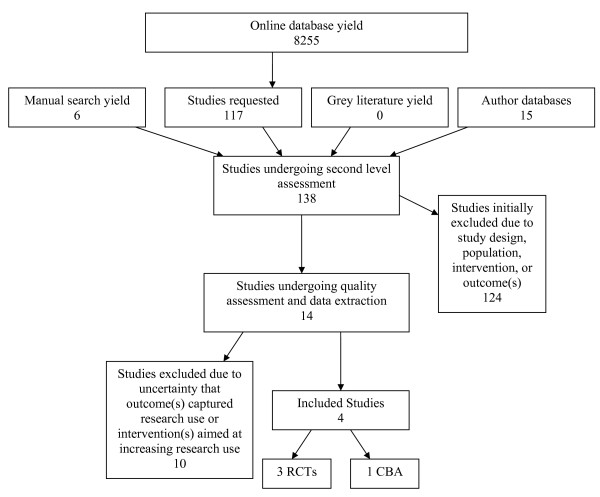
Over 8,000 titles were screened. Three randomized controlled trials and one controlled before- and after-study met the inclusion criteria. The methodological quality of included studies was generally low. Three investigators evaluated single interventions. The most common intervention was education. Investigators measured research use using a combination of surveys (three studies) and compliance with guidelines (one study). Researcher-led educational meetings were ineffective in two studies. Educational meetings led by a local opinion leader (one study) and the formation of multidisciplinary committees (one study) were both effective at increasing research use.
Little is known about how to increase research use in nursing, and the evidence to support or refute specific interventions is inconclusive. To advance the field, we recommend that investigators: (1) use theoretically informed interventions to increase research use, (2) measure research use longitudinally using theoretically informed and psychometrically sound measures of research use, as well as, measuring patient outcomes relevant to the intervention, and (3) use more robust and methodologically sound study designs to evaluate interventions. If investigators aim to establish a link between using research and improved patient outcomes they must first identify those interventions that are effective at increasing research use.
最近,人们对开发和评估旨在提高临床医生研究应用率的干预措施产生了浓厚兴趣。然而,大多数工作都集中在医疗实践方面;在现有的系统评价中,护理领域的代表性不足。本文旨在报告一项针对旨在提高护理领域研究应用率的干预措施的系统评价结果。
评估旨在提高护理领域研究应用率的干预措施的证据。
通过数据库(Medline、CINAHL、Healthstar、ERIC、Cochrane对照试验中央注册库和Psychinfo)、灰色文献、追溯检索(Cochrane系统评价数据库)、关键信息提供者以及对期刊的手工检索,对护理领域的研究应用进行了系统评价。如果随机对照试验和前后对照研究涉及护士,干预措施明确旨在提高研究应用率或循证实践,并且研究应用有明确的结果,则纳入研究。使用预先存在的工具评估方法学质量。使用预先建立的分类法提取和分类干预措施及结果的数据。
筛选了8000多篇标题。三项随机对照试验和一项前后对照研究符合纳入标准。纳入研究的方法学质量普遍较低。三名研究人员评估了单一干预措施。最常见的干预措施是教育。研究人员通过调查(三项研究)和指南依从性(一项研究)相结合的方式来衡量研究应用情况。在两项研究中,由研究人员主导的教育会议无效。由当地意见领袖主持的教育会议(一项研究)和多学科委员会的组建(一项研究)在提高研究应用率方面均有效。
对于如何提高护理领域的研究应用率知之甚少,支持或反驳特定干预措施的证据尚无定论。为推动该领域的发展,我们建议研究人员:(1)使用基于理论的干预措施来提高研究应用率;(2)纵向使用基于理论且心理测量学上合理的研究应用测量方法来衡量研究应用情况,并测量与干预措施相关的患者结局;(3)使用更可靠且方法学上合理的研究设计来评估干预措施。如果研究人员旨在建立研究应用与改善患者结局之间的联系,他们必须首先确定那些在提高研究应用率方面有效的干预措施。