Moioli Eduardo K, Clark Paul A, Xin Xuejun, Lal Shan, Mao Jeremy J
Columbia University, Tissue Engineering and Regenerative Medicine Laboratory (TERML), College of Dental Medicine, Fu Foundation School of Engineering and Applied Sciences, Department of Biomedical Engineering, New York, NY 10032, USA.
Adv Drug Deliv Rev. 2007 May 30;59(4-5):308-24. doi: 10.1016/j.addr.2007.03.019. Epub 2007 Apr 18.
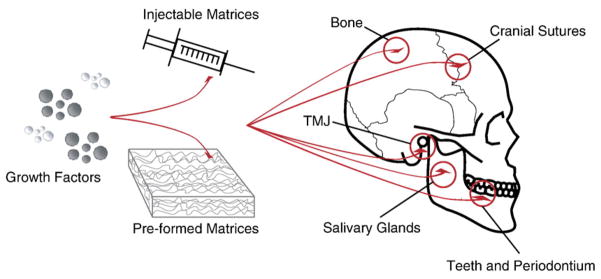
Current treatments for diseases and trauma of dental, oral and craniofacial (DOC) structures rely on durable materials such as amalgam and synthetic materials, or autologous tissue grafts. A paradigm shift has taken place to utilize tissue engineering and drug delivery approaches towards the regeneration of these structures. Several prototypes of DOC structures have been regenerated such as temporomandibular joint (TMJ) condyle, cranial sutures, tooth structures and periodontium components. However, many challenges remain when taking in consideration the high demand for esthetics of DOC structures, the complex environment and yet minimal scar formation in the oral cavity, and the need for accommodating multiple tissue phenotypes. This review highlights recent advances in the regeneration of DOC structures, including the tooth, periodontium, TMJ, cranial sutures and implant dentistry, with specific emphasis on controlled release of signaling cues for stem cells, biomaterial matrices and scaffolds, and integrated tissue engineering approaches.
目前针对牙齿、口腔和颅面(DOC)结构疾病及创伤的治疗方法依赖于汞合金和合成材料等耐用材料,或自体组织移植。利用组织工程和药物递送方法来实现这些结构的再生,这已经发生了范式转变。已经再生了几种DOC结构的原型,如颞下颌关节(TMJ)髁突、颅缝、牙齿结构和牙周组织成分。然而,考虑到DOC结构对美学的高要求、口腔复杂的环境以及疤痕形成最少,同时还需要容纳多种组织表型,仍然存在许多挑战。本综述重点介绍了DOC结构再生的最新进展,包括牙齿、牙周组织、颞下颌关节、颅缝和种植牙科,特别强调了干细胞信号线索的控释、生物材料基质和支架以及综合组织工程方法。