Maibach Edward W, Abroms Lorien C, Marosits Mark
Department of Prevention and Community Health, George Washington University School of Public Health & Health Services, Washington, DC 20037, USA.
BMC Public Health. 2007 May 22;7:88. doi: 10.1186/1471-2458-7-88.
Communication and marketing are rapidly becoming recognized as core functions, or core competencies, in the field of public health. Although these disciplines have fostered considerable academic inquiry, a coherent sense of precisely how these disciplines can inform the practice of public health has been slower to emerge.
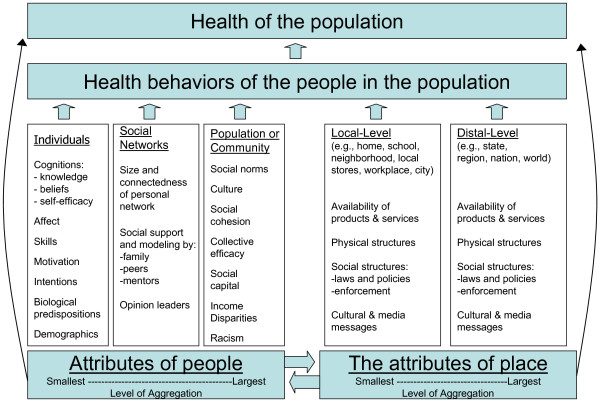
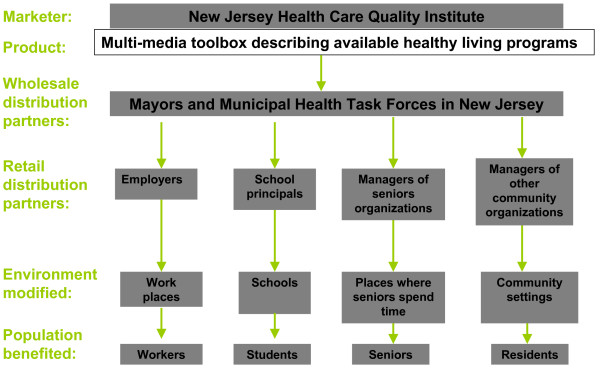
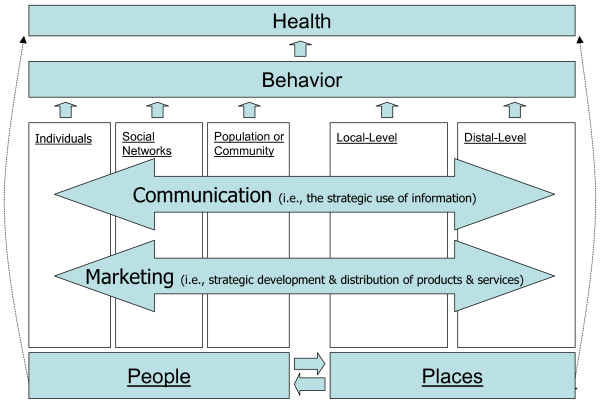
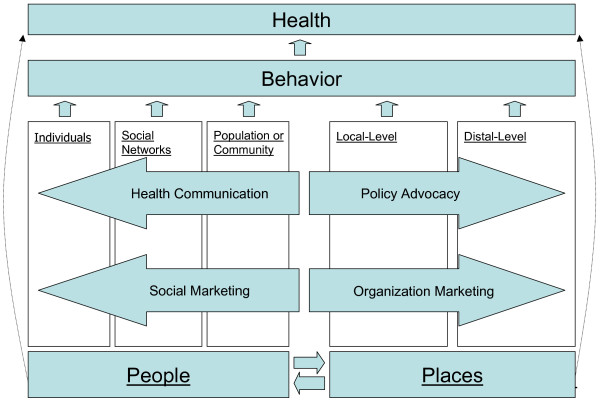
In this article we propose a framework--based on contemporary ecological models of health--to explain how communication and marketing can be used to advance public health objectives. The framework identifies the attributes of people (as individuals, as social networks, and as communities or populations) and places that influence health behaviors and health. Communication, i.e., the provision of information, can be used in a variety of ways to foster beneficial change among both people (e.g., activating social support for smoking cessation among peers) and places (e.g., convincing city officials to ban smoking in public venues). Similarly, marketing, i.e., the development, distribution and promotion of products and services, can be used to foster beneficial change among both people (e.g., by making nicotine replacement therapy more accessible and affordable) and places (e.g., by providing city officials with model anti-tobacco legislation that can be adapted for use in their jurisdiction).
Public health agencies that use their communication and marketing resources effectively to support people in making healthful decisions and to foster health-promoting environments have considerable opportunity to advance the public's health, even within the constraints of their current resource base.
传播与营销正迅速成为公共卫生领域公认的核心职能或核心竞争力。尽管这些学科引发了大量学术探究,但对于这些学科究竟如何为公共卫生实践提供信息,一种连贯的认识却姗姗来迟。
在本文中,我们提出一个基于当代健康生态模型的框架,以解释传播与营销如何能够用于推进公共卫生目标。该框架确定了影响健康行为和健康的人群(作为个体、作为社会网络以及作为社区或群体)和场所的属性。传播,即信息的提供,可以通过多种方式用于促进人群(例如,在同龄人中激发对戒烟的社会支持)和场所(例如,说服市政府官员在公共场所禁烟)的有益改变。同样,营销,即产品和服务的开发、分销和推广,可以用于促进人群(例如,使尼古丁替代疗法更容易获得且更实惠)和场所(例如,向市政府官员提供可在其辖区适用的示范反烟草立法)的有益改变。
有效利用其传播和营销资源来支持人们做出健康决策并营造促进健康环境的公共卫生机构,即使在其当前资源基础的限制范围内,也有相当大的机会推进公众健康。