Watson C S, Alyea R A, Jeng Y-J, Kochukov M Y
Department of Biochemistry & Molecular Biology, University of Texas Medical Branch, Galveston, TX 77555-0645, USA.
Mol Cell Endocrinol. 2007 Aug 15;274(1-2):1-7. doi: 10.1016/j.mce.2007.05.011. Epub 2007 May 21.
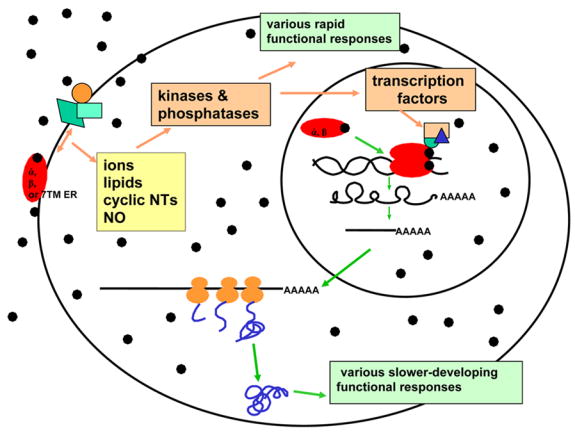
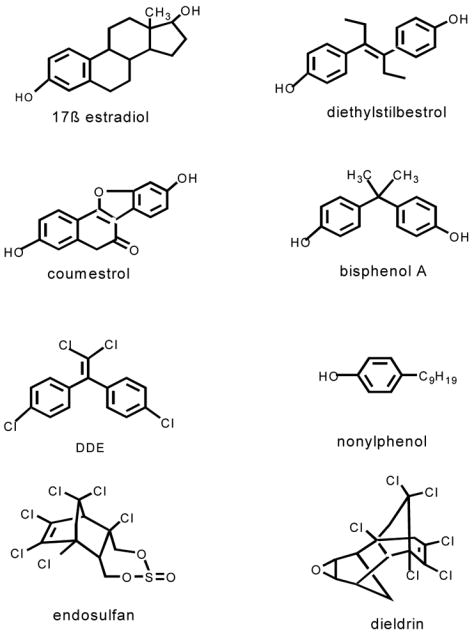
Nongenomic estrogenic mechanisms offer an opportunity to explain the conundrum of environmental estrogen and plant estrogen effects on cells and animals at the very low concentrations which are prevalent in our environments and diets. Heretofore the actions of these compounds have not been adequately accounted for by laboratory tests utilizing assays for actions only via the genomic pathway of steroid action and the nuclear forms of estrogen receptor alpha and beta. Membrane versions of these receptors, and the newly described GPR30 (7TMER) receptor protein provide explanations for the more potent actions of xenoestrogens. The effects of estrogens on many tissues demand a comprehensive assessment of the receptors, receptor levels, and mechanisms that might be involved, to determine which of these estrogen mimetic compounds are harmful and which might even be used therapeutically, depending upon the life stage at which we are exposed to them.
非基因组雌激素机制为解释环境雌激素和植物雌激素在我们的环境和饮食中普遍存在的极低浓度下对细胞和动物产生的影响这一难题提供了契机。迄今为止,仅通过类固醇作用的基因组途径以及雌激素受体α和β的核形式进行作用检测的实验室测试,尚未充分解释这些化合物的作用。这些受体的膜形式以及新描述的GPR30(7TMER)受体蛋白,为外源性雌激素更有效的作用提供了解释。雌激素对许多组织的影响需要对可能涉及的受体、受体水平和机制进行全面评估,以确定哪些雌激素模拟化合物是有害的,以及哪些甚至可能用于治疗,这取决于我们接触它们的生命阶段。