Riehle Michelle M, Markianos Kyriacos, Lambrechts Louis, Xia Ai, Sharakhov Igor, Koella Jacob C, Vernick Kenneth D
Microbial and Plant Genomics Institute and Department of Microbiology, University of Minnesota, St. Paul, MN 55108, USA.
Malar J. 2007 Jul 6;6:87. doi: 10.1186/1475-2875-6-87.
Genetic linkage mapping identified a region of chromosome 2L in the Anopheles gambiae genome that exerts major control over natural infection by Plasmodium falciparum. This 2L Plasmodium-resistance interval was mapped in mosquitoes from a natural population in Mali, West Africa, and controls the numbers of P. falciparum oocysts that develop on the vector midgut. An important question is whether genetic variation with respect to Plasmodium-resistance exists across Africa, and if so whether the same or multiple geographically distinct resistance mechanisms are responsible for the trait.
To identify P falciparum resistance loci in pedigrees generated and infected in Kenya, East Africa, 28 microsatellite loci were typed across the mosquito genome. Genetic linkage mapping was used to detect significant linkage between genotype and numbers of midgut oocysts surviving to 7-8 days post-infection.
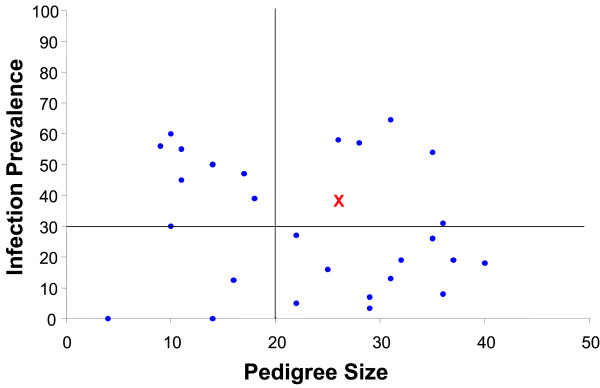
A major malaria-control locus was identified on chromosome 2L in East African mosquitoes, in the same apparent position originally identified from the West African population. Presence of this resistance locus explains 75% of parasite free mosquitoes. The Kenyan resistance locus is named EA_Pfin1 (East Africa_ Plasmodium falciparum Infection Intensity).
Detection of a malaria-control locus at the same chromosomal location in both East and West African mosquitoes indicates that, to the level of genetic resolution of the analysis, the same mechanism of Plasmodium-resistance, or a mechanism controlled by the same genomic region, is found across Africa, and thus probably operates in A. gambiae throughout its entire range.
基因连锁图谱分析确定了冈比亚按蚊基因组中2L染色体上的一个区域,该区域对恶性疟原虫的自然感染具有主要控制作用。这个2L疟原虫抗性区间是在西非马里一个自然种群的蚊子中定位的,它控制着在媒介中肠上发育的恶性疟原虫卵囊数量。一个重要的问题是,非洲各地是否存在与疟原虫抗性相关的基因变异,如果存在,那么是相同的还是多个地理上不同的抗性机制导致了这一性状。
为了在东非肯尼亚产生并感染疟原虫的家系中鉴定恶性疟原虫抗性位点,在蚊子基因组中对28个微卫星位点进行了分型。利用基因连锁图谱分析来检测基因型与感染后7 - 8天存活的中肠卵囊数量之间的显著连锁关系。
在东非蚊子的2L染色体上鉴定出一个主要的疟疾控制位点,其位置与最初在西非种群中确定的位置明显相同。这个抗性位点的存在解释了75%的无寄生虫蚊子。肯尼亚的抗性位点被命名为EA_Pfin1(东非_恶性疟原虫感染强度)。
在东非和西非蚊子的相同染色体位置检测到一个疟疾控制位点,这表明,就分析的基因分辨率水平而言,在整个非洲发现了相同的疟原虫抗性机制,或者是由相同基因组区域控制的机制,因此可能在冈比亚按蚊的整个分布范围内起作用。