Programa de Investigación en Enfermedades Tropicales, Escuela de Medicina Veterinaria, Universidad Nacional, Heredia, Costa Rica.
PLoS One. 2007 Jul 18;2(7):e631. doi: 10.1371/journal.pone.0000631.
To unravel the strategy by which Brucella abortus establishes chronic infections, we explored its early interaction with innate immunity.
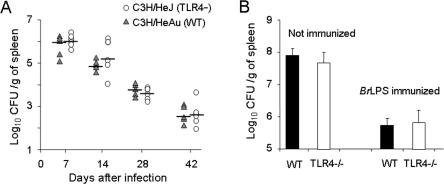
METHODOLOGY/PRINCIPAL FINDINGS: Brucella did not induce proinflammatory responses as demonstrated by the absence of leukocyte recruitment, humoral or cellular blood changes in mice. Brucella hampered neutrophil (PMN) function and PMN depletion did not influence the course of infection. Brucella barely induced proinflammatory cytokines and consumed complement, and was strongly resistant to bactericidal peptides, PMN extracts and serum. Brucella LPS (BrLPS), NH-polysaccharides, cyclic glucans, outer membrane fragments or disrupted bacterial cells displayed low biological activity in mice and cells. The lack of proinflammatory responses was not due to conspicuous inhibitory mechanisms mediated by the invading Brucella or its products. When activated 24 h post-infection macrophages did not kill Brucella, indicating that the replication niche was not fusiogenic with lysosomes. Brucella intracellular replication did not interrupt the cell cycle or caused cytotoxicity in WT, TLR4 and TLR2 knockout cells. TNF-alpha-induction was TLR4- and TLR2-dependent for live but not for killed B. abortus. However, intracellular replication in TLR4, TLR2 and TLR4/2 knockout cells was not altered and the infection course and anti-Brucella immunity development upon BrLPS injection was unaffected in TLR4 mutant mice.
CONCLUSION/SIGNIFICANCE: We propose that Brucella has developed a stealth strategy through PAMPs reduction, modification and hiding, ensuring by this manner low stimulatory activity and toxicity for cells. This strategy allows Brucella to reach its replication niche before activation of antimicrobial mechanisms by adaptive immunity. This model is consistent with clinical profiles observed in humans and natural hosts at the onset of infection and could be valid for those intracellular pathogens phylogenetically related to Brucella that also cause long lasting infections.
为了揭示布鲁氏菌属建立慢性感染的策略,我们探讨了其与先天免疫的早期相互作用。
方法/主要发现:布鲁氏菌属不会诱导炎症反应,这表现在小鼠中没有白细胞募集、血液体液或细胞变化。布鲁氏菌属阻碍中性粒细胞(PMN)的功能,PMN 耗竭并不影响感染过程。布鲁氏菌属几乎不诱导促炎细胞因子和消耗补体,并且对杀菌肽、PMN 提取物和血清具有很强的抗性。布鲁氏菌属脂多糖(BrLPS)、NH-多糖、环状葡聚糖、外膜片段或破裂的细菌细胞在小鼠和细胞中显示出低的生物活性。缺乏炎症反应不是由于入侵的布鲁氏菌或其产物介导的明显抑制机制所致。感染后 24 小时激活的巨噬细胞不能杀死布鲁氏菌,表明复制位与溶酶体不融合。布鲁氏菌的细胞内复制不会中断细胞周期或在 WT、TLR4 和 TLR2 敲除细胞中引起细胞毒性。TNF-α诱导对于活的但不是死的 B.abortus 是 TLR4 和 TLR2 依赖性的。然而,TLR4、TLR2 和 TLR4/2 敲除细胞中的细胞内复制没有改变,并且在 TLR4 突变小鼠中注射 BrLPS 后感染过程和抗布鲁氏菌免疫的发展不受影响。
结论/意义:我们提出,布鲁氏菌通过减少、修饰和隐藏 PAMPs 而发展出一种隐身策略,从而确保对细胞的低刺激活性和毒性。这种策略允许布鲁氏菌在适应性免疫的抗菌机制被激活之前到达其复制位。这种模型与人类和自然宿主在感染开始时观察到的临床特征一致,并且可能对那些与布鲁氏菌属在进化上相关的、也会导致长期感染的胞内病原体有效。