Lenglet Annick D, Hernando Victoria, Rodrigo Pilar, Larrauri Amparo, Donado Juan D M, de Mateo Salvador
European Programme for Intervention Epidemiology Training, Smittskyddinstitutet/EPI, Solna, Sweden.
BMC Public Health. 2007 Aug 8;7:197. doi: 10.1186/1471-2458-7-197.
Seasonal flu epidemics in the European region cause high numbers of cases and deaths. Flu-associated mortality has been estimated but morbidity studies are necessary to understand the burden of disease in the population. Our objective was to estimate the excess hospital admissions in Spain of diseases associated with influenza during four epidemic influenza periods (2000-2004).
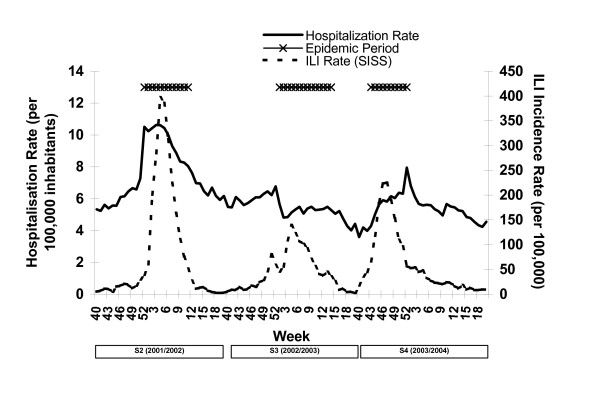
Hospital discharge registers containing pneumonia, chronic bronchitis, heart failure and flu from all public hospitals in Spain were reviewed for the years 2000 to 2004. Epidemic periods were defined by data from the Sentinel Surveillance System. Excess hospitalisations were calculated as the difference between the average number of weekly hospitalisations/100,000 in epidemic and non-epidemic periods. Flu epidemics were defined for seasons 2001/2002, 2002/2003, 2003/2004.
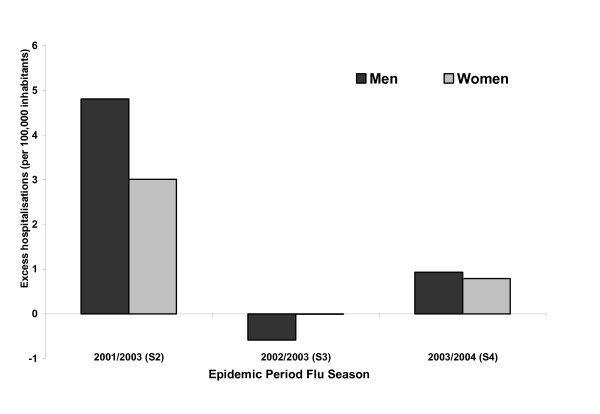
A(H3N2) was the dominant circulating serotype in 2001/2002 and 2003/2004. Negligible excess hospitalisations were observed during the 2002/2003 epidemic where A(H1N1) was circulating. During 2000/2001, flu activity remained below threshold levels and therefore no epidemic period was defined. In two epidemic periods studied a delay between the peak of the influenza epidemic and the peak of hospitalisations was observed. During flu epidemics with A(H3N2), excess hospitalisations were higher in men and in persons <5 and >64 years higher than 10 per 100,000. Pneumonia accounted for 70% of all flu associated hospitalisations followed by chronic bronchitis. No excess flu-specific hospitalisations were recorded during all seasons.
Flu epidemics have an impact on hospital morbidity in Spain. Further studies that include other variables, such as temperature and humidity, are necessary and will deepen our understanding of the role of each factor during flu epidemics and their relation with morbidity.
欧洲区域的季节性流感流行导致大量病例和死亡。已对与流感相关的死亡率进行了估算,但需要开展发病率研究以了解疾病在人群中的负担。我们的目标是估算西班牙在四个流感流行期(2000 - 2004年)与流感相关疾病的额外住院人数。
对西班牙所有公立医院2000年至2004年包含肺炎、慢性支气管炎、心力衰竭和流感的医院出院登记数据进行审查。流行期由哨点监测系统的数据确定。额外住院人数计算为流行期和非流行期每周每10万人住院平均人数的差值。确定2001/2002、2002/2003、2003/2004季节为流感流行季。
A(H3N2)是2001/2002和2003/2004年主要的流行血清型。在2002/2003年A(H1N1)流行期间,观察到可忽略不计的额外住院人数。2000/2001年,流感活动维持在阈值水平以下,因此未确定流行期。在所研究的两个流行期,观察到流感流行高峰与住院高峰之间存在延迟。在A(H3N2)流感流行期间,男性以及年龄小于5岁和大于64岁人群的额外住院人数高于每10万人10例。肺炎占所有与流感相关住院病例的70%,其次是慢性支气管炎。所有季节均未记录到额外的流感特异性住院病例。
流感流行对西班牙的医院发病率有影响。有必要开展包括温度和湿度等其他变量的进一步研究,这将加深我们对流感流行期间各因素作用及其与发病率关系的理解。