Ekerbicer Hasan C, Celik Mustafa, Guler Ekrem, Davutoglu Mehmet, Kilinc Metin
Department of Public Health, Faculty of Medicine, Kahramanmaras Sutcu Imam University, Kahramanmaras, Turkey.
BMC Public Health. 2007 Aug 10;7:202. doi: 10.1186/1471-2458-7-202.
In countries like Turkey where smoking is highly prevalent, children's exposure to tobacco smoke is an important public health problem. The goals of this study were to determine the self-reported environmental tobacco smoke exposure status of primary school students in grades 3 to 5, to verify self-reported exposure levels with data provided from a biomarker of exposure, and to develop methods for preventing school children from passive smoking.
The study was conducted on 347 primary school students by using a standard questionnaire and urinary cotinine tests. Children with verified ETS exposure were randomly assigned to 2 intervention groups. Two phone interviews were conducted with the parents of the first group regarding their children's passive smoking status and its possible consequences. On the other hand, a brief note concerning urinary cotinine test result was sent to parents of the second group. Nine months after the initial urinary cotinine tests, measurements were repeated in both groups.
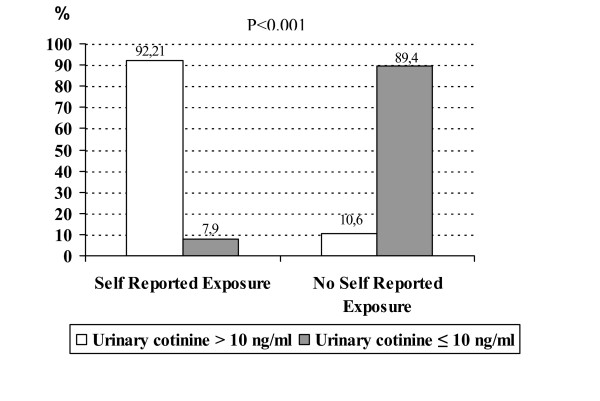
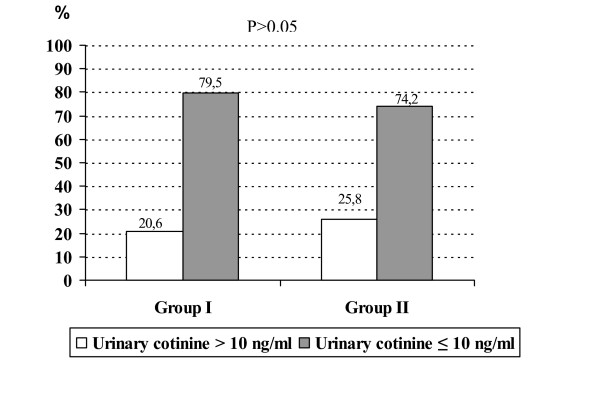
According to questionnaire data, 59.9% of the study group (208 of 347) were exposed to ETS. Urinary cotinine measurements of children were highly consistent with the self-reported exposure levels (P < 0.001). Two different intervention methods were applied to parents of the exposed children. Control tests suggested a remarkable reduction in the proportion of those children demonstrating a recent exposure to ETS in both groups. Proportions of children with urinary cotinine concentrations 10 ng/ml or lower were 79.5% in Group I and 74.2% in Group II (P > 0.05).
Self-reported ETS exposure was found to be pretty accurate in the 9-11 age group when checked with urinary cotinine tests. Only informing parents that their children' ETS exposure were confirmed by a laboratory test seems to be very promising in preventing children from ETS.
在土耳其这样吸烟率很高的国家,儿童接触烟草烟雾是一个重要的公共卫生问题。本研究的目的是确定三至五年级小学生自我报告的环境烟草烟雾暴露状况,用暴露生物标志物提供的数据验证自我报告的暴露水平,并制定预防学童被动吸烟的方法。
采用标准问卷和尿可替宁检测对347名小学生进行研究。经证实有环境烟草烟雾暴露的儿童被随机分为两个干预组。对第一组儿童的家长进行了两次电话访谈,询问他们孩子的被动吸烟状况及其可能的后果。另一方面,向第二组儿童的家长发送了一份关于尿可替宁检测结果的简要说明。在首次尿可替宁检测九个月后,对两组儿童再次进行检测。
根据问卷数据,研究组中59.9%(347名中的208名)暴露于环境烟草烟雾。儿童的尿可替宁测量结果与自我报告的暴露水平高度一致(P < 0.001)。对暴露儿童的家长采用了两种不同的干预方法。对照测试表明,两组中近期暴露于环境烟草烟雾的儿童比例均显著降低。尿可替宁浓度在10 ng/ml或更低的儿童比例,第一组为79.5%,第二组为74.2%(P > 0.05)。
通过尿可替宁检测发现,在9至11岁年龄组中,自我报告的环境烟草烟雾暴露情况相当准确。仅告知家长其孩子的环境烟草烟雾暴露已通过实验室检测得到证实,这在预防儿童接触环境烟草烟雾方面似乎很有前景。