van der Heijden Inneke M, Levin Anna S, De Pedri Ewerton H, Fung Liang, Rossi Flavia, Duboc Gisele, Barone Antonio A, Costa Silvia F
Laboratory of Medical Investigation 54, Hospital das Clinicas, University of São Paulo, Brazil.
Ann Clin Microbiol Antimicrob. 2007 Aug 15;6:8. doi: 10.1186/1476-0711-6-8.
Considering the increasing use of polymyxins to treat infections due to multidrug resistant Gram-negative in many countries, it is important to evaluate different susceptibility testing methods to this class of antibiotic.
Susceptibility of 109 carbapenem-resistant P. aeruginosa to polymyxins was tested comparing broth microdilution (reference method), disc diffusion, and Etest using the new interpretative breakpoints of Clinical and Laboratory Standards Institute.
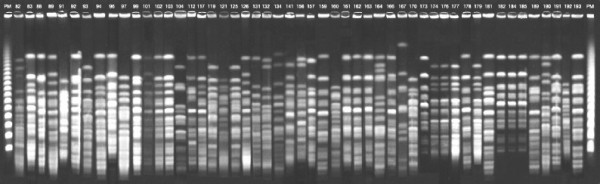
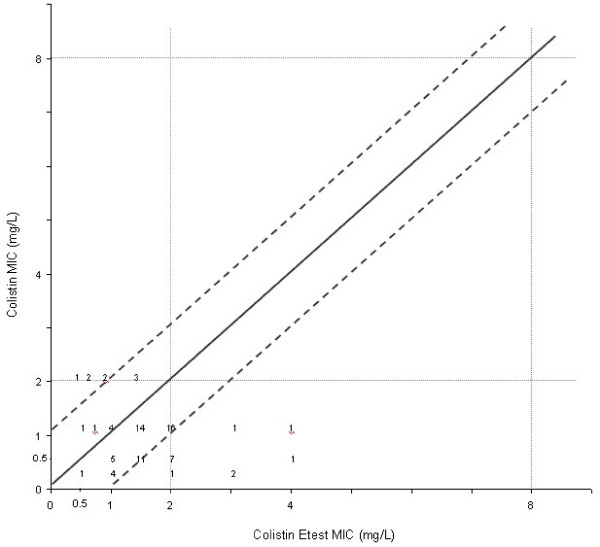
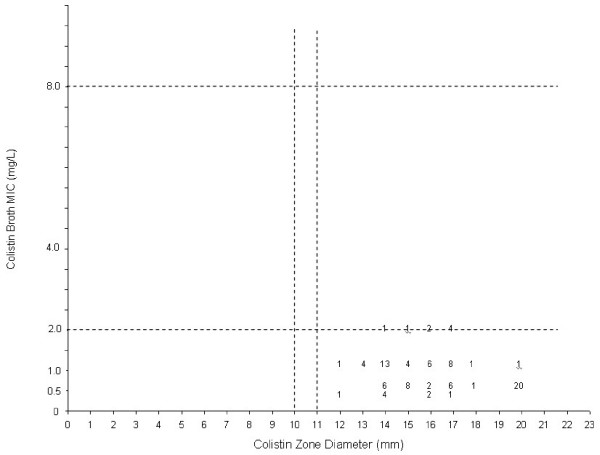
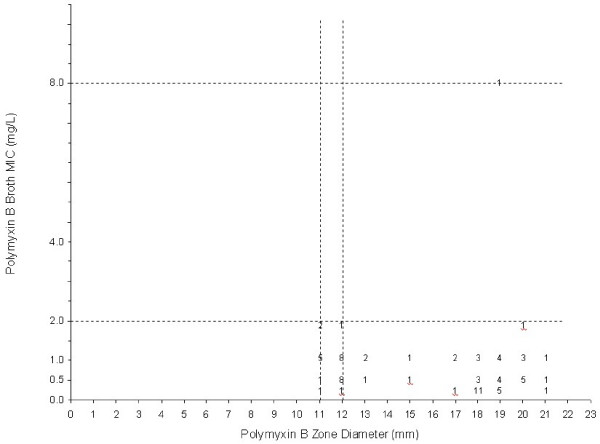
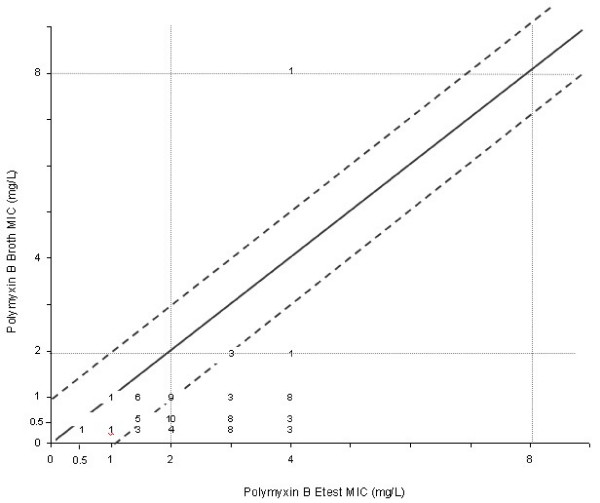
Twenty-nine percent of isolates belonged to endemic clone and thus, these strains were excluded of analysis. Among 78 strains evaluated, only one isolate was resistant to polymyxin B by the reference method (MIC: 8.0 microg/mL). Very major and major error rates of 1.2% and 11.5% were detected comparing polymyxin B disc diffusion with the broth microdilution (reference method). Agreement within 1 twofold dilution between Etest and the broth microdilution were 33% for polymyxin B and 79.5% for colistin. One major error and 48.7% minor errors were found comparing polymyxin B Etest with broth microdilution and only 6.4% minor errors with colistin. The concordance between Etest and the broth microdilution (reference method) was respectively 100% for colistin and 90% for polymyxin B.
Resistance to polymyxins seems to be rare among hospital carbapenem-resistant P. aeruginosa isolates over a six-year period. Our results showed, using the new CLSI criteria, that the disc diffusion susceptibility does not report major errors (false-resistant results) for colistin. On the other hand, showed a high frequency of minor errors and 1 very major error for polymyxin B. Etest presented better results for colistin than polymyxin B. Until these results are reproduced with a large number of polymyxins-resistant P. aeruginosa isolates, susceptibility to polymyxins should be confirmed by a reference method.
鉴于在许多国家多粘菌素用于治疗多重耐药革兰氏阴性菌感染的情况日益增多,评估针对这类抗生素的不同药敏试验方法非常重要。
采用临床和实验室标准协会的新解释性断点,通过肉汤微量稀释法(参考方法)、纸片扩散法和Etest法,对109株耐碳青霉烯类铜绿假单胞菌对多粘菌素的敏感性进行检测。
29%的分离株属于地方性克隆株,因此这些菌株被排除在分析之外。在评估的78株菌株中,参考方法显示只有1株对多粘菌素B耐药(MIC:8.0μg/mL)。将多粘菌素B纸片扩散法与肉汤微量稀释法(参考方法)比较,检测到的极重大错误率和重大错误率分别为1.2%和11.5%。Etest法与肉汤微量稀释法在1倍稀释范围内的一致性,多粘菌素B为33%,黏菌素为79.5%。将多粘菌素B的Etest法与肉汤微量稀释法比较,发现1例重大错误和48.7%的微小错误,而黏菌素只有6.4%的微小错误。Etest法与肉汤微量稀释法(参考方法)的一致性,黏菌素为100%,多粘菌素B为90%。
在六年期间,医院内耐碳青霉烯类铜绿假单胞菌分离株中对多粘菌素耐药似乎很少见。我们的结果表明,采用新的CLSI标准,纸片扩散药敏试验对黏菌素未报告重大错误(假耐药结果)。另一方面,多粘菌素B显示出高频率的微小错误和1例极重大错误。Etest法对黏菌素的结果比对多粘菌素B更好。在这些结果通过大量耐多粘菌素铜绿假单胞菌分离株重现之前,应通过参考方法确认对多粘菌素的敏感性。