Brown Joshua W, Braver Todd S
Department of Psychological and Brain Sciences, Indiana University, 1101 E Tenth St., Bloomington, IN 47405, USA.
Brain Res. 2008 Apr 2;1202:99-108. doi: 10.1016/j.brainres.2007.06.080. Epub 2007 Jul 26.
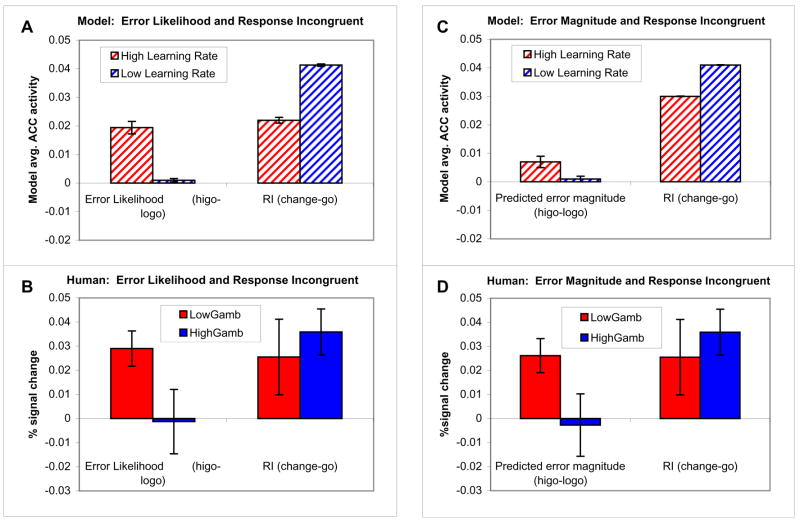
The error likelihood effect in anterior cingulate cortex (ACC) has recently been shown to be a special case of an even more general risk prediction effect, which signals both the likelihood of an error and the potential severity of its consequences. Surprisingly, these error likelihood and anticipated consequence effects are strikingly absent in risk-taking individuals. Conversely, conflict effects in ACC were found to be stronger in these same individuals. Here we show that the error likelihood computational model can account for individual differences in error likelihood, predicted error consequence, and conflict effects in ACC with no changes from the published version of the model. In particular, the model accounts for the counterintuitive inverse relationship between conflict and error likelihood effects as a function of the ACC learning rate in response to errors. As the learning rate increases, ACC learns more effectively from mistakes, which increases risk prediction effects at the expense of conflict effects. Thus, the model predicts that individuals with faster error-based learning in ACC will be more risk-averse and shows greater ACC error likelihood effects but smaller ACC conflict effects. Furthermore, the model suggests that apparent response conflict effects in ACC may actually consist of two related effects: increased error likelihood and a greater number of simultaneously cued responses, whether or not the responses are mutually incompatible. The results clarify the basic computational mechanisms of learned risk aversion and may have broad implications for predicting and managing risky behavior in healthy and clinical populations.
前扣带皮层(ACC)中的错误可能性效应最近被证明是一种更普遍的风险预测效应的特殊情况,该效应既表示错误的可能性,也表示其后果的潜在严重性。令人惊讶的是,在冒险者中,这些错误可能性和预期后果效应明显不存在。相反,在这些相同个体中发现ACC中的冲突效应更强。在这里,我们表明错误可能性计算模型可以解释ACC中错误可能性、预测错误后果和冲突效应的个体差异,且无需对已发表的模型版本进行更改。特别是,该模型将冲突与错误可能性效应之间违反直觉的反比关系解释为ACC对错误响应的学习率的函数。随着学习率的增加,ACC从错误中学习得更有效,这以冲突效应为代价增加了风险预测效应。因此,该模型预测,ACC中基于错误的学习速度更快的个体将更厌恶风险,表现出更大的ACC错误可能性效应,但ACC冲突效应更小。此外,该模型表明,ACC中明显的反应冲突效应实际上可能由两个相关效应组成:错误可能性增加和同时提示的反应数量增加,无论这些反应是否相互不兼容。这些结果阐明了习得性风险厌恶的基本计算机制,可能对预测和管理健康人群及临床人群的风险行为具有广泛意义。