Reilly David, Mercer Stewart W, Bikker Annemieke P, Harrison Tansy
AdHom Academic Department, Centre for Integrative Care, Glasgow Homoeopathic Hospital, 1053 Great Western Road, Glasgow G12 OXQ, Scotland, UK.
BMC Health Serv Res. 2007 Sep 2;7:139. doi: 10.1186/1472-6963-7-139.
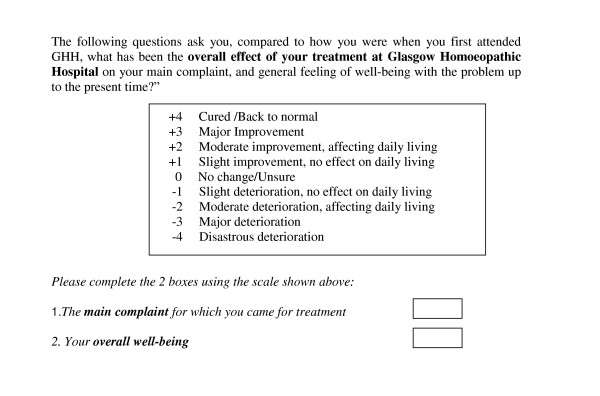
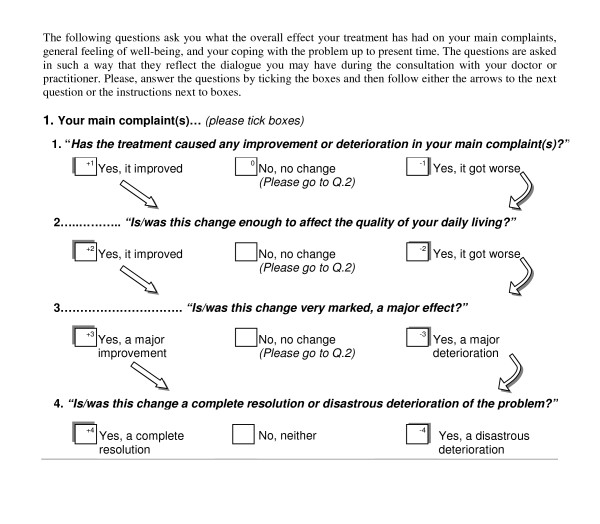
The challenge of finding practical, patient-rated outcome measures is a key issue in the evaluation of health care systems and interventions. The ORIDL (Outcome in Relation to Impact on Daily Living) instrument (formerly referred to as the Glasgow Homoeopathic Hospital Outcomes Scale or GHHOS) has been developed to measure patient's views of the outcome of their care by asking about change, and relating this to impact on daily life. The aim of the present paper is to describe the background and potential uses of the ORIDL, and to report on its preliminary validation in a series of three studies in secondary and primary care.
In the first study, 105 patients attending the Glasgow Homoeopathic Hospital (GHH) were followed-up at 12 months and changes in health status were measured by the EuroQol (EQOL) and the ORIDL. In the second study, 187 new patients at the GHH were followed-up at 3, 12, and 33 months, using the ORIDL, the Short Form 12 (SF-12), and the Measure Yourself Medical Outcome Profile (MYMOP). In study three, 323 patients in primary care were followed for 1 month post-consultation using the ORIDL and MYMOP. In all 3 studies the Patient Enablement Instrument (PEI) was also used as an outcome measure.
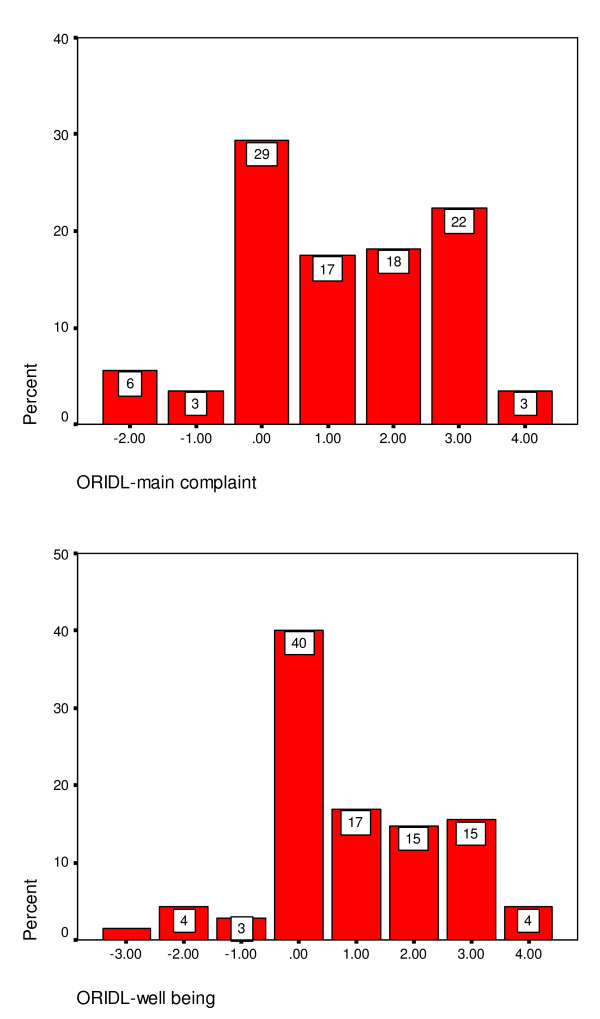
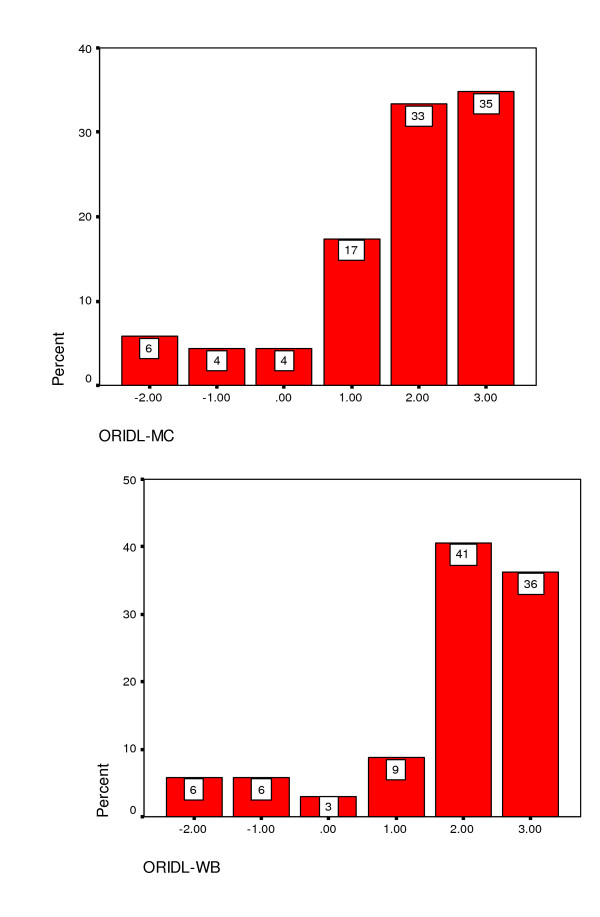
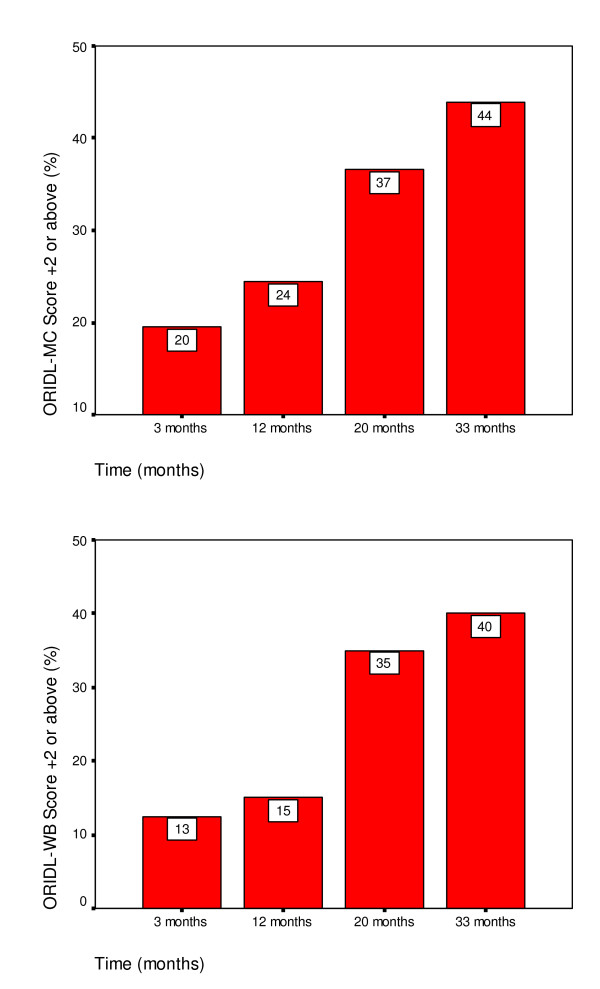
Study 1 showed substantial improvements in main complaint and well-being over 12 months using the ORIDL, with two-thirds of patients reporting improvements in daily living. These improvements were not significantly correlated with changes in serial measures of the EQOL between baseline and 12 months, but were correlated with the EQOL transitions measure. Study 2 showed step-wise improvements in ORIDL scores between 3 and 33 months, which were only weakly associated with similar changes in SF-12 scores. However, MYMOP change scores correlated well with ORIDL scores at all time points. Study 3 showed similar high correlations between ORIDL scores and MYMOP scores. In all 3 studies, ORIDL scores were also significantly correlated with PEI-outcome scores.
There is significant agreement between patient outcomes assessed by the ORIDL and the EQOL transition scale, the MYMOP, and the PEI-outcome instrument, suggesting that the ORIDL may be a valid and sensitive tool for measuring change in relation to impact on life.
寻找实用的、由患者评定的结果测量方法是医疗保健系统和干预措施评估中的一个关键问题。已经开发出ORIDL(与日常生活影响相关的结果)工具(以前称为格拉斯哥顺势疗法医院结果量表或GHHOS),通过询问变化情况并将其与对日常生活的影响联系起来,来衡量患者对其治疗结果的看法。本文的目的是描述ORIDL的背景和潜在用途,并报告其在一系列三项二级和初级保健研究中的初步验证情况。
在第一项研究中,对105名就诊于格拉斯哥顺势疗法医院(GHH)的患者进行了12个月的随访,使用欧洲五维度健康量表(EQOL)和ORIDL来测量健康状况的变化。在第二项研究中,对GHH的187名新患者在3个月、12个月和33个月时进行了随访,使用ORIDL、简短健康调查问卷12项版(SF-12)和自我测量医疗结果概况量表(MYMOP)。在第三项研究中,对323名初级保健患者在会诊后1个月使用ORIDL和MYMOP进行随访。在所有三项研究中,患者赋能工具(PEI)也被用作结果测量指标。
研究1显示,使用ORIDL,在12个月内主要症状和幸福感有显著改善,三分之二的患者报告日常生活有所改善。这些改善与基线至12个月期间EQOL系列测量的变化没有显著相关性,但与EQOL转换测量相关。研究2显示,在3至33个月期间,ORIDL评分逐步提高,这与SF-12评分的类似变化仅有微弱关联。然而,MYMOP变化评分在所有时间点都与ORIDL评分有良好的相关性。研究3显示,ORIDL评分与MYMOP评分之间也有类似的高度相关性。在所有三项研究中,ORIDL评分也与PEI结果评分显著相关。
ORIDL评估的患者结果与EQOL转换量表、MYMOP和PEI结果工具之间存在显著一致性,这表明ORIDL可能是一种有效且敏感的工具,用于测量与生活影响相关的变化。