Tang Xun, Hu Yonghua, Chen Dafang, Zhan Siyan, Zhang Zongxin, Dou Huidong
Department of Epidemiology & Biostatistics, Peking University School of Public Health, Beijing 100083, China.
BMC Med Genet. 2007 Sep 10;8:60. doi: 10.1186/1471-2350-8-60.
The exact etiology of ischemic stroke remains unclear, because multiple genetic predispositions and environmental risk factors may be involved, and their interactions dictate the complexity. Family-based studies provide unique features in design, while they are currently underrepresented for studies of ischemic stroke in developing countries. The Fangshan/Family-based Ischemic Stroke Study In China (FISSIC) program aims to conduct a genetic pedigree study of ischemic stroke in rural communities of China.
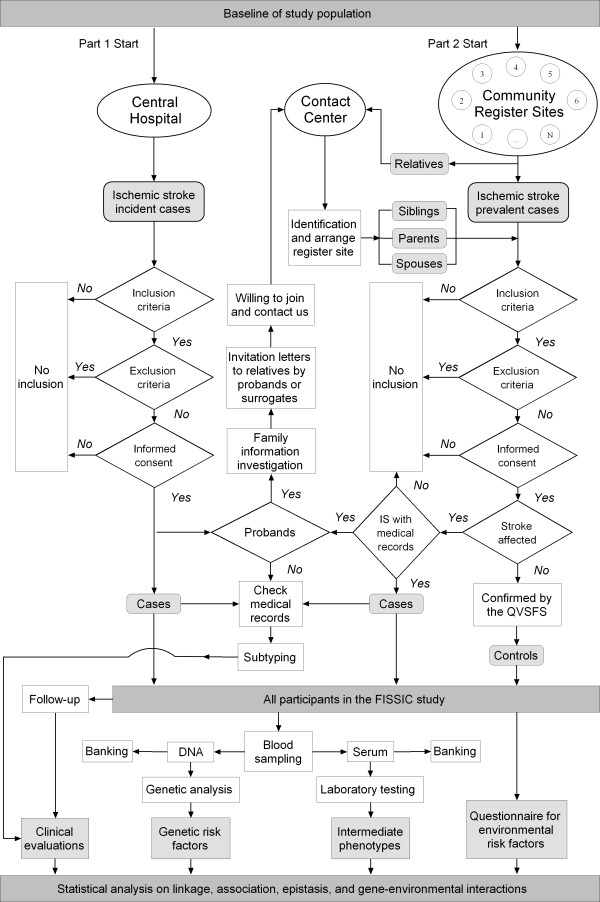
METHODS/DESIGN: The pedigrees of ischemic stroke with clear documentation are recruited by using the proband-initiated contact method, based on the stroke registry in hospital and communities. Blood samples and detailed information of pedigrees are collected through the health care network in the rural area, and prospective follow-up of the pedigrees cohort is scheduled. Complementary strategies of both family-based design and matched case-spousal control design are used, and comprehensive statistical methods will be implemented to ascertain potential complex genetic and environmental factors and their interactions as well.
This study is complementary to other genetic pedigree studies of ischemic stroke, such as the Siblings With Ischemic Stroke Study (SWISS), which are established in developed countries. We describe the protocol of this family-based genetic epidemiological study that may be used as a new practical guideline and research paradigm in developing countries and facilitate initiatives of stroke study for international collaborations.
缺血性中风的确切病因仍不清楚,因为可能涉及多种遗传易感性和环境风险因素,它们之间的相互作用决定了其复杂性。基于家系的研究在设计上具有独特之处,但目前在发展中国家缺血性中风研究中所占比例较低。中国房山/基于家系的缺血性中风研究(FISSIC)项目旨在对中国农村社区的缺血性中风进行遗传谱系研究。
方法/设计:采用先证者启动的联系方法,根据医院和社区的中风登记信息,招募有明确记录的缺血性中风家系。通过农村地区的医疗保健网络收集家系的血液样本和详细信息,并对家系队列进行前瞻性随访。采用基于家系设计和匹配病例-配偶对照设计的互补策略,并将实施综合统计方法以确定潜在的复杂遗传和环境因素及其相互作用。
本研究是对其他缺血性中风遗传谱系研究的补充,如在发达国家开展的缺血性中风同胞研究(SWISS)。我们描述了这项基于家系的遗传流行病学研究方案,该方案可作为发展中国家新的实用指南和研究范式,并促进中风研究国际合作倡议。