Bérubé Julie, Bouchard Amélie, Berthoux Lionel
Laboratory of Retrovirology, GRBCM, University of Québec, Trois-Rivières, QC G9A 5H7, Canada.
Retrovirology. 2007 Sep 24;4:68. doi: 10.1186/1742-4690-4-68.
TRIM5alpha, which is expressed in most primates and the related TRIMCyp, which has been found in one of the New World monkey species, are antiviral proteins of the TRIM5 family that are able to intercept incoming retroviruses early after their entry into cells. The mechanism of action has been partially elucidated for TRIM5alpha, which seems to promote premature decapsidation of the restricted retroviruses. In addition, through its N-terminal RING domain, TRIM5alpha may sensitize retroviruses to proteasome-mediated degradation. TRIM5alpha-mediated restriction requires a physical interaction with the capsid protein of targeted retroviruses. It is unclear whether other cellular proteins are involved in the inhibition mediated by TRIM5alpha and TRIMCyp. A previous report suggested that the inhibition of HIV-1 by the rhesus macaque orthologue of TRIM5alpha was inefficient in the D17a canine cell line, suggesting that the cellular environment was important for the restriction mechanism. Here we investigated further the behavior of TRIM5alpha and TRIMCyp in the D17 cells.
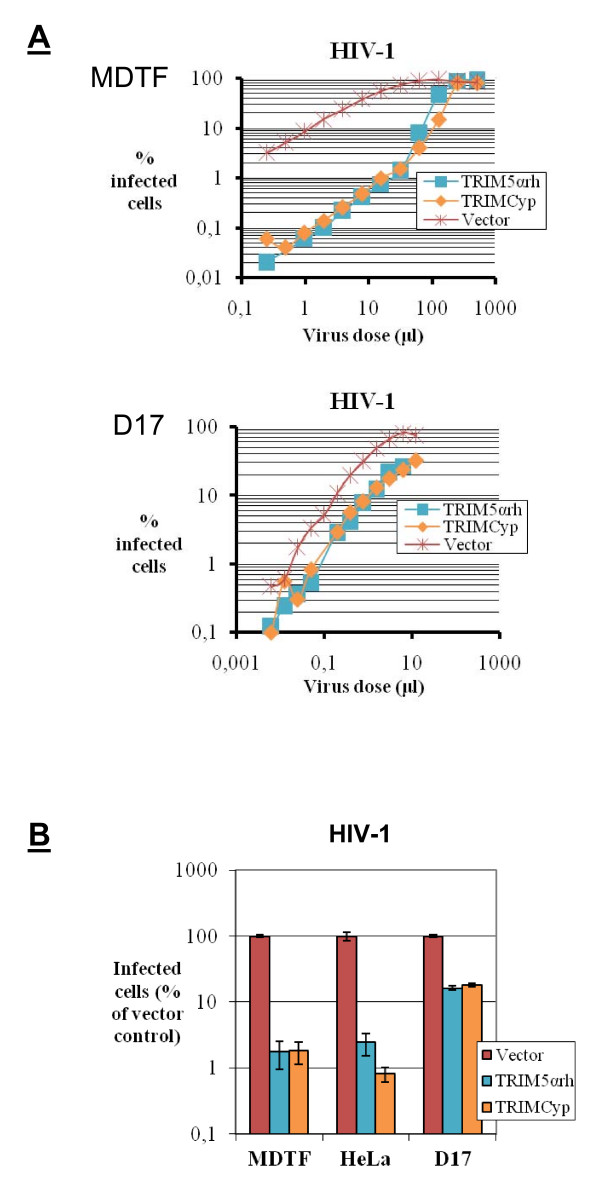
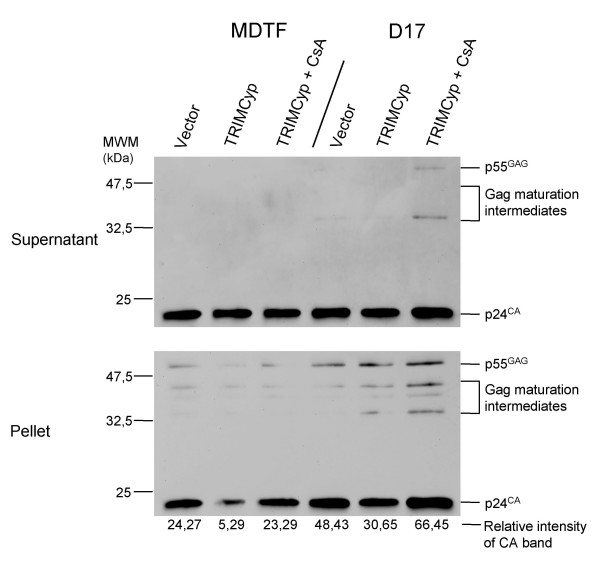
We found that the various TRIM5alpha orthologues studied (human, rhesus macaque, African green monkey) as well as TRIMCyp had poor antiviral activity in the D17 cells, despite seemingly normal expression levels and subcellular distribution. Restriction of both HIV-1 and the distantly related N-tropic murine leukemia virus (N-MLV) was low in D17 cells. Both TRIM5alpharh and TRIMCyp promoted early HIV-1 decapsidation in murine cells, but weak levels of restriction in D17 cells correlated with the absence of accelerated decapsidation in these cells and also correlated with normal levels of cDNA synthesis. Fv1, a murine restriction factor structurally unrelated to TRIM5alpha, was fully functional in D17 cells, showing that the loss of activity was specific to TRIM5alpha/TRIMCyp.
We show that D17 cells provide a poor environment for the inhibition of retroviral replication by proteins of the TRIM5 family. Because both TRIM5alpha and TRIMCyp are poorly active in these cells, despite having quite different viral target recognition domains, we conclude that a step either upstream or downstream of target recognition is impaired. We speculate that an unknown factor required for TRIM5alpha and TRIMCyp activity is missing or inadequately expressed in D17 cells.
TRIM5α 在大多数灵长类动物中表达,而在一种新大陆猴物种中发现的相关蛋白 TRIMCyp 是 TRIM5 家族的抗病毒蛋白,能够在逆转录病毒进入细胞后不久拦截它们。TRIM5α 的作用机制已部分阐明,它似乎能促进受限制逆转录病毒的过早脱壳。此外,通过其 N 端的 RING 结构域,TRIM5α 可能使逆转录病毒对蛋白酶体介导的降解敏感。TRIM5α 介导的限制需要与靶向逆转录病毒的衣壳蛋白进行物理相互作用。目前尚不清楚是否有其他细胞蛋白参与 TRIM5α 和 TRIMCyp 介导的抑制作用。先前的一份报告表明,恒河猴 TRIM5α 的同源物对 HIV-1 的抑制在 D17a 犬细胞系中效率低下,这表明细胞环境对限制机制很重要。在此,我们进一步研究了 TRIM5α 和 TRIMCyp 在 D17 细胞中的行为。
我们发现,所研究的各种 TRIM5α 同源物(人类、恒河猴、非洲绿猴)以及 TRIMCyp 在 D17 细胞中的抗病毒活性较差,尽管其表达水平和亚细胞分布看似正常。D17 细胞对 HIV-1 和远亲的 N 型嗜性鼠白血病病毒(N-MLV)的限制作用都很低。TRIM5αrh 和 TRIMCyp 都能促进鼠细胞中 HIV-1 的早期脱壳,但 D17 细胞中较弱的限制水平与这些细胞中脱壳加速的缺失相关,也与 cDNA 合成的正常水平相关。Fv1 是一种在结构上与 TRIM5α 无关的鼠类限制因子,在 D17 细胞中功能完全正常,这表明活性丧失是 TRIM5α/TRIMCyp 特有的。
我们表明,D17 细胞为 TRIM5 家族蛋白抑制逆转录病毒复制提供了一个不利的环境。由于 TRIM5α 和 TRIMCyp 在这些细胞中的活性都很差,尽管它们具有截然不同的病毒靶标识别结构域,我们得出结论,靶标识别上游或下游的某个步骤受到了损害。我们推测 D17 细胞中缺少或未充分表达 TRIM5α 和 TRIMCyp 活性所需的未知因子。