Carrara Anne-Sophie, Coffey Lark L, Aguilar Patricia V, Moncayo Abelardo C, Da Rosa Amelia P A Travassos, Nunes Marcio R T, Tesh Robert B, Weaver Scott C
Department of Pathology, University of Texas Medical Branch, Galveston 77555-0609, USA.
Emerg Infect Dis. 2007 Aug;13(8):1158-65. doi: 10.3201/eid1308.061157.
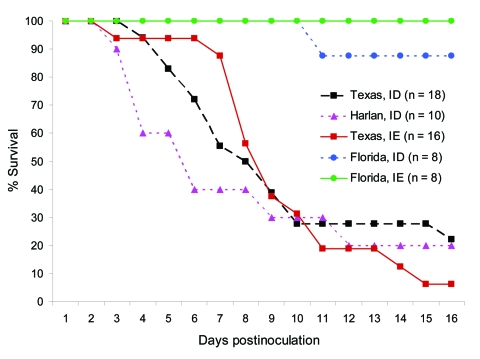
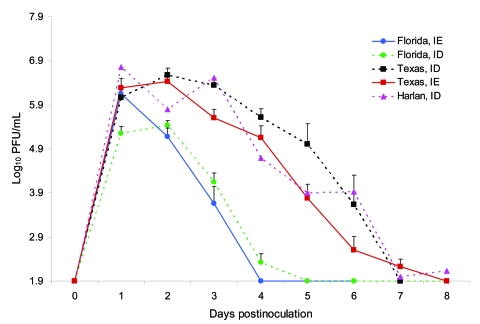
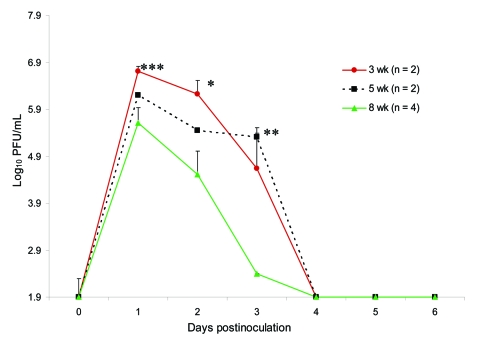
Venezuelan equine encephalitis virus (VEEV) is an emerging pathogen of equids and humans, but infection of its rodent reservoir hosts has received little study. To determine whether responses to infection vary among geographic populations, we inoculated 3 populations of cotton rats with 2 enzootic VEEV strains (Co97-0054 [enzootic ID subtype] and 68U201 [enzootic IE subtype]). The 3 populations were offspring from wild-caught cotton rats collected in a VEE-enzootic area of south Florida, USA; wild-caught cotton rats from a non-VEE-enzootic area of Texas, USA; and commercially available (Harlan) colony-reared cotton rats from a non-VEE-enzootic region. Although each population had similar early viremia titers, no detectable disease developed in the VEE-sympatric Florida animals, but severe disease and death affected the Texas and Harlan animals. Our findings suggest that the geographic origins of cotton rats are important determinants of the outcome of VEE infection and reservoir potential of these rodents.
委内瑞拉马脑炎病毒(VEEV)是马和人类的一种新出现病原体,但其啮齿动物储存宿主的感染情况鲜少得到研究。为了确定不同地理种群对感染的反应是否存在差异,我们用两种地方流行性VEEV毒株(Co97 - 0054 [地方流行性ID亚型] 和68U201 [地方流行性IE亚型])接种了3个棉鼠种群。这3个种群分别是:从美国佛罗里达州南部VEE地方流行区捕获的野生棉鼠的后代;从美国得克萨斯州非VEE地方流行区捕获的野生棉鼠;以及来自非VEE地方流行区的市售(Harlan)饲养棉鼠种群。尽管每个种群的早期病毒血症滴度相似,但在VEE同域分布的佛罗里达动物中未出现可检测到的疾病,而得克萨斯州和Harlan种群的动物则出现了严重疾病和死亡。我们的研究结果表明,棉鼠的地理来源是VEE感染结果以及这些啮齿动物储存宿主潜力的重要决定因素。