Tam Lai-Shan, Leung Ping-Chung, Li Tena K, Zhang Lang, Li Edmund K
The Department of Medicine & Therapeutics, The Prince of Wales Hospital, The Chinese University of Hong Kong, Hong Kong, China.
BMC Complement Altern Med. 2007 Nov 3;7:35. doi: 10.1186/1472-6882-7-35.
In planning a randomized controlled trial of acupuncture, we conducted a pilot study using validated outcome measures to assess the feasibility of the protocol, and to obtain preliminary data on efficacy and tolerability of 3 different forms of acupuncture treatment as an adjunct for the treatment of chronic pain in patients with Rheumatoid arthritis (RA).
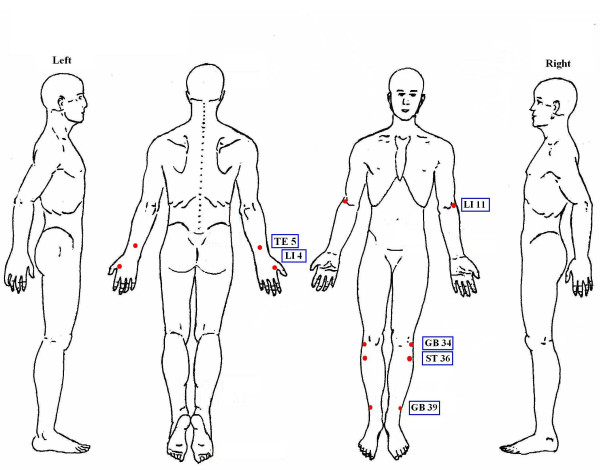
The study employs a randomized, prospective, double-blind, placebo-controlled trial to evaluate the effect of electroacupuncture (EA), traditional Chinese acupuncture (TCA) and sham acupuncture (Sham) in patients with RA. All patients received 20 sessions over a period of 10 weeks. Six acupuncture points were chosen. Primary outcome is the changes in the pain score. Secondary outcomes included the changes in the ACR core disease measures, DAS 28 score and the number of patients who achieved ACR 20 at week 10.
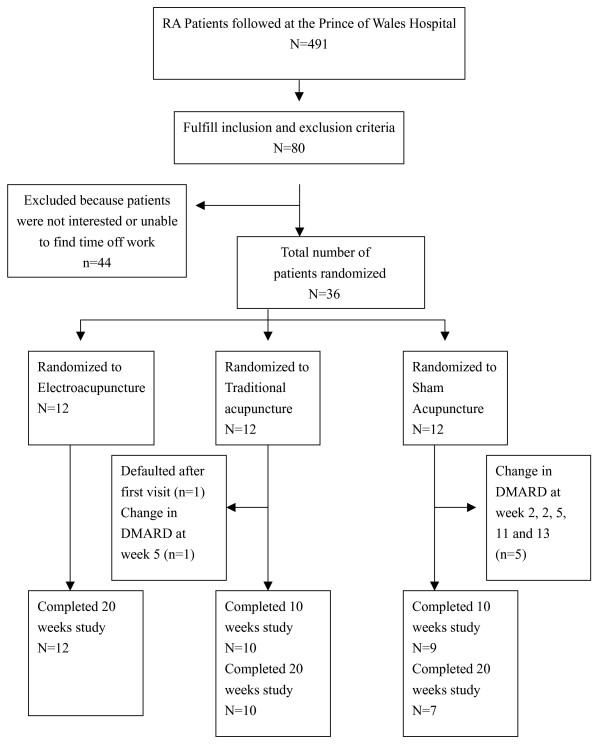
From 80 eligible patients, 36 patients with mean age of 58 +/- 10 years and disease duration of 9.3 +/- 6.4 years were recruited. Twelve patients were randomized to each group. Twelve, 10 and 7 patients from the EA, TCA and Sham group respectively completed the study at 20 weeks (p < 0.03); all except one of the premature dropouts were due to lack of efficacy. At week 10, the pain score remained unchanged in all 3 groups. The number of tender joints was significantly reduced for the EA and TCA groups. Physician's global score was significantly reduced for the EA group and patient's global score was significantly reduced for the TCA group. All the outcomes except patient's global score remained unchanged in the Sham group.
This pilot study has allowed a number of recommendations to be made to facilitate the design of a large-scale trial, which in turn will help to clarify the existing evidence base on acupuncture for RA.
ClinicalTrials.gov NCT00404443.
在规划一项针灸随机对照试验时,我们进行了一项先导研究,使用经过验证的结局指标来评估方案的可行性,并获取关于三种不同形式针灸治疗作为类风湿性关节炎(RA)患者慢性疼痛辅助治疗的疗效和耐受性的初步数据。
本研究采用随机、前瞻性、双盲、安慰剂对照试验,以评估电针(EA)、传统中医针灸(TCA)和假针灸(Sham)对RA患者的疗效。所有患者在10周内接受20次治疗。选择了六个穴位。主要结局是疼痛评分的变化。次要结局包括美国风湿病学会(ACR)核心疾病指标的变化、疾病活动度评分28(DAS 28)评分以及在第10周达到ACR 20的患者数量。
从80名符合条件的患者中,招募了36名平均年龄为58±10岁、病程为9.3±6.4年的患者。每组随机分配12名患者。EA组、TCA组和假针灸组分别有12名、10名和7名患者在20周时完成研究(p<0.03);除一名提前退出者外,所有提前退出均因缺乏疗效。在第10周时,所有三组的疼痛评分均未改变。EA组和TCA组的压痛关节数量显著减少。EA组的医生整体评分显著降低,TCA组的患者整体评分显著降低。假针灸组除患者整体评分外的所有结局均未改变。
这项先导研究提出了一些建议,以促进大规模试验的设计,这反过来将有助于澄清现有的关于针灸治疗RA的证据基础。
ClinicalTrials.gov NCT00404443。