Song Joo-Hyun, Takahashi Naomi, McPeek Robert M
Smith-Kettlewell Eye Research Institute, 2318 Fillmore St., San Francisco, CA 94115, USA.
J Neurophysiol. 2008 Jan;99(1):14-24. doi: 10.1152/jn.01106.2007. Epub 2007 Nov 7.
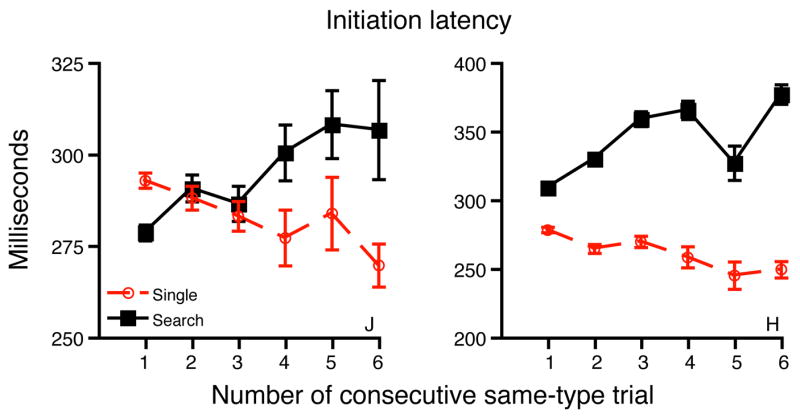
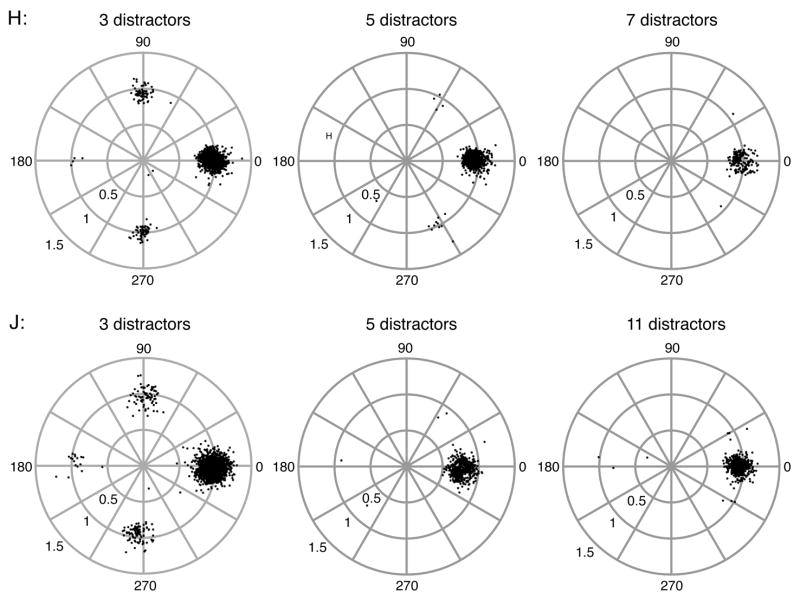
We examined target selection for visually guided reaching in monkeys using a visual search task in which an odd-colored target was presented with distractors. The colors of the target and distractors were randomly switched in each trial between red and green, and the number of distractors was varied. Previous studies of saccades and attention have shown that target selection in this task is easier when a greater number of homogenous distractors is present. We found that monkeys made fewer reaches to distractors and that reaches to the target were completed more quickly when a greater number of homogenous distractors was present. When the target was presented in a sparse array of distractors, reaches had longer movement durations and greater trajectory curvature. Reaching errors were directed more often to a distractor adjacent to the target, suggesting a spatially coarse-to-fine progression during target selection. Reaches were also influenced by the properties of trials in the recent past. When the colors of the target and distractors remained the same from trial to trial rather than switching, reaches were completed more quickly and accurately, indicating that color priming across trials facilitates target selection. Moreover, when difficult search trials were randomly intermixed with easier trials without distractors, reach latencies were influenced by the difficulty of previous trials, indicating that motor initiation strategies are gradually adjusted based on accumulated experience. Overall, these results are consistent with reaching results in humans, indicating that the monkey provides a sound model for understanding the neural underpinnings of reach target selection.
我们使用视觉搜索任务来研究猴子在视觉引导下伸手抓取目标的目标选择情况,在该任务中,一个颜色奇特的目标与干扰物一起呈现。目标和干扰物的颜色在每次试验中随机在红色和绿色之间切换,并且干扰物的数量也有所变化。先前关于扫视和注意力的研究表明,当存在更多数量的同质干扰物时,此任务中的目标选择会更容易。我们发现,当存在更多数量的同质干扰物时,猴子伸向干扰物的次数减少,并且伸向目标的动作完成得更快。当目标出现在稀疏的干扰物阵列中时,伸手动作的持续时间更长,轨迹曲率更大。伸手错误更常指向与目标相邻的干扰物,这表明在目标选择过程中存在从空间上的粗略到精细的进展。伸手动作还受到近期试验特性的影响。当目标和干扰物的颜色在每次试验中保持不变而不是切换时,伸手动作完成得更快且更准确,这表明跨试验的颜色启动有助于目标选择。此外,当困难的搜索试验与无干扰物的较容易试验随机混合时,伸手潜伏期会受到先前试验难度的影响,这表明运动启动策略会根据积累的经验逐渐调整。总体而言,这些结果与人类的伸手结果一致,表明猴子为理解伸手目标选择的神经基础提供了一个可靠的模型。