Schonberg Mara A, McCarthy Ellen P, York Meghan, Davis Roger B, Marcantonio Edward R
Division of General Medicine and Primary Care, Department of Medicine, Harvard Medical School, Beth Israel Deaconess Medical Center, Boston, MA, USA.
BMC Geriatr. 2007 Nov 16;7:26. doi: 10.1186/1471-2318-7-26.
Although guidelines recommend that clinicians consider life expectancy before screening older women for breast cancer, many older women with limited life expectancies are screened. We aimed to identify factors important to mammography screening decisions among women aged 80 and older compared to women aged 65-79.
Telephone surveys of 107 women aged 80+ and 93 women aged 65-79 randomly selected from one academic primary care practice who were able to communicate in English (60% response rate). The survey addressed the following factors in regards to older women's mammography screening decisions: perceived importance of a history of breast disease, family history of breast cancer, doctor's recommendations, habit, reassurance, previous experience, mailed reminder cards, family/friend's recommendations or experience with breast cancer, age, health, and media. The survey also assessed older women's preferred role in decision making around mammography screening.
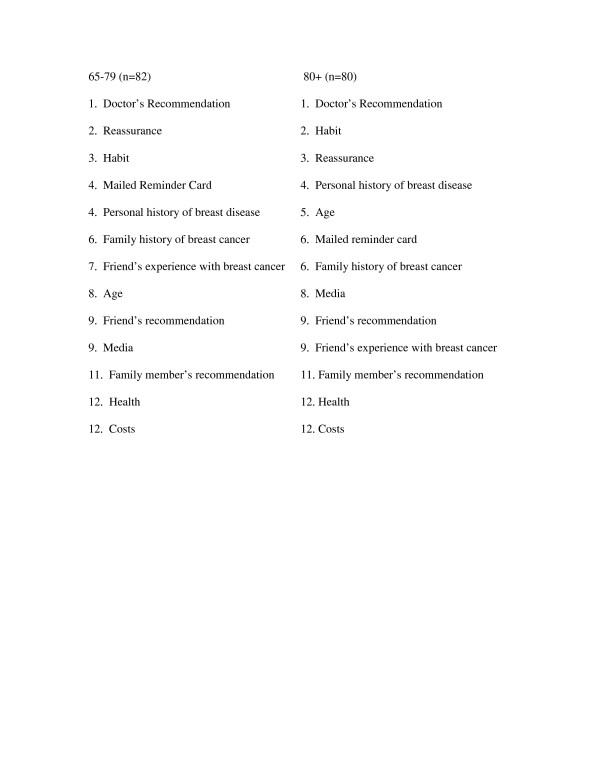
Of the 200 women, 65.5% were non-Hispanic white and 82.8% were in good to excellent health. Most (81.3%) had undergone mammography in the past 2 years. Regardless of age, older women ranked doctor's recommendations as the most important factor influencing their decision to get screened. Habit and reassurance were the next two highly ranked factors influencing older women to get screened. Among women who did not get screened, women aged 80 and older ranked age and doctor's counseling as the most influential factors and women aged 65-79 ranked a previous negative experience with mammography as the most important factor. There were no significant differences in preferred role in decision-making around mammography screening by age, however, most women in both age groups preferred to make the final decision on their own (46.6% of women aged 80+ and 50.5% of women aged 65-79).
While a doctor's recommendation is the most important factor influencing elderly women's mammography screening decisions, habit and reassurance also strongly influence decision-making. Interventions aimed at improving clinician counseling about mammography, which include discussions around habit and reassurance, may result in better decision-making.
尽管指南建议临床医生在对老年女性进行乳腺癌筛查前考虑其预期寿命,但许多预期寿命有限的老年女性仍接受了筛查。我们旨在确定与65 - 79岁女性相比,80岁及以上女性在乳腺钼靶筛查决策中重要的因素。
对从一家学术性初级保健机构中随机选取的107名80岁及以上女性和93名65 - 79岁女性进行电话调查,这些女性能够用英语交流(回复率为60%)。该调查涉及以下与老年女性乳腺钼靶筛查决策相关的因素:乳腺疾病史的感知重要性、乳腺癌家族史、医生建议、习惯、安心程度、既往经历、邮寄提醒卡、家人/朋友关于乳腺癌的建议或经历、年龄、健康状况和媒体。该调查还评估了老年女性在乳腺钼靶筛查决策中偏好的角色。
在这200名女性中,65.5%为非西班牙裔白人,82.8%健康状况良好至极佳。大多数(81.3%)在过去2年中接受过乳腺钼靶检查。无论年龄如何,老年女性都将医生的建议列为影响她们接受筛查决策的最重要因素。习惯和安心程度是接下来影响老年女性接受筛查的两个排名靠前的因素。在未接受筛查的女性中,80岁及以上女性将年龄和医生的咨询列为最有影响力的因素,而65 - 79岁女性将既往乳腺钼靶检查的负面经历列为最重要的因素。在乳腺钼靶筛查决策中偏好的角色方面,年龄没有显著差异,然而,两个年龄组的大多数女性都更倾向于自己做出最终决定(80岁及以上女性中有46.6%,65 - 79岁女性中有50.5%)。
虽然医生的建议是影响老年女性乳腺钼靶筛查决策的最重要因素,但习惯和安心程度也强烈影响决策。旨在改善临床医生关于乳腺钼靶检查咨询的干预措施,包括围绕习惯和安心程度的讨论,可能会带来更好的决策。