• 文献检索
  • 文档翻译
  • 深度研究
  • 学术资讯
  • Suppr Zotero 插件Zotero 插件
  • 邀请有礼
  • 套餐&价格
  • 历史记录
应用&插件
Suppr Zotero 插件Zotero 插件浏览器插件Mac 客户端Windows 客户端微信小程序
定价
高级版会员购买积分包购买API积分包
服务
文献检索文档翻译深度研究API 文档MCP 服务
关于我们
关于 Suppr公司介绍联系我们用户协议隐私条款
关注我们

Suppr 超能文献

核心技术专利:CN118964589B侵权必究
粤ICP备2023148730 号-1Suppr @ 2026

文献检索

告别复杂PubMed语法,用中文像聊天一样搜索,搜遍4000万医学文献。AI智能推荐,让科研检索更轻松。

立即免费搜索

文件翻译

保留排版,准确专业,支持PDF/Word/PPT等文件格式,支持 12+语言互译。

免费翻译文档

深度研究

AI帮你快速写综述,25分钟生成高质量综述,智能提取关键信息,辅助科研写作。

立即免费体验

快速的经济发展加速了中国的生物入侵。

Fast economic development accelerates biological invasions in China.

作者信息

Lin Wen, Zhou Guofa, Cheng Xinyue, Xu Rumei

机构信息

Ministry of Education Key Laboratory for Biodiversity Sciences and Ecological Engineering, Beijing Normal University, Beijing, China.

出版信息

PLoS One. 2007 Nov 21;2(11):e1208. doi: 10.1371/journal.pone.0001208.

DOI:10.1371/journal.pone.0001208
PMID:18030342
原文链接:https://pmc.ncbi.nlm.nih.gov/articles/PMC2065902/
Abstract

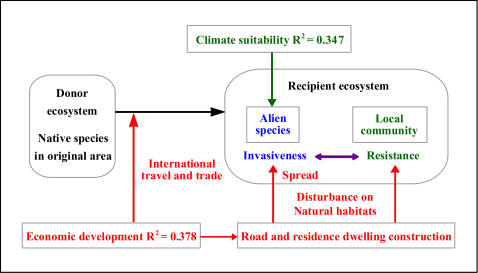
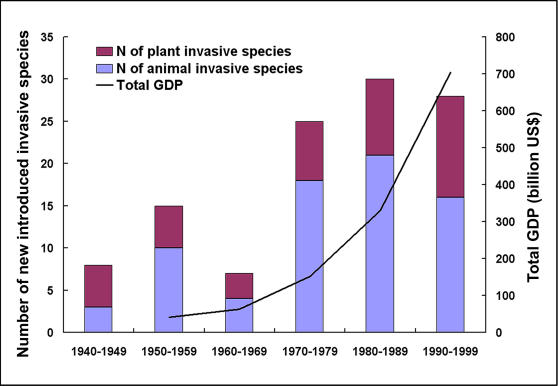
Increasing levels of global trade and intercontinental travel have been cited as the major causes of biological invasion. However, indirect factors such as economic development that affect the intensity of invasion have not been quantitatively explored. Herein, using principal factor analysis, we investigated the relationship between biological invasion and economic development together with climatic information for China from the 1970s to present. We demonstrate that the increase in biological invasion is coincident with the rapid economic development that has occurred in China over the past three decades. The results indicate that the geographic prevalence of invasive species varies substantially on the provincial scale, but can be surprisingly well predicted using the combination of economic development (R(2) = 0.378) and climatic factors (R(2) = 0.347). Economic factors are proven to be at least equal to if not more determinant of the occurrence of invasive species than climatic factors. International travel and trade are shown to have played a less significant role in accounting for the intensity of biological invasion in China. Our results demonstrate that more attention should be paid to economic factors to improve the understanding, prediction and management of biological invasions.

摘要

全球贸易水平的提高和洲际旅行被认为是生物入侵的主要原因。然而,影响入侵强度的间接因素,如经济发展,尚未得到定量研究。在此,我们运用主因子分析方法,研究了20世纪70年代至今中国生物入侵与经济发展以及气候信息之间的关系。我们发现,生物入侵的增加与中国过去三十年快速的经济发展相吻合。结果表明,入侵物种的地理分布在省级尺度上差异很大,但通过经济发展(R² = 0.378)和气候因素(R² = 0.347)的结合能够得到惊人的准确预测。事实证明,经济因素在决定入侵物种的发生方面至少与气候因素同等重要,甚至更为关键。国际旅行和贸易在中国生物入侵强度的形成中所起的作用相对较小。我们的研究结果表明,为了更好地理解、预测和管理生物入侵,应更多地关注经济因素。
https://cdn.ncbi.nlm.nih.gov/pmc/blobs/fe3a/2065902/3726ab8db2cd/pone.0001208.g003.jpg
https://cdn.ncbi.nlm.nih.gov/pmc/blobs/fe3a/2065902/2e2fe4058f67/pone.0001208.g001.jpg
https://cdn.ncbi.nlm.nih.gov/pmc/blobs/fe3a/2065902/def4f5f9eac5/pone.0001208.g002.jpg
https://cdn.ncbi.nlm.nih.gov/pmc/blobs/fe3a/2065902/3726ab8db2cd/pone.0001208.g003.jpg
https://cdn.ncbi.nlm.nih.gov/pmc/blobs/fe3a/2065902/2e2fe4058f67/pone.0001208.g001.jpg
https://cdn.ncbi.nlm.nih.gov/pmc/blobs/fe3a/2065902/def4f5f9eac5/pone.0001208.g002.jpg
https://cdn.ncbi.nlm.nih.gov/pmc/blobs/fe3a/2065902/3726ab8db2cd/pone.0001208.g003.jpg

相似文献

1
Fast economic development accelerates biological invasions in China.快速的经济发展加速了中国的生物入侵。
PLoS One. 2007 Nov 21;2(11):e1208. doi: 10.1371/journal.pone.0001208.
2
Impact of different economic factors on biological invasions on the global scale.不同经济因素对全球范围内生物入侵的影响。
PLoS One. 2011 Apr 13;6(4):e18797. doi: 10.1371/journal.pone.0018797.
3
Ecology, economics and political will: the vicissitudes of malaria strategies in Asia.生态学、经济学与政治意愿:亚洲疟疾防治策略的变迁
Parassitologia. 1998 Jun;40(1-2):39-46.
4
Drivers of global Scolytinae invasion patterns.全球小蠹亚科入侵模式的驱动因素。
Ecol Appl. 2020 Jul;30(5):e02103. doi: 10.1002/eap.2103. Epub 2020 Mar 26.
5
What do we really know about alien plant invasion? A review of the invasion mechanism of one of the world's worst weeds.我们对外来植物入侵究竟了解多少?对世界上最有害杂草之一的入侵机制的综述。
Planta. 2016 Jul;244(1):39-57. doi: 10.1007/s00425-016-2510-x. Epub 2016 Apr 7.
6
Spatial risk assessment of alien invasive plants in China.中国外来入侵植物的空间风险评估。
Environ Sci Technol. 2013 Jul 16;47(14):7624-32. doi: 10.1021/es400382c. Epub 2013 Jul 8.
7
Inter-country trade, genetic diversity and bio-ecological parameters upgrade pest risk maps for the coconut hispid Brontispa longissima.国家间贸易、遗传多样性和生物生态参数提升了椰子鳞毛毕露蝽的虫害风险地图。
Pest Manag Sci. 2020 Apr;76(4):1483-1491. doi: 10.1002/ps.5663. Epub 2019 Nov 27.
8
Can species distribution models really predict the expansion of invasive species?物种分布模型真的能预测入侵物种的扩张吗?
PLoS One. 2018 Mar 6;13(3):e0193085. doi: 10.1371/journal.pone.0193085. eCollection 2018.
9
Climate change and biological invasions: evidence, expectations, and response options.气候变化与生物入侵:证据、预期及应对选择。
Biol Rev Camb Philos Soc. 2017 Aug;92(3):1297-1313. doi: 10.1111/brv.12282. Epub 2016 May 31.
10
Biological invasions, ecological resilience and adaptive governance.生物入侵、生态恢复力与适应性治理
J Environ Manage. 2016 Dec 1;183(Pt 2):399-407. doi: 10.1016/j.jenvman.2016.04.040. Epub 2016 Jul 2.

引用本文的文献

1
Seed Traits and Germination of Invasive Plant (Solanaceae) in the Arid Zone of Northern China Indicate Invasion Patterns.中国北方干旱区茄科入侵植物的种子特性与萌发表明其入侵模式
Plants (Basel). 2024 Nov 22;13(23):3287. doi: 10.3390/plants13233287.
2
Distribution Patterns and Determinants of Invasive Alien Plants in China.中国外来入侵植物的分布格局与影响因素
Plants (Basel). 2023 Jun 16;12(12):2341. doi: 10.3390/plants12122341.
3
Species Distribution Models of the Loisel in Its Origin and Invasive Country Reveal an Ecological Niche Shift.

本文引用的文献

1
Invasion in a heterogeneous world: resistance, coexistence or hostile takeover?异质世界中的入侵:抵抗、共存还是恶意接管?
Ecol Lett. 2007 Jan;10(1):77-94. doi: 10.1111/j.1461-0248.2006.00987.x.
2
Global traffic and disease vector dispersal.全球交通与疾病媒介传播。
Proc Natl Acad Sci U S A. 2006 Apr 18;103(16):6242-7. doi: 10.1073/pnas.0508391103. Epub 2006 Apr 10.
3
Global hot spots of biological invasions: evaluating options for ballast-water management.全球生物入侵热点地区:评估压载水管理方案
洛塞尔氏物种在其原生地和入侵地的分布模型揭示了生态位转移。
Front Plant Sci. 2021 Oct 12;12:738769. doi: 10.3389/fpls.2021.738769. eCollection 2021.
4
Ageratina adenophora and Lantana camara in Kailash Sacred Landscape, India: Current distribution and future climatic scenarios through modeling.印度凯拉萨圣地景观中的 Ageratina adenophora 和 Lantana camara:通过建模预测当前分布和未来气候情景。
PLoS One. 2021 May 11;16(5):e0239690. doi: 10.1371/journal.pone.0239690. eCollection 2021.
5
Global distribution patterns and niche modelling of the invasive Kalanchoe × houghtonii (Crassulaceae).入侵物种钝叶落地生根(景天科)的全球分布格局与生态位建模。
Sci Rep. 2020 Feb 21;10(1):3143. doi: 10.1038/s41598-020-60079-2.
6
Invasive alien plant species dynamics in the Himalayan region under climate change.喜马拉雅地区气候变化下的外来入侵植物物种动态。
Ambio. 2018 Oct;47(6):697-710. doi: 10.1007/s13280-018-1017-z. Epub 2018 Jan 25.
7
Disentangling Environmental and Anthropogenic Impacts on the Distribution of Unintentionally Introduced Invasive Alien Insects in Mainland China.解析环境和人为因素对中国大陆无意引入的外来入侵昆虫分布的影响
J Insect Sci. 2017 May 1;17(3). doi: 10.1093/jisesa/iex042.
8
Bark and Ambrosia Beetles Show Different Invasion Patterns in the USA.树皮甲虫和食菌小蠹在美国呈现出不同的入侵模式。
PLoS One. 2016 Jul 26;11(7):e0158519. doi: 10.1371/journal.pone.0158519. eCollection 2016.
9
Modelling Hotspots for Invasive Alien Plants in India.印度外来入侵植物热点地区建模
PLoS One. 2015 Jul 31;10(7):e0134665. doi: 10.1371/journal.pone.0134665. eCollection 2015.
10
Assessing species distribution using Google Street View: a pilot study with the Pine Processionary Moth.利用谷歌街景评估物种分布:以松毛虫为例的初步研究。
PLoS One. 2013 Oct 9;8(10):e74918. doi: 10.1371/journal.pone.0074918. eCollection 2013.
Proc Biol Sci. 2004 Mar 22;271(1539):575-80. doi: 10.1098/rspb.2003.2629.
4
Canal construction destroys the barrier between major European invasion lineages of the zebra mussel.运河建设破坏了斑马贻贝在欧洲主要入侵谱系之间的屏障。
Proc Biol Sci. 2002 Jun 7;269(1496):1139-42. doi: 10.1098/rspb.2002.1994.
5
Biodiversity as a barrier to ecological invasion.生物多样性作为生态入侵的一个障碍。
Nature. 2002 Jun 6;417(6889):636-8. doi: 10.1038/nature00776.
6
Hybridization as a stimulus for the evolution of invasiveness in plants?杂交是植物入侵性进化的一种刺激因素吗?
Proc Natl Acad Sci U S A. 2000 Jun 20;97(13):7043-50. doi: 10.1073/pnas.97.13.7043.