Andersen Daniel A, Roos Bernard A, Stanziano Damian C, Gonzalez Natasha M, Signorile Joseph F
Stein Gerontological Institute, Miami, FL, USA.
Clin Interv Aging. 2007;2(1):123-37. doi: 10.2147/ciia.2007.2.1.123.
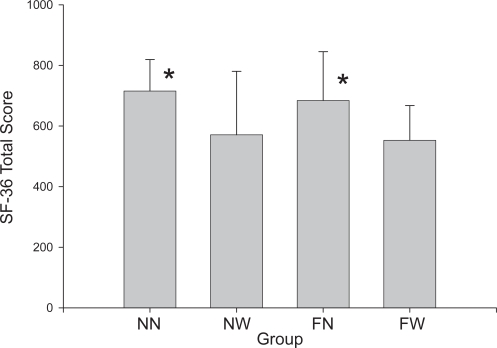
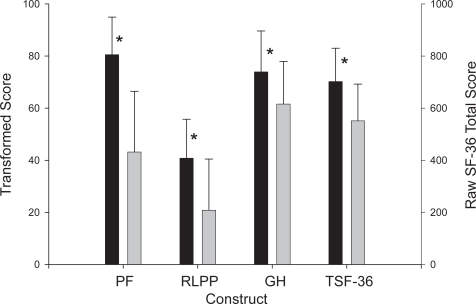
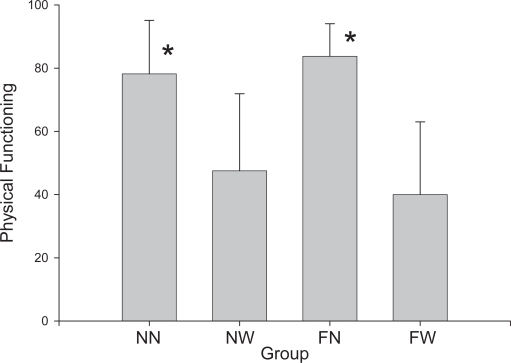
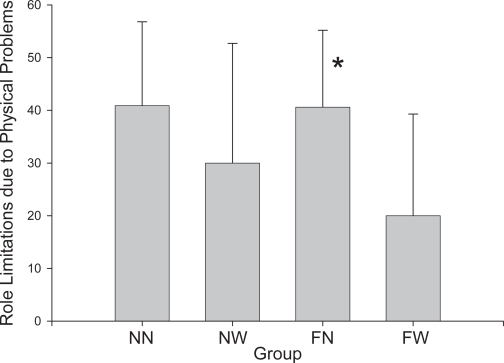
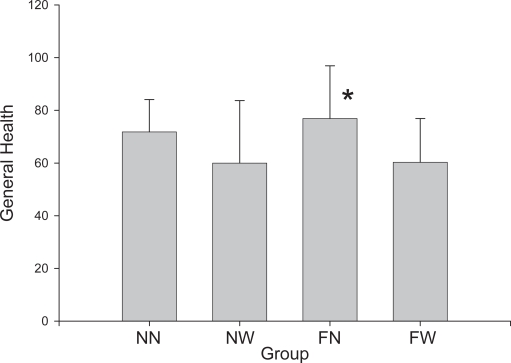
The relationship between perceived health and walker use has seldom been addressed. Concerns over falls and falls risk are precursors to walker use. We compared the SF-36 scores of 26 women and 14 men, mean age 86.8 +/- 6.0 years based on walker use and faller status. An analysis of covariance (ANCOVA) with age as the covariate, compared groups for the SF-36 constructs and totals score. Significant differences were noted between walker users and nonusers in physical functioning, role limitations due to physical problems, general health, and the total SF-36 score. Pairwise comparisons favored nonusers, while no differences were seen due to faller status. Walker use is associated with lower self-perceptions of physical functioning, role limitations due to physical problems, and general health in assisted-living residents. Faller status is not associated with self-perceived health status. Although walker use aids mobility and lowers the probability of falls, further research is needed to determine if the prescription of assistive devices has a more negative impact on self-perceived health than does falling. This possibility could be explained, in part, by the greater activity levels of those individuals who do not depend on walkers.
自我感知健康与助行器使用之间的关系鲜有研究涉及。对跌倒及跌倒风险的担忧是使用助行器的先兆。我们比较了26名女性和14名男性(平均年龄86.8±6.0岁)基于助行器使用情况和是否跌倒的SF-36评分。以年龄作为协变量进行协方差分析(ANCOVA),比较各小组的SF-36各项指标及总分。在身体功能、因身体问题导致的角色限制、总体健康状况以及SF-36总分方面,使用助行器者与未使用者之间存在显著差异。两两比较结果显示未使用者更具优势,而是否跌倒则未产生差异。在辅助生活设施的居民中,使用助行器与较低的身体功能自我认知、因身体问题导致的角色限制以及总体健康状况相关。是否跌倒与自我感知健康状况无关。尽管使用助行器有助于行动并降低跌倒概率,但仍需进一步研究以确定辅助器械的使用对自我感知健康的负面影响是否大于跌倒本身。这种可能性部分可以由那些不依赖助行器的个体具有更高的活动水平来解释。