Hofmann Stefan G
Department of Psychology, Boston University, Boston, MA 02215-2002, USA.
Cogn Behav Ther. 2007;36(4):193-209. doi: 10.1080/16506070701421313.
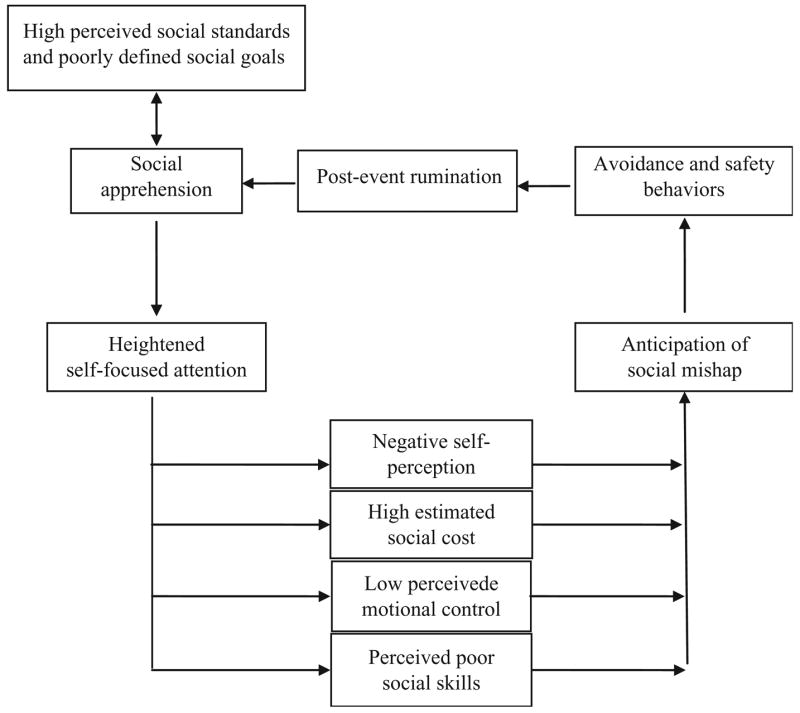
Social anxiety disorder (SAD) is a common, distressing and persistent mental illness. Recent studies have identified a number of psychological factors that could explain the maintenance of the disorder. These factors are presented here as part of a comprehensive psychological maintenance model of SAD. This model assumes that social apprehension is associated with unrealistic social standards and a deficiency in selecting attainable social goals. When confronted with challenging social situations, individuals with SAD shift their attention toward their anxiety, view themselves negatively as a social object, overestimate the negative consequences of a social encounter, believe that they have little control over their emotional response, and view their social skills as inadequate to effectively cope with the social situation. In order to avoid social mishaps, individuals with SAD revert to maladaptive coping strategies, including avoidance and safety behaviors, followed by post-event rumination, which leads to further social apprehension in the future. Possible disorder-specific intervention strategies are discussed.
社交焦虑障碍(SAD)是一种常见、令人痛苦且持续存在的精神疾病。最近的研究已经确定了一些可以解释该障碍持续存在的心理因素。这些因素在此作为社交焦虑障碍综合心理维持模型的一部分呈现。该模型假定社交忧虑与不切实际的社会标准以及在选择可实现的社会目标方面的不足有关。当面对具有挑战性的社交情境时,社交焦虑障碍患者会将注意力转向自己的焦虑情绪,消极地将自己视为一个社会客体,高估社交遭遇的负面后果,认为自己几乎无法控制自己的情绪反应,并认为自己的社交技能不足以有效应对社交情境。为了避免社交失误,社交焦虑障碍患者会采用适应不良的应对策略,包括回避和安全行为,随后是事后反复思考,这会导致未来进一步的社交忧虑。文中还讨论了可能针对该障碍的干预策略。