Cunninghame Graham Deborah S, Graham Robert R, Manku Harinder, Wong Andrew K, Whittaker John C, Gaffney Patrick M, Moser Kathy L, Rioux John D, Altshuler David, Behrens Timothy W, Vyse Timothy J
Section of Molecular Genetics and Rheumatology, Imperial College Faculty of Medicine, Hammersmith Hospital, Du Cane Road, London W12 0NN, UK.
Nat Genet. 2008 Jan;40(1):83-9. doi: 10.1038/ng.2007.47. Epub 2007 Dec 2.
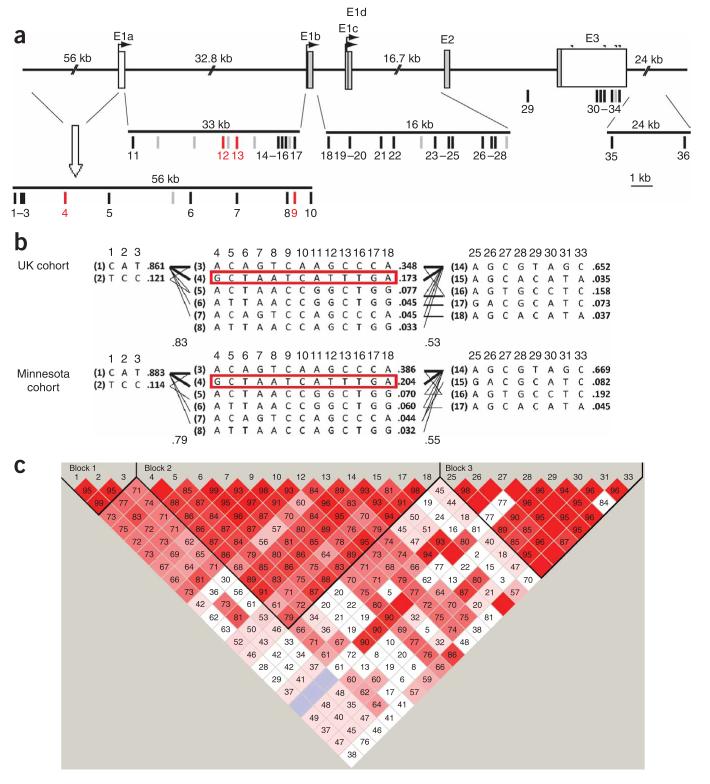
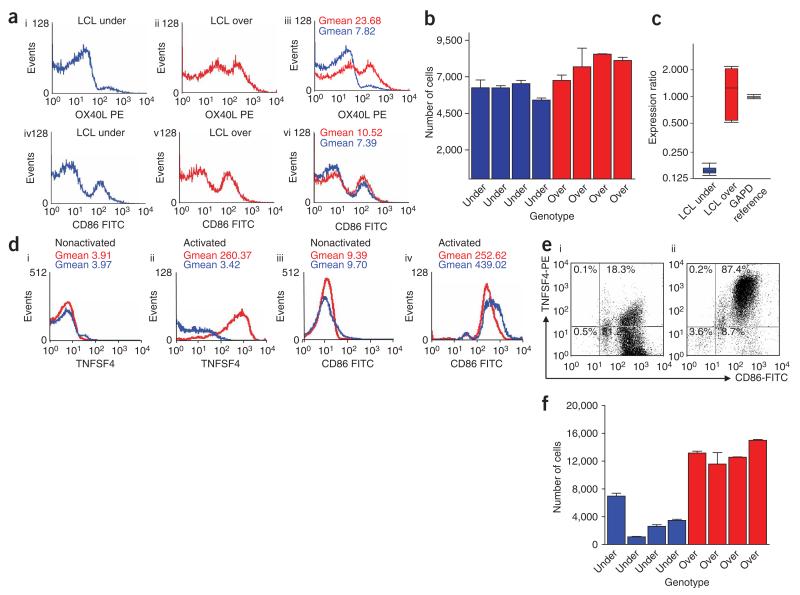
Systemic lupus erythematosus (SLE) is a multisystem complex autoimmune disease of uncertain etiology (OMIM 152700). Over recent years a genetic component to SLE susceptibility has been established. Recent successes with association studies in SLE have identified genes including IRF5 (refs. 4,5) and FCGR3B. Two tumor necrosis factor (TNF) superfamily members located within intervals showing genetic linkage with SLE are TNFSF4 (also known as OX40L; 1q25), which is expressed on activated antigen-presenting cells (APCs) and vascular endothelial cells, and also its unique receptor, TNFRSF4 (also known as OX40; 1p36), which is primarily expressed on activated CD4+ T cells. TNFSF4 produces a potent co-stimulatory signal for activated CD4+ T cells after engagement of TNFRSF4 (ref. 11). Using both a family-based and a case-control study design, we show that the upstream region of TNFSF4 contains a single risk haplotype for SLE, which is correlated with increased expression of both cell-surface TNFSF4 and the TNFSF4 transcript. We hypothesize that increased expression of TNFSF4 predisposes to SLE either by quantitatively augmenting T cell-APC interaction or by influencing the functional consequences of T cell activation via TNFRSF4.
系统性红斑狼疮(SLE)是一种病因不明的多系统复杂性自身免疫性疾病(OMIM 152700)。近年来,已确定SLE易感性存在遗传因素。SLE关联研究最近取得的成功已鉴定出包括IRF5(参考文献4,5)和FCGR3B在内的基因。位于与SLE存在遗传连锁的区间内的两个肿瘤坏死因子(TNF)超家族成员是TNFSF4(也称为OX40L;1q25),其在活化的抗原呈递细胞(APC)和血管内皮细胞上表达,以及其独特的受体TNFRSF4(也称为OX40;1p36),其主要在活化的CD4 + T细胞上表达。TNFSF4在与TNFRSF4结合后为活化的CD4 + T细胞产生强大的共刺激信号(参考文献11)。使用基于家系和病例对照的研究设计,我们表明TNFSF4的上游区域包含一个SLE的单一风险单倍型,其与细胞表面TNFSF4和TNFSF4转录物的表达增加相关。我们假设TNFSF4表达增加通过定量增强T细胞与APC的相互作用或通过影响经由TNFRSF4的T细胞活化的功能后果而使个体易患SLE。