Rawat Satinder S, Zimmerman Christina, Johnson Benitra T, Cho Edward, Lockett Stephen J, Blumenthal Robert, Puri Anu
CCRNP, NCI-Frederick, National Institutes of Health, Frederick, Maryland 21702-1201, USA.
Mol Membr Biol. 2008 Jan;25(1):83-94. doi: 10.1080/09687680701613713.
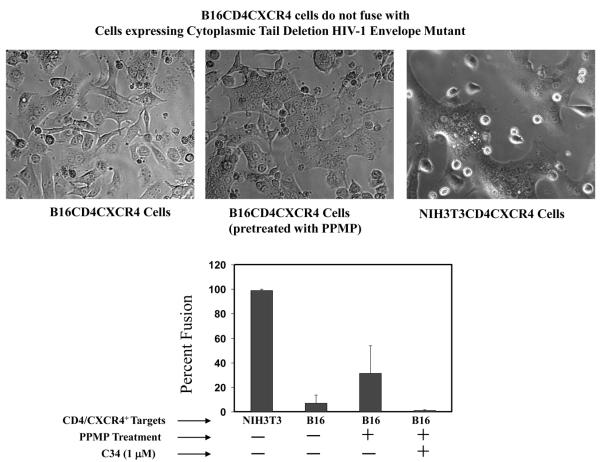
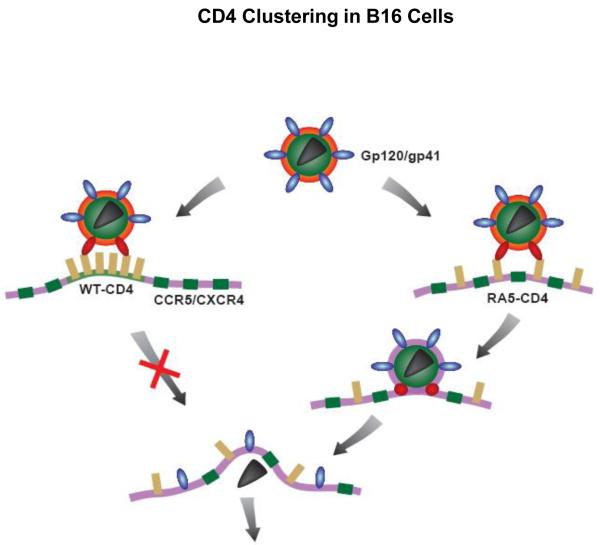
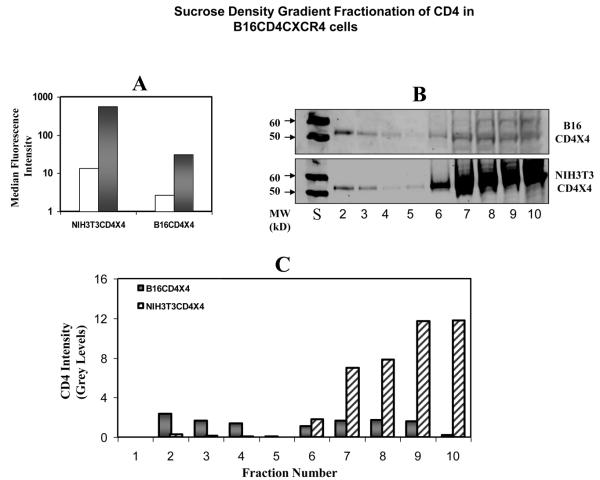
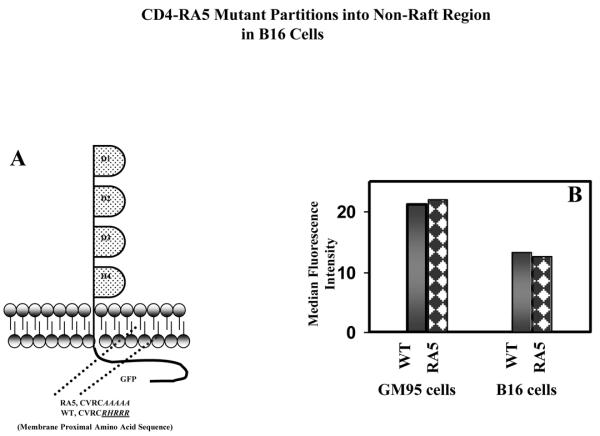
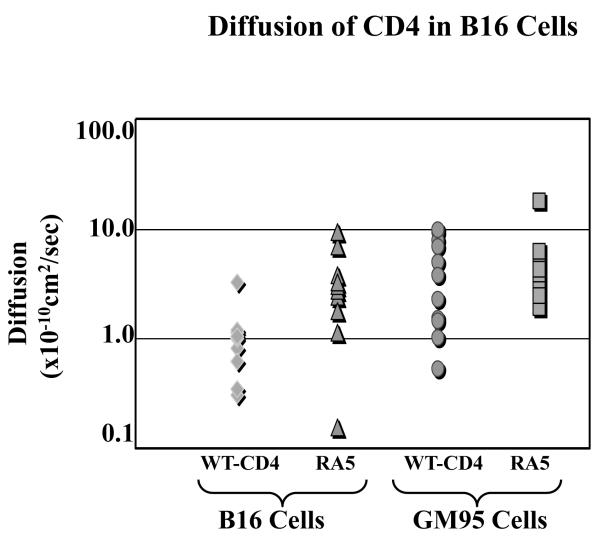
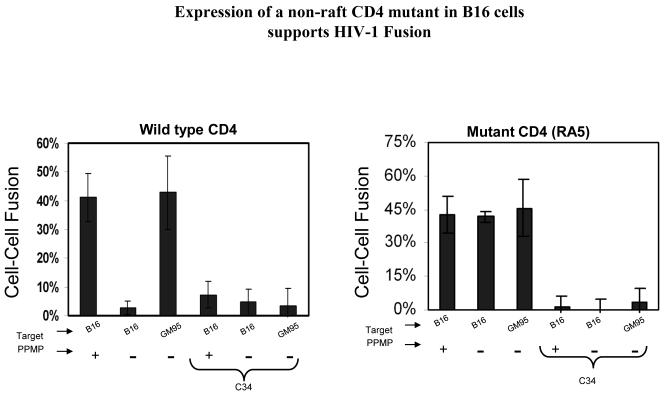
We investigated the effect of receptor mobility on HIV-1 envelope glycoprotein (Env)-triggered fusion using B16 mouse melanoma cells that are engineered to express CD4 and CXCR4 or CCR5. These engineered cells are resistant to fusion mediated CD4-dependent HIV-1 envelope glycoprotein. Receptor mobility was measured by fluorescence recovery after photobleaching (FRAP) using either fluorescently-labeled antibodies or transient expression of GFP-tagged receptors in the cells. No significant differences between B16 and NIH3T3 (fusion-permissive) cells were seen in lateral mobility of CCR5 or lipid probes. By contrast CD4 mobility in B16 cells was about seven-fold reduced compared to its mobility in fusion-permissive NIH3T3 cells. However, a CD4 mutant (RA5) that localizes to non-raft membrane microdomains exhibited a three-fold increased mobility in B16 cells as compared with WT-CD4. Interestingly, the B16 cells expressing the RA5 mutant (but not the wild type CD4) and coreceptors supported HIV-1 Env-mediated fusion. Our data demonstrate that the lateral mobility of CD4 is an important determinant of HIV-1 fusion/entry.
我们使用经过基因工程改造以表达CD4和CXCR4或CCR5的B16小鼠黑色素瘤细胞,研究了受体流动性对HIV-1包膜糖蛋白(Env)触发融合的影响。这些经过基因工程改造的细胞对融合介导的CD4依赖性HIV-1包膜糖蛋白具有抗性。通过使用荧光标记抗体或细胞中GFP标记受体的瞬时表达,通过光漂白后荧光恢复(FRAP)测量受体流动性。在CCR5或脂质探针的横向流动性方面,未观察到B16细胞与NIH3T3(融合许可)细胞之间存在显著差异。相比之下,B16细胞中CD4的流动性与其在融合许可的NIH3T3细胞中的流动性相比降低了约7倍。然而,定位于非脂筏膜微区的CD4突变体(RA5)在B16细胞中的流动性与野生型CD4相比增加了3倍。有趣的是,表达RA5突变体(而非野生型CD4)和共受体的B16细胞支持HIV-1 Env介导的融合。我们的数据表明,CD4的横向流动性是HIV-1融合/进入的重要决定因素。