Pulkrabová Jana, Hajslová Jana, Poustka Jan, Kazda Radek
Institute of Chemical Technology, Department of Food Chemistry and Analysis, Prague, Czech Republic.
Environ Health Perspect. 2007 Dec;115 Suppl 1(Suppl 1):28-34. doi: 10.1289/ehp.9354.
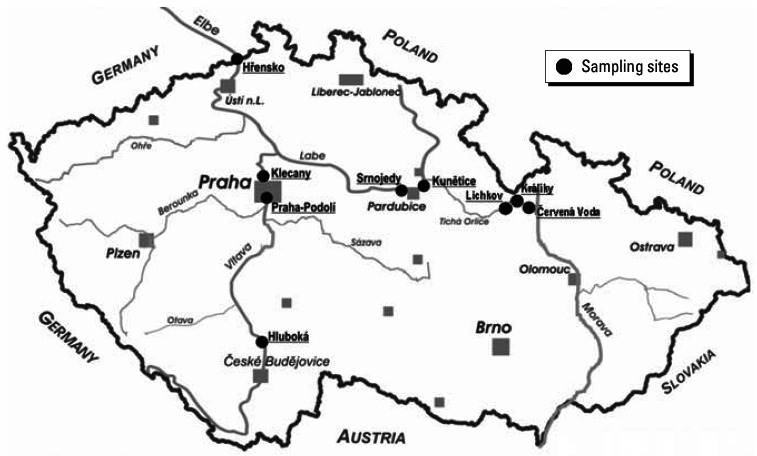
Brominated flame retardants (BFRs)--polybrominated diphenyl ethers (PBDEs) and hexabromocyclododecane (HBCD)--belong to the group of relatively "new" environmental contaminants. The occurrence of these compounds in the Czech aquatic ecosystem was for the first time documented within the 3-year monitoring study initiated in 2001. In 2002-2003 HBCD and the major PBDE congeners (28, 47, 49, 66, 85, 99, 100, 153, 154, and 183) were found in 136 freshwater fish samples collected from several sampling sites located at three Czech rivers (Vltava, Elbe, Tichá Orlice). Chub (Leuciscus cephalus), barbel (Barbus barbus), bream (Abramis brama), perch (Perca fluviatilis), and trout (Salmo trutta), representing the most common fish species, were examined by gas chromatography coupled with negative chemical ionization mass spectrometry.
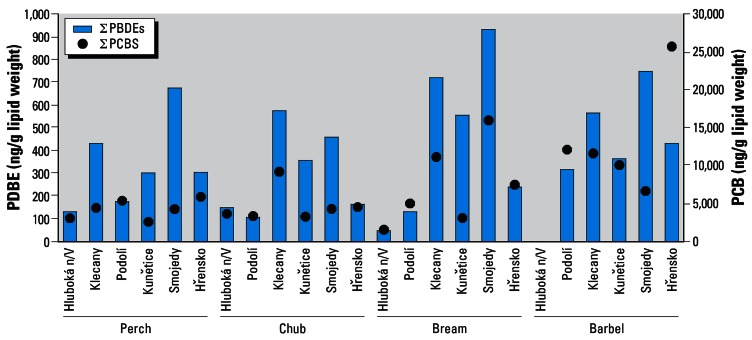
The presence of PBDE congeners and HBCD was detected in all analyzed samples (limits of detection for target analyts ranged from 0.015 to 0.1 ng/g lipid weight). Without exception the dominating congener was BDE-47. The most pronounced extent of fish contamination was found in the Vltava river at Klecany, downstream from the industrial agglomeration of Prague. As for fish species, the highest concentrations of PBDEs (sum of congeners) were measured in benthic species, represented by bream and barbel, up to 19.6 ng/g wet weight and 16.5 ng/g wet weight, respectively. The lowest accumulation occurred in predator fish (perch and trout). The highest levels of HBCD were detected in barbel from Srnojedy on the Elbe River (15.6 ng/g wet weight), downstream.
溴化阻燃剂(BFRs)——多溴二苯醚(PBDEs)和六溴环十二烷(HBCD)——属于相对“新型”的环境污染物。2001年启动的一项为期3年的监测研究首次记录了这些化合物在捷克水生生态系统中的存在情况。在2002年至2003年期间,从捷克三条河流(伏尔塔瓦河、易北河、蒂恰奥尔利采河)的多个采样点采集的136份淡水鱼样本中,检测到了HBCD和主要的PBDE同系物(28、47、49、66、85、99、100、153、154和183)。通过气相色谱-负化学电离质谱联用仪对代表最常见鱼类物种的鲢鱼(Leuciscus cephalus)、鲃鱼(Barbus barbus)、鲷鱼(Abramis brama)、鲈鱼(Perca fluviatilis)和鳟鱼(Salmo trutta)进行了检测。
在所有分析样本中均检测到了PBDE同系物和HBCD(目标分析物的检测限为0.015至0.1 ng/g脂重)。无一例外,占主导地位的同系物是BDE - 47。在布拉格工业集聚区下游的克莱卡尼的伏尔塔瓦河中,鱼类受污染程度最为明显。就鱼类物种而言,底栖物种(以鲷鱼和鲃鱼为代表)中测得的PBDEs(同系物总和)浓度最高,分别高达19.6 ng/g湿重和16.5 ng/g湿重。捕食性鱼类(鲈鱼和鳟鱼)中的积累量最低。在易北河斯特尔诺耶迪下游的鲃鱼中检测到的HBCD含量最高(15.6 ng/g湿重)。