Li Chuan-Yun, Mao Xizeng, Wei Liping
Center for Bioinformatics, National Laboratory of Protein Engineering and Plant Genetic Engineering, College of Life Sciences, Peking University, Beijing, People's Republic of China.
PLoS Comput Biol. 2008 Jan;4(1):e2. doi: 10.1371/journal.pcbi.0040002. Epub 2007 Nov 20.
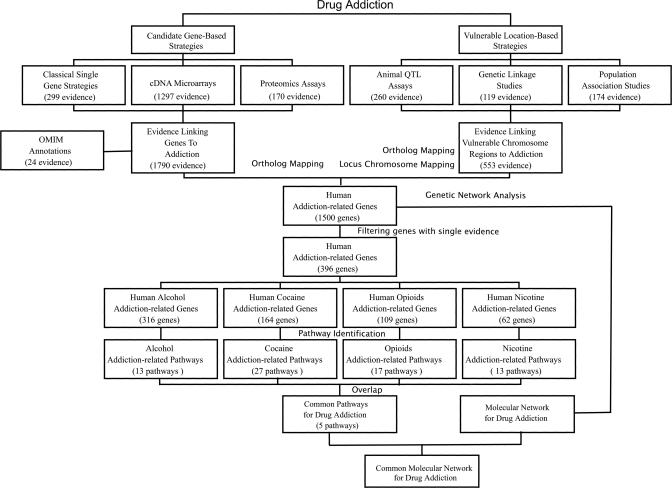
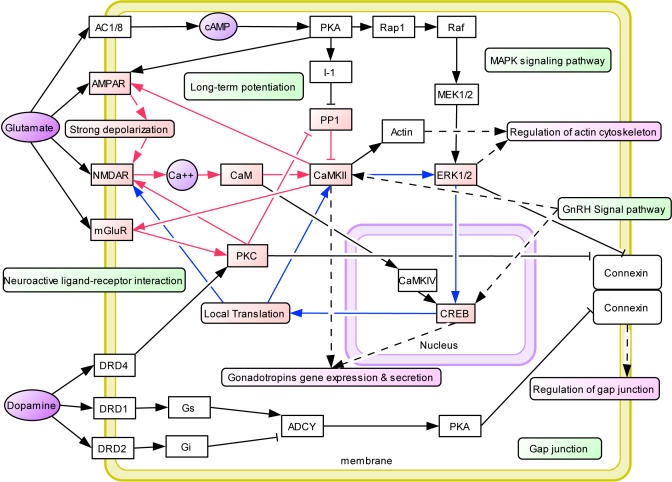
Drug addiction is a serious worldwide problem with strong genetic and environmental influences. Different technologies have revealed a variety of genes and pathways underlying addiction; however, each individual technology can be biased and incomplete. We integrated 2,343 items of evidence from peer-reviewed publications between 1976 and 2006 linking genes and chromosome regions to addiction by single-gene strategies, microrray, proteomics, or genetic studies. We identified 1,500 human addiction-related genes and developed KARG (http://karg.cbi.pku.edu.cn), the first molecular database for addiction-related genes with extensive annotations and a friendly Web interface. We then performed a meta-analysis of 396 genes that were supported by two or more independent items of evidence to identify 18 molecular pathways that were statistically significantly enriched, covering both upstream signaling events and downstream effects. Five molecular pathways significantly enriched for all four different types of addictive drugs were identified as common pathways which may underlie shared rewarding and addictive actions, including two new ones, GnRH signaling pathway and gap junction. We connected the common pathways into a hypothetical common molecular network for addiction. We observed that fast and slow positive feedback loops were interlinked through CAMKII, which may provide clues to explain some of the irreversible features of addiction.
药物成瘾是一个严重的全球性问题,受到强大的遗传和环境影响。不同的技术揭示了成瘾背后的各种基因和途径;然而,每种单独的技术都可能存在偏差且不完整。我们整合了1976年至2006年间同行评审出版物中的2343项证据,这些证据通过单基因策略、微阵列、蛋白质组学或基因研究将基因和染色体区域与成瘾联系起来。我们鉴定出1500个人类成瘾相关基因,并开发了KARG(http://karg.cbi.pku.edu.cn),这是首个具有广泛注释和友好网络界面的成瘾相关基因分子数据库。然后,我们对396个由两项或更多独立证据支持的基因进行了荟萃分析,以鉴定出18条在统计学上显著富集的分子途径,涵盖上游信号事件和下游效应。我们确定了五条对所有四种不同类型成瘾药物均显著富集的分子途径为共同途径,这些途径可能是共享奖赏和成瘾行为的基础,其中包括两条新途径,即促性腺激素释放激素信号通路和缝隙连接。我们将这些共同途径连接成一个成瘾的假设性共同分子网络。我们观察到快速和慢速正反馈回路通过钙/钙调蛋白依赖蛋白激酶II相互连接,这可能为解释成瘾的一些不可逆特征提供线索。