Huntley Brian, Collingham Yvonne C, Willis Stephen G, Green Rhys E
Institute of Ecosystem Science, School of Biological and Biomedical Sciences, Durham University, Durham, United Kingdom.
PLoS One. 2008 Jan 16;3(1):e1439. doi: 10.1371/journal.pone.0001439.
Climatic change is expected to lead to changes in species' geographical ranges. Adaptation strategies for biodiversity conservation require quantitative estimates of the magnitude, direction and rates of these potential changes. Such estimates are of greatest value when they are made for large ensembles of species and for extensive (sub-continental or continental) regions.
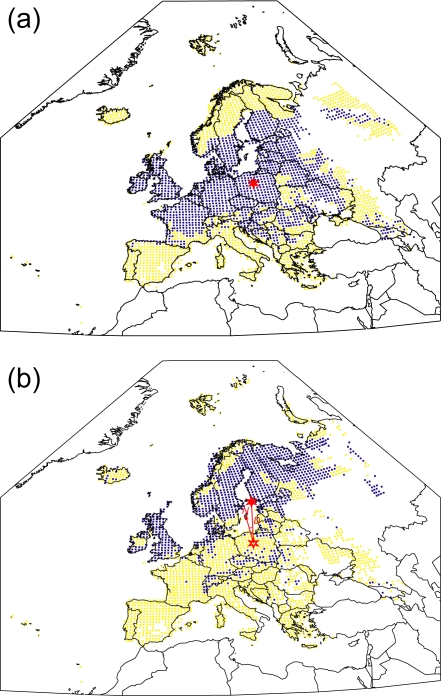
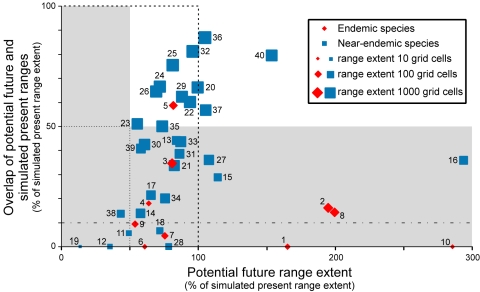
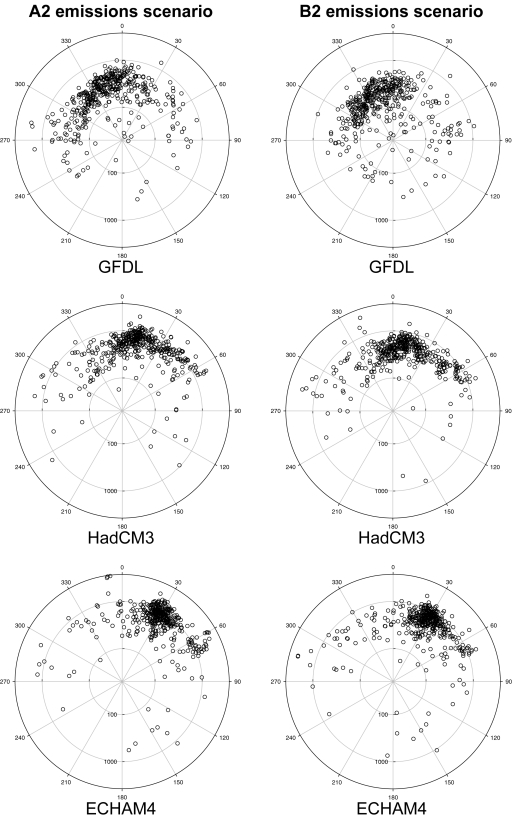
METHODOLOGY/PRINCIPAL FINDINGS: For six climate scenarios for 2070-99 changes have been estimated for 431 European breeding bird species using models relating species' distributions in Europe to climate. Mean range centroid potentially shifted 258-882 km in a direction between 341 degrees (NNW) and 45 degrees (NE), depending upon the climate scenario considered. Potential future range extent averaged 72-89% of the present range, and overlapped the present range by an average of 31-53% of the extent of the present range. Even if potential range changes were realised, the average number of species breeding per 50x50 km grid square would decrease by 6.8-23.2%. Many species endemic or near-endemic to Europe have little or no overlap between their present and potential future ranges; such species face an enhanced extinction risk as a consequence of climatic change.
CONCLUSIONS/SIGNIFICANCE: Although many human activities exert pressures upon wildlife, the magnitude of the potential impacts estimated for European breeding birds emphasises the importance of climatic change. The development of adaptation strategies for biodiversity conservation in the face of climatic change is an urgent need; such strategies must take into account quantitative evidence of potential climatic change impacts such as is presented here.
气候变化预计将导致物种地理分布范围的变化。生物多样性保护的适应策略需要对这些潜在变化的幅度、方向和速率进行定量估计。当对大量物种集合和广泛(次大陆或大陆)区域进行此类估计时,其价值最大。
方法/主要发现:利用将欧洲物种分布与气候相关联的模型,对2070 - 99年的六种气候情景下431种欧洲繁殖鸟类物种的变化进行了估计。平均分布中心可能会在341度(西北偏北)至45度(东北)之间的方向上移动258 - 882公里,这取决于所考虑的气候情景。未来潜在的分布范围平均为当前范围的72 - 89%,并且与当前范围的重叠部分平均为当前范围范围的31 - 53%。即使潜在的范围变化得以实现,每50×50公里网格方块内繁殖的物种平均数量也将减少6.8 - 23.2%。许多欧洲特有的或近乎特有的物种,其当前和未来潜在分布范围几乎没有重叠;因此,这些物种因气候变化而面临更高的灭绝风险。
结论/意义:尽管许多人类活动对野生动物施加了压力,但对欧洲繁殖鸟类估计的潜在影响程度突出了气候变化的重要性。面对气候变化制定生物多样性保护的适应策略迫在眉睫;此类策略必须考虑到诸如本文所呈现的潜在气候变化影响的定量证据。