• 文献检索
  • 文档翻译
  • 深度研究
  • 学术资讯
  • Suppr Zotero 插件Zotero 插件
  • 邀请有礼
  • 套餐&价格
  • 历史记录
应用&插件
Suppr Zotero 插件Zotero 插件浏览器插件Mac 客户端Windows 客户端微信小程序
定价
高级版会员购买积分包购买API积分包
服务
文献检索文档翻译深度研究API 文档MCP 服务
关于我们
关于 Suppr公司介绍联系我们用户协议隐私条款
关注我们

Suppr 超能文献

核心技术专利:CN118964589B侵权必究
粤ICP备2023148730 号-1Suppr @ 2026

文献检索

告别复杂PubMed语法,用中文像聊天一样搜索,搜遍4000万医学文献。AI智能推荐,让科研检索更轻松。

立即免费搜索

文件翻译

保留排版,准确专业,支持PDF/Word/PPT等文件格式,支持 12+语言互译。

免费翻译文档

深度研究

AI帮你快速写综述,25分钟生成高质量综述,智能提取关键信息,辅助科研写作。

立即免费体验

淋浴后血液中三卤甲烷水平的外源性和内源性决定因素。

Exogenous and endogenous determinants of blood trihalomethane levels after showering.

作者信息

Backer Lorraine C, Lan Qing, Blount Benjamin C, Nuckols J R, Branch Robert, Lyu Christopher W, Kieszak Stephanie M, Brinkman Marielle C, Gordon Sydney M, Flanders W Dana, Romkes Marjorie, Cantor Kenneth P

机构信息

National Center for Environmental Health, Centers for Disease Control and Prevention, Chamblee, GA 30341, USA.

出版信息

Environ Health Perspect. 2008 Jan;116(1):57-63. doi: 10.1289/ehp.10049.

DOI:10.1289/ehp.10049
PMID:18197300
原文链接:https://pmc.ncbi.nlm.nih.gov/articles/PMC2199304/
Abstract

BACKGROUND

We previously conducted a study to assess whether household exposures to tap water increased an individual's internal dose of trihalomethanes (THMs). Increases in blood THM levels among subjects who showered or bathed were variable, with increased levels tending to cluster in two groups.

OBJECTIVES

Our goal was to assess the importance of personal characteristics, previous exposures, genetic polymorphisms, and environmental exposures in determining THM concentrations in blood after showering.

METHODS

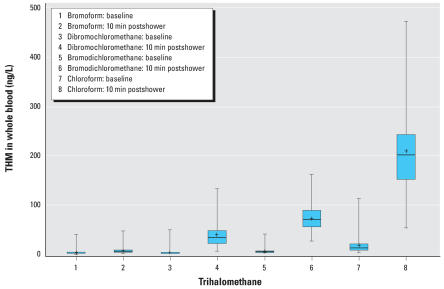
One hundred study participants completed a health symptom questionnaire, a 48-hr food and water consumption diary, and took a 10-min shower in a controlled setting. We examined THM levels in blood samples collected at baseline and 10 and 30 min after the shower. We assessed the significance of personal characteristics, previous exposures to THMs, and specific gene polymorphisms in predicting postshower blood THM concentrations.

RESULTS

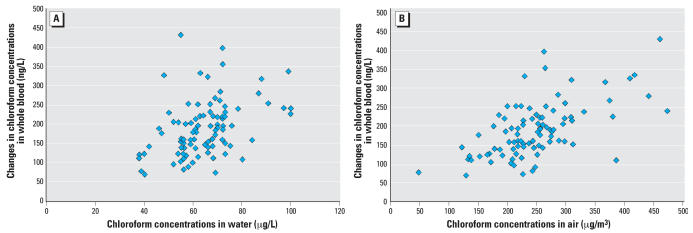
We did not observe the clustering of blood THM concentrations observed in our earlier study. We found that environmental THM concentrations were important predictors of blood THM concentrations immediately after showering. For example, the chloroform concentration in the shower stall air was the most important predictor of blood chloroform levels 10 min after the shower (p < 0.001). Personal characteristics, previous exposures to THMs, and specific polymorphisms in CYP2D6 and GSTT1 genes were significant predictors of both baseline and postshowering blood THM concentrations as well as of changes in THM concentrations associated with showering.

CONCLUSION

The inclusion of information about individual physiologic characteristics and environmental measurements would be valuable in future studies to assess human health effects from exposures to THMs in tap water.

摘要

背景

我们之前进行了一项研究,以评估家庭自来水中的接触是否会增加个体三卤甲烷(THMs)的体内剂量。淋浴或沐浴的受试者血液中THM水平的升高情况各不相同,升高水平倾向于聚集在两组。

目的

我们的目标是评估个人特征、既往接触情况、基因多态性和环境暴露在确定淋浴后血液中THM浓度方面的重要性。

方法

100名研究参与者完成了一份健康症状问卷、一份48小时的食物和水消耗日记,并在受控环境中进行了10分钟的淋浴。我们检测了在基线、淋浴后10分钟和30分钟采集的血液样本中的THM水平。我们评估了个人特征、既往THM接触情况和特定基因多态性在预测淋浴后血液THM浓度方面的意义。

结果

我们没有观察到早期研究中出现的血液THM浓度聚集现象。我们发现环境THM浓度是淋浴后立即血液THM浓度的重要预测因素。例如,淋浴间空气中的氯仿浓度是淋浴后10分钟血液氯仿水平的最重要预测因素(p < 0.001)。个人特征、既往THM接触情况以及CYP2D6和GSTT1基因的特定多态性是基线和淋浴后血液THM浓度以及与淋浴相关的THM浓度变化的重要预测因素。

结论

在未来评估自来水中THM暴露对人类健康影响的研究中,纳入个体生理特征和环境测量信息将是有价值的。
https://cdn.ncbi.nlm.nih.gov/pmc/blobs/949d/2199304/dd6798279ea2/ehp0116-000057f3.jpg
https://cdn.ncbi.nlm.nih.gov/pmc/blobs/949d/2199304/1dc0740b9817/ehp0116-000057f1.jpg
https://cdn.ncbi.nlm.nih.gov/pmc/blobs/949d/2199304/a4d177bc4e24/ehp0116-000057f2.jpg
https://cdn.ncbi.nlm.nih.gov/pmc/blobs/949d/2199304/dd6798279ea2/ehp0116-000057f3.jpg
https://cdn.ncbi.nlm.nih.gov/pmc/blobs/949d/2199304/1dc0740b9817/ehp0116-000057f1.jpg
https://cdn.ncbi.nlm.nih.gov/pmc/blobs/949d/2199304/a4d177bc4e24/ehp0116-000057f2.jpg
https://cdn.ncbi.nlm.nih.gov/pmc/blobs/949d/2199304/dd6798279ea2/ehp0116-000057f3.jpg

相似文献

1
Exogenous and endogenous determinants of blood trihalomethane levels after showering.淋浴后血液中三卤甲烷水平的外源性和内源性决定因素。
Environ Health Perspect. 2008 Jan;116(1):57-63. doi: 10.1289/ehp.10049.
2
Influence of tap water quality and household water use activities on indoor air and internal dose levels of trihalomethanes.自来水水质和家庭用水活动对室内空气中三卤甲烷含量及体内剂量水平的影响。
Environ Health Perspect. 2005 Jul;113(7):863-70. doi: 10.1289/ehp.7141.
3
Predictors of blood trihalomethane concentrations in NHANES 1999-2006.1999 - 2006年美国国家健康与营养检查调查中血液三卤甲烷浓度的预测因素
Environ Health Perspect. 2014 Jul;122(7):695-702. doi: 10.1289/ehp.1306499. Epub 2014 Mar 19.
4
Interactions between CYP2E1, GSTZ1 and GSTT1 polymorphisms and exposure to drinking water trihalomethanes and their association with semen quality.细胞色素P450 2E1(CYP2E1)、谷胱甘肽S-转移酶Zeta 1(GSTZ1)和谷胱甘肽S-转移酶Theta 1(GSTT1)基因多态性与饮用水中三卤甲烷暴露之间的相互作用及其与精液质量的关联。
Environ Res. 2016 May;147:445-52. doi: 10.1016/j.envres.2016.03.009. Epub 2016 Mar 10.
5
The influence of physicochemical properties on the internal dose of trihalomethanes in humans following a controlled showering exposure.在控制沐浴暴露后,物理化学性质对人体中三卤甲烷内剂量的影响。
J Expo Sci Environ Epidemiol. 2013 Jan-Feb;23(1):39-45. doi: 10.1038/jes.2012.80. Epub 2012 Jul 25.
6
Comparison of trihalomethanes in tap water and blood.自来水和血液中三卤甲烷的比较。
Environ Sci Technol. 2002 Apr 15;36(8):1692-8. doi: 10.1021/es001991j.
7
Patterns of water use and exposure to trihalomethanes among children in Spain.西班牙儿童的用水模式和三卤甲烷暴露情况。
Environ Res. 2010 Aug;110(6):571-9. doi: 10.1016/j.envres.2010.05.008. Epub 2010 Jun 15.
8
Changes in breath trihalomethane levels resulting from household water-use activities.家庭用水活动导致的呼吸性三卤甲烷水平变化。
Environ Health Perspect. 2006 Apr;114(4):514-21. doi: 10.1289/ehp.8171.
9
Multi-route trihalomethane exposure in households using municipal tap water treated with chlorine or ozone-chlorine.使用经氯或臭氧 - 氯处理的市政自来水的家庭中多途径三卤甲烷暴露情况。
Sci Total Environ. 2005 Mar 1;339(1-3):143-52. doi: 10.1016/j.scitotenv.2004.07.026.
10
Exposure assessment for trihalomethanes in municipal drinking water and risk reduction strategy.市政饮用水中三卤甲烷的暴露评估与降低风险策略。
Sci Total Environ. 2013 Oct 1;463-464:922-30. doi: 10.1016/j.scitotenv.2013.06.104. Epub 2013 Jul 19.

引用本文的文献

1
Exposure to Drinking Water Chlorination by-Products and Fetal Growth and Prematurity: A Nationwide Register-Based Prospective Study.饮用水氯化副产物暴露与胎儿生长和早产:一项全国范围内基于登记的前瞻性研究。
Environ Health Perspect. 2020 May;128(5):57006. doi: 10.1289/EHP6012. Epub 2020 May 18.
2
Maternal swimming pool exposure during pregnancy in relation to birth outcomes and cord blood DNA methylation among private well users.孕妇在怀孕期间接触母体游泳池与私人水井使用者的出生结局和脐带血 DNA 甲基化的关系。
Environ Int. 2019 Feb;123:459-466. doi: 10.1016/j.envint.2018.12.017. Epub 2019 Jan 5.
3
Prenatal exposure to drinking-water chlorination by-products, cytochrome P450 gene polymorphisms and small-for-gestational-age neonates.

本文引用的文献

1
Bladder cancer and exposure to water disinfection by-products through ingestion, bathing, showering, and swimming in pools.膀胱癌与通过摄入、沐浴、淋浴以及在泳池游泳接触水消毒副产物。
Am J Epidemiol. 2007 Jan 15;165(2):148-56. doi: 10.1093/aje/kwj364. Epub 2006 Nov 1.
2
Meta- and pooled analysis of GSTT1 and lung cancer: a HuGE-GSEC review.谷胱甘肽S-转移酶T1(GSTT1)与肺癌的Meta分析和汇总分析:一项HuGE-GSEC综述
Am J Epidemiol. 2006 Dec 1;164(11):1027-42. doi: 10.1093/aje/kwj321. Epub 2006 Sep 25.
3
Exposure to drinking water disinfection by-products and pregnancy loss.
产前暴露于饮用水氯化副产物、细胞色素 P450 基因多态性与小于胎龄儿。
Reprod Toxicol. 2017 Oct;73:75-86. doi: 10.1016/j.reprotox.2017.07.019. Epub 2017 Jul 31.
4
Birth Weight, Ethnicity, and Exposure to Trihalomethanes and Haloacetic Acids in Drinking Water during Pregnancy in the Born in Bradford Cohort.布拉德福德出生队列中出生体重、种族以及孕期饮用水中三卤甲烷和卤乙酸的暴露情况
Environ Health Perspect. 2016 May;124(5):681-9. doi: 10.1289/ehp.1409480. Epub 2015 Sep 4.
5
Blood Biomarkers of Late Pregnancy Exposure to Trihalomethanes in Drinking Water and Fetal Growth Measures and Gestational Age in a Chinese Cohort.中国队列中孕期晚期暴露于饮用水中三卤甲烷的血液生物标志物、胎儿生长指标和孕周
Environ Health Perspect. 2016 Apr;124(4):536-41. doi: 10.1289/ehp.1409234. Epub 2015 Aug 18.
6
Predictors of blood trihalomethane concentrations in NHANES 1999-2006.1999 - 2006年美国国家健康与营养检查调查中血液三卤甲烷浓度的预测因素
Environ Health Perspect. 2014 Jul;122(7):695-702. doi: 10.1289/ehp.1306499. Epub 2014 Mar 19.
7
Comparison of trihalomethanes in tap water and blood: a case study in the United States.自来水中和血液中的三卤甲烷比较:美国案例研究。
Environ Health Perspect. 2012 May;120(5):661-7. doi: 10.1289/ehp.1104347. Epub 2012 Jan 26.
8
Genotoxic effects in swimmers exposed to disinfection by-products in indoor swimming pools.游泳者在室内游泳池接触到消毒副产物时的遗传毒性影响。
Environ Health Perspect. 2010 Nov;118(11):1531-7. doi: 10.1289/ehp.1001959.
接触饮用水消毒副产物与流产
Am J Epidemiol. 2006 Dec 1;164(11):1043-51. doi: 10.1093/aje/kwj300. Epub 2006 Sep 6.
4
Changes in breath trihalomethane levels resulting from household water-use activities.家庭用水活动导致的呼吸性三卤甲烷水平变化。
Environ Health Perspect. 2006 Apr;114(4):514-21. doi: 10.1289/ehp.8171.
5
Assessment of lifetime exposure to trihalomethanes through different routes.评估通过不同途径终生接触三卤甲烷的情况。
Occup Environ Med. 2006 Apr;63(4):273-7. doi: 10.1136/oem.2005.023069.
6
Influence of tap water quality and household water use activities on indoor air and internal dose levels of trihalomethanes.自来水水质和家庭用水活动对室内空气中三卤甲烷含量及体内剂量水平的影响。
Environ Health Perspect. 2005 Jul;113(7):863-70. doi: 10.1289/ehp.7141.
7
When is baseline adjustment useful in analyses of change? An example with education and cognitive change.在变化分析中,基线调整何时有用?以教育与认知变化为例。
Am J Epidemiol. 2005 Aug 1;162(3):267-78. doi: 10.1093/aje/kwi187. Epub 2005 Jun 29.
8
Measurement of trihalomethanes and methyl tert-butyl ether in whole blood using gas chromatography with high-resolution mass spectrometry.使用气相色谱-高分辨率质谱法测定全血中的三卤甲烷和甲基叔丁基醚。
J Anal Toxicol. 2005 Mar;29(2):81-9. doi: 10.1093/jat/29.2.81.
9
Dermal uptake of chloroform and haloketones during bathing.沐浴期间氯仿和卤代酮的皮肤吸收。
J Expo Anal Environ Epidemiol. 2005 Jul;15(4):289-96. doi: 10.1038/sj.jea.7500404.
10
Drinking water contaminants, gene polymorphisms, and fetal growth.饮用水污染物、基因多态性与胎儿生长
Environ Health Perspect. 2004 Aug;112(11):1213-6. doi: 10.1289/ehp.7003.