Larsson Per-Göran, Stray-Pedersen Babill, Ryttig Kjeld R, Larsen Stig
Department of Obstetrics and Gynaecology, Kärnsjukhuset, SE-541 85 Skövde, Sweden.
BMC Womens Health. 2008 Jan 15;8:3. doi: 10.1186/1472-6874-8-3.
The primary objective of this study was to investigate if supplementary lactobacilli treatment could improve the initial cure rate after vaginal clindamycin therapy, and secondly, if lactobacilli as repeated adjunct treatment during 3 menstrual cycles could lengthen the time to relapse after initial cure.
Women (n = 100) with bacterial vaginosis diagnosed by Amsel criteria were after informed consent offered vaginal clindamycin therapy followed by vaginal gelatine capsules containing either 109 freeze-dried lactobacilli or identical placebo capsules for 10 days during 3 menstrual cycles in a double-blind, randomized, placebo-controlled trial.
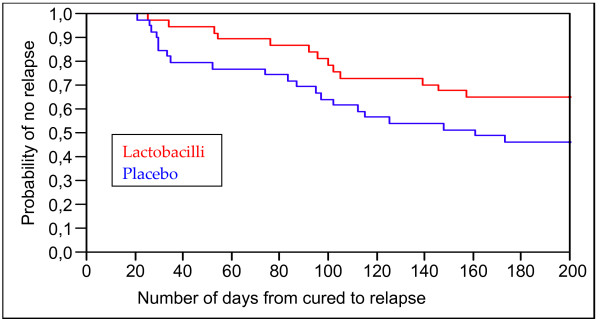
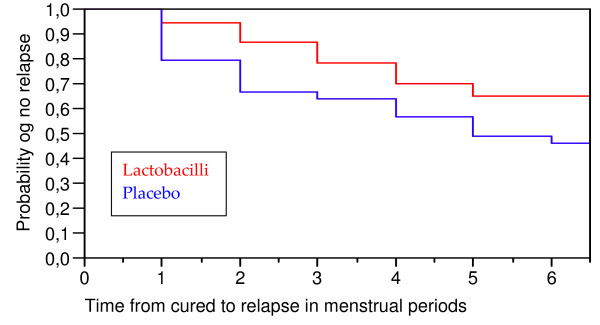
The initial intent to treat (ITT) analysis for the one-month cure rate was 64% in the lactobacilli group and 78% in the placebo group (p > 0.05). However, any patient with missing or unclassified smears at the initial visit who continued the study and whose next smear indicated a cure was included in the cured group; the study also excluded two of the patients in the lactobacilli group who reported that they did not take any vaginal capsules. With consideration to these population changes, the initial cure rate would be 77% in the lactobacilli group. The 76 cured women were followed for 6 menstrual cycles or until relapse within that time span. At the end of the study, 64.9% (24/37) of the lactobacilli treated women were still BV-free compared to 46.2% (18/39) of the placebo treated women. Comparison of the two groups regarding "Time from cure to relapse" was statistically significant (p = 0.027) in favour of the lactobacilli treatment. Adjuvant therapy with lactobacilli contributed significantly to avoidance of relapse with a proportional Hazard Risk ratio (HR) of 0.73 (0.54-0.98) (p < 0.05)
The study shows that supplementary treatment combining two different strains of probiotic lactobacilli does not improve the efficacy of BV therapy during the first month of treatment, but for women initially cured, adjunct treatment of lactobacilli during 3 menstrual cycles lengthens the time to relapse significantly in that more women remained BV free at the end of the 6-month follow up.
ISRCTN62879834.
本研究的主要目的是调查补充乳酸杆菌治疗是否能提高阴道克林霉素治疗后的初始治愈率,其次,乳酸杆菌作为三个月经周期的重复辅助治疗是否能延长初始治愈后的复发时间。
在一项双盲、随机、安慰剂对照试验中,100名根据阿姆塞尔标准诊断为细菌性阴道病的女性在签署知情同意书后接受阴道克林霉素治疗,随后在三个月经周期内的10天里,分别给予含有10⁹冻干乳酸杆菌的阴道明胶胶囊或相同的安慰剂胶囊。
乳酸杆菌组的初始意向性治疗(ITT)分析显示,一个月治愈率为64%,安慰剂组为78%(p>0.05)。然而,任何在初次就诊时涂片缺失或未分类但继续参与研究且下次涂片显示治愈的患者都被纳入治愈组;该研究还排除了乳酸杆菌组中两名报告未服用任何阴道胶囊的患者。考虑到这些人群变化,乳酸杆菌组的初始治愈率将为77%。对76名治愈的女性进行了6个月经周期的随访,或直至在此期间复发。在研究结束时,接受乳酸杆菌治疗的女性中有64.9%(24/37)仍无细菌性阴道病,而接受安慰剂治疗的女性中这一比例为46.2%(18/39)。两组在“从治愈到复发的时间”方面的比较具有统计学意义(p = 0.027),支持乳酸杆菌治疗。乳酸杆菌辅助治疗对避免复发有显著贡献,比例风险比(HR)为0.73(0.54 - 0.98)(p < 0.05)
该研究表明,联合两种不同益生菌乳酸杆菌的补充治疗在治疗的第一个月内不会提高细菌性阴道病治疗的疗效,但对于最初治愈的女性,在三个月经周期内进行乳酸杆菌辅助治疗可显著延长复发时间,因为在6个月随访结束时更多女性仍无细菌性阴道病。试验注册号:ISRCTN62879834。