Roseman Ashley S, Kasckow John, Fellows Ian, Osatuke Katerine, Patterson Thomas L, Mohamed Somaia, Zisook Sidney
University of Texas MD Anderson Cancer Center, Houston, TX 77230-1439, USA.
Int J Geriatr Psychiatry. 2008 Jul;23(7):760-5. doi: 10.1002/gps.1978.
The quality of life (QOL) for individuals with schizophrenia is determined by a number of factors, not limited to symptomatology. The current study examined lack of insight as one such factor that may influence subjective QOL or functional capacity. It was hypothesized that insight would significantly interact with symptom severity to influence subjective QOL. Insight was not expected to influence the relation between symptom severity and functional capacity.
Participants were middle-aged and older outpatients who met diagnostic criteria for schizophrenia or schizoaffective disorder, and subsyndromal depression. Insight, psychopathology, and subjective QOL were assessed via semi-structured interviews and functional capacity was assessed via performance-based measures.
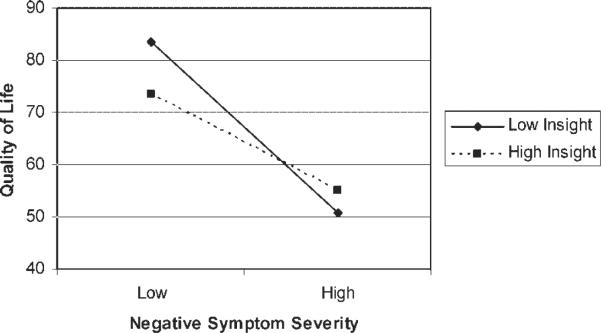
Insight interacts with negative symptom severity to predict subjective QOL. Severity of negative symptoms and insight contribute directly to functional capacity.
Individuals with intact insight may be better able to manage their symptoms, resulting in improved QOL. Treatment implications for improving the QOL of middle age and older adults with schizophrenia are discussed.
精神分裂症患者的生活质量(QOL)由多种因素决定,不限于症状学。本研究考察自知力缺失这一可能影响主观生活质量或功能能力的因素。研究假设自知力会与症状严重程度显著相互作用,从而影响主观生活质量。自知力预计不会影响症状严重程度与功能能力之间的关系。
参与者为符合精神分裂症或分裂情感性障碍及亚综合征抑郁诊断标准的中老年门诊患者。通过半结构化访谈评估自知力、精神病理学和主观生活质量,并通过基于表现的测量方法评估功能能力。
自知力与阴性症状严重程度相互作用,以预测主观生活质量。阴性症状的严重程度和自知力直接影响功能能力。
自知力完整的个体可能更有能力管理自身症状,从而改善生活质量。本文讨论了改善中老年精神分裂症患者生活质量的治疗意义。