Schweitzer Frank, Mach Robert
Systems Design, ETH Zurich, Zurich, Switzerland.
PLoS One. 2008 Jan 23;3(1):e1458. doi: 10.1371/journal.pone.0001458.
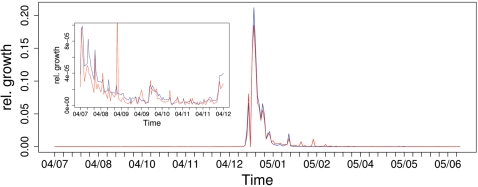
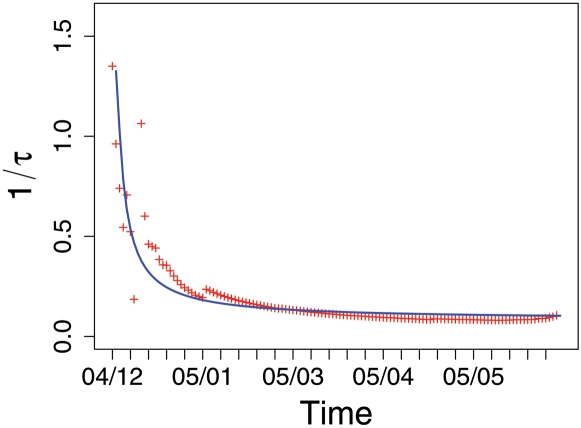
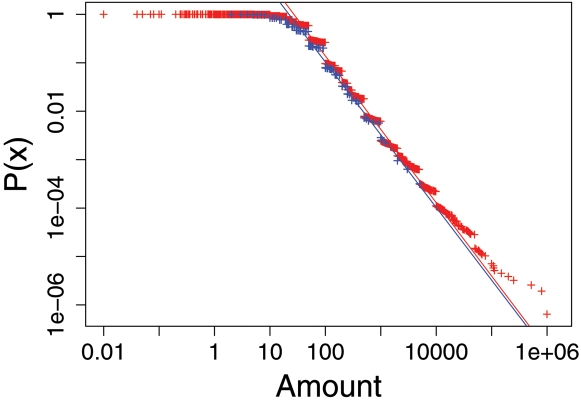
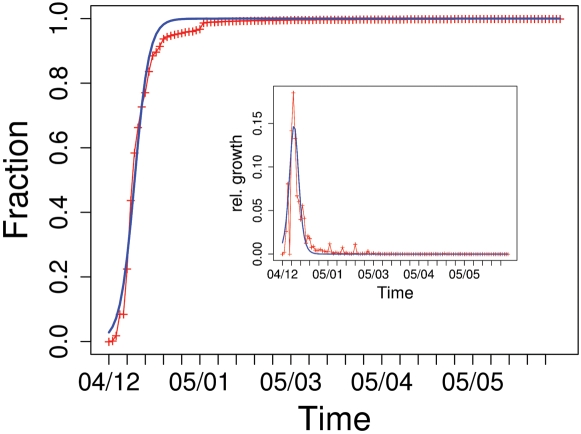
This paper demonstrates that collective social dynamics resulting from individual donations can be well described by an epidemic model. It captures the herding behavior in donations as a non-local interaction between individual via a time-dependent mean field representing the mass media. Our study is based on the statistical analysis of a unique dataset obtained before and after the tsunami disaster of 2004. We find a power-law behavior for the distributions of donations with similar exponents for different countries. Even more remarkably, we show that these exponents are the same before and after the tsunami, which accounts for some kind of universal behavior in donations independent of the actual event. We further show that the time-dependent change of both the number and the total amount of donations after the tsunami follows a logistic growth equation. As a new element, a time-dependent scaling factor appears in this equation which accounts for the growing lack of public interest after the disaster. The results of the model are underpinned by the data analysis and thus also allow for a quantification of the media influence.
本文表明,个体捐赠所产生的集体社会动态可以用一种流行病模型很好地描述。它将捐赠中的羊群行为捕捉为个体之间通过代表大众媒体的随时间变化的平均场进行的非局部相互作用。我们的研究基于对2004年海啸灾难前后获得的独特数据集的统计分析。我们发现不同国家捐赠分布具有幂律行为且指数相似。更值得注意的是,我们表明这些指数在海啸前后是相同的,这说明了捐赠中某种独立于实际事件的普遍行为。我们进一步表明,海啸后捐赠数量和总额随时间的变化遵循逻辑增长方程。作为一个新元素,该方程中出现了一个随时间变化的缩放因子,它解释了灾难后公众兴趣日益缺乏的情况。模型结果得到了数据分析的支持,因此也能够对媒体影响进行量化。