Centre for Phytochemistry and Pharmacology, Southern Cross University, Lismore NSW 2480, Australia and Shanxi Provincial People's Hospital, Taiyuan, Shanxi 030012, China.
Evid Based Complement Alternat Med. 2007 Dec;4(4):425-30. doi: 10.1093/ecam/nel091.
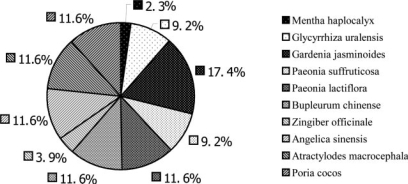
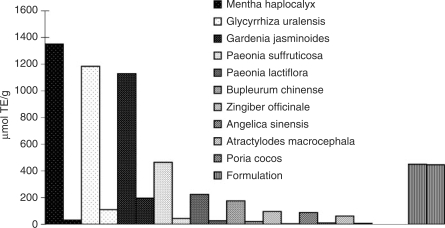
Danzhixiaoyao Wan (DW) is a common 10 herbs formulation in China for regulating several clinical conditions affecting women. This research tried to explain one of DW's functions, purging heat, using in vitro pharmacological analyses. The whole formulation and each single herb of DW were compared based on antioxidant activity with the oxygen radical absorbance capacity (ORAC) assay, and for their inhibitory effect (IE) on nitric oxide (NO) production by lipopolysaccharide (LPS)-activated RAW 264.7 macrophages with the Griess assay. The results showed that DW as a whole formulation had both antioxidant activity and an IE on NO production, while the individual herb component of DW varied in their ORAC values and inhibition of NO production. The ORAC value of the whole DW was 450 mumol TE g(-1). The order of antioxidant (ORAC) activity of the single herbs was: Mentha haplocalyx (1352 mumol TE g(-1)) > Glycyrrhiza uralensis (1184 mumol TE g(-1)) > Gardenia jasminoides (1129 mumol TE g(-1)) > Paeonia suffruticosa (465 mumol TE g(-1)), with the contributions being additive rather than synergistic. The production of nitrite by stimulated RAW 264.7 murine macrophages (unstimulated: 0.5 +/- 0.1 muM versus LPS: 38.9 +/- 2.3 muM) was significantly inhibited (P < 0.05) by M. haplocalyx, G. jasminoides, Bupleurum chinense and Paeonia lactiflora. DW as a whole had an IE on NO production, but this was not significant. The single herb M. haplocalyx had the highest ORAC value and the highest IE on NO production, followed by G. jasminoides. Both of these herbs have the 'purging heat' property in the theory of traditional Chinese medicine and this property of the samples may be correlated with the antioxidant activity and IE on NO production.
丹栀逍遥丸(DW)是一种常用的 10 种草药配方,用于调节影响女性的几种临床病症。本研究试图通过体外药理分析来解释 DW 的一种功能,即清热。通过氧自由基吸收能力(ORAC)测定法比较了整个配方和 DW 的每一种单味草药的抗氧化活性,并通过格里斯测定法比较了它们对脂多糖(LPS)激活的 RAW 264.7 巨噬细胞产生一氧化氮(NO)的抑制作用(IE)。结果表明,DW 作为一个整体配方具有抗氧化活性和对 NO 产生的抑制作用,而 DW 的个别草药成分在 ORAC 值和对 NO 产生的抑制作用方面存在差异。整个 DW 的 ORAC 值为 450 mumol TE g(-1)。单味草药的抗氧化(ORAC)活性顺序为:薄荷(Mentha haplocalyx)(1352 mumol TE g(-1))>甘草(Glycyrrhiza uralensis)(1184 mumol TE g(-1))>栀子(Gardenia jasminoides)(1129 mumol TE g(-1))>牡丹(Paeonia suffruticosa)(465 mumol TE g(-1)),其贡献是相加而不是协同的。刺激的 RAW 264.7 鼠巨噬细胞(未刺激:0.5 +/- 0.1 muM 与 LPS:38.9 +/- 2.3 muM)产生的亚硝酸盐产量明显受到抑制(P < 0.05)薄荷、栀子、柴胡和白芍。DW 作为一个整体对 NO 产生具有抑制作用,但这并不显著。单味药薄荷具有最高的 ORAC 值和对 NO 产生的最高抑制作用,其次是栀子。这两种草药在中国传统医学理论中都具有“清热”的特性,而这些样品的特性可能与抗氧化活性和对 NO 产生的抑制作用有关。