Liao Hui
Department of Pharmacy, Shanxi Provincial People's Hospital, 29 Shuangtasi Street, Taiyuan, Shanxi 030012, China.
Evid Based Complement Alternat Med. 2015;2015:828156. doi: 10.1155/2015/828156. Epub 2015 Mar 18.
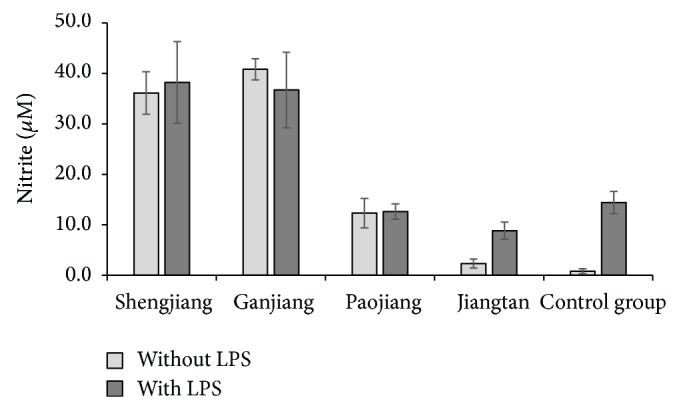
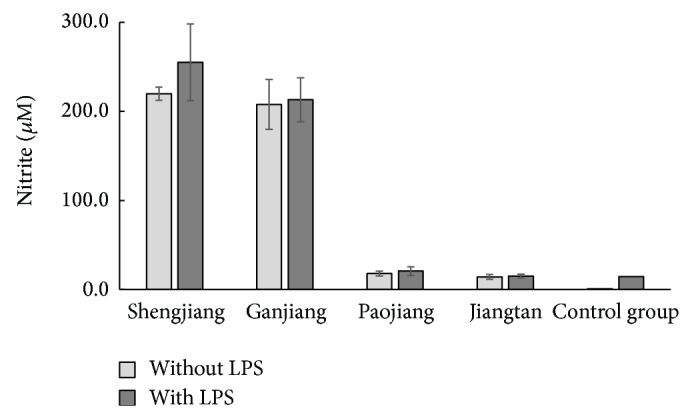
In Chinese medicine, Shengjiang (Zingiberis Rhizoma Recens) and its processed products, such as Ganjiang (Zingiberis Rhizoma), Paojiang (Zingiberis Rhizoma Preparatum), and Jiangtan (Zingiberis Rhizoma Carbonisata), exert distinct efficacy clinically. This research tried to study the effects of extracts from Shengjiang and its processed products in RAW 264.7 macrophage cells. After incubation of the different ginger types in RAW 264.7 cells for 24 h, an aliquot of the culture was mixed with an equal volume of Griess reagent, and nitric oxide (NO) production was evaluated using a Griess assay. Lipopolysaccharide (LPS) was used as the positive control. Milli-Q water (MQW) was used as the solvent control. The results showed that NO production increased significantly in RAW 264.7 cells following the stimulation of LPS (0.05 μg mL(-1)), Shengjiang, Ganjiang, Paojiang, and Jiangtan (50 μg mL(-1), 500 μg mL(-1)) separately compared with the MQW control (P < 0.01). The stimulation effects of Shengjiang and Ganjiang were significantly higher than those of Paojiang and Jiangtan at different concentrations (P < 0.01). The conclusion we could get from this research is that Shengjiang and its processed products could induce NO production in RAW 264.7 cells.
在中医中,生姜及其炮制品,如干姜、炮姜和姜炭,在临床上具有不同的功效。本研究试图探讨生姜及其炮制品提取物对RAW 264.7巨噬细胞的影响。将不同类型的生姜在RAW 264.7细胞中孵育24小时后,取一份培养物与等体积的格里斯试剂混合,使用格里斯法评估一氧化氮(NO)的产生。脂多糖(LPS)用作阳性对照。超纯水(MQW)用作溶剂对照。结果表明,与MQW对照相比,LPS(0.05μg mL(-1))、生姜、干姜、炮姜和姜炭(50μg mL(-1)、500μg mL(-1))分别刺激RAW 264.7细胞后,NO产生显著增加(P < 0.01)。在不同浓度下,生姜和干姜的刺激作用显著高于炮姜和姜炭(P < 0.01)。从本研究中我们可以得出的结论是,生姜及其炮制品可诱导RAW 264.7细胞产生NO。