Zeba Augustin N, Sorgho Hermann, Rouamba Noël, Zongo Issiaka, Rouamba Jeremie, Guiguemdé Robert T, Hamer Davidson H, Mokhtar Najat, Ouedraogo Jean-Bosco
Institut de recherche en sciences de la santé (IRSS), Bobo Dioulasso, Burkina Faso.
Nutr J. 2008 Jan 31;7:7. doi: 10.1186/1475-2891-7-7.
Vitamin A and zinc are crucial for normal immune function, and may play a synergistic role for reducing the risk of infection including malaria caused by Plasmodium falciparum.
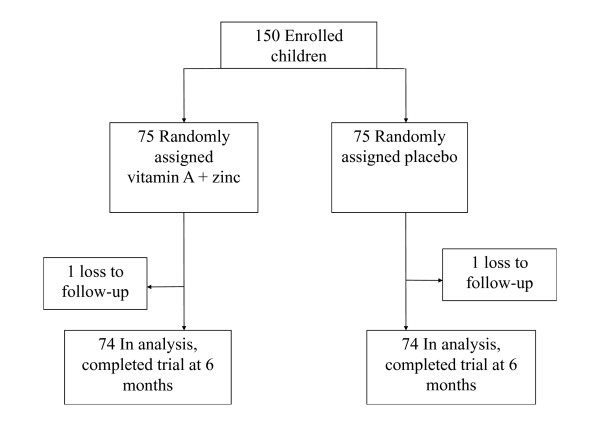
A randomized, double-blind, placebo-controlled trial of a single dose of 200 000 IU of vitamin A with daily zinc supplementation was done in children of Sourkoudougou village, Burkina Faso. Children aged from 6 to 72 months were randomized to receive a single dose of 200 000 IU of vitamin A plus 10 mg elemental zinc, six days a week (n = 74) or placebo (n = 74) for a period of six months. Cross-sectional surveys were conducted at the beginning and the end of the study, and children were evaluated daily for fever. Microscopic examination of blood smear was done in the case of fever (temperature > or =37.5 degrees C) for malaria parasite detection.
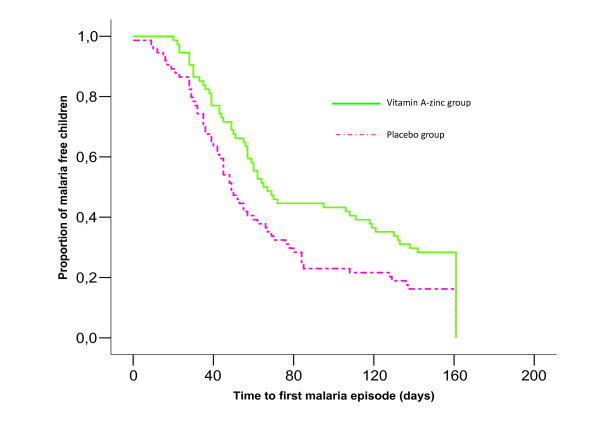
At the end of the study we observed a significant decrease in the prevalence malaria in the supplemented group (34%) compared to the placebo group (3.5%) (p < 0.001). Malaria episodes were lower in the supplemented group (p = 0.029), with a 30.2% reduction of malaria cases (p = 0.025). Time to first malaria episode was longer in the supplemented group (p = 0.015). The supplemented group also had 22% fewer fever episodes than the placebo group (p = 0.030).
These results suggest that combined vitamin A plus zinc supplementation reduces the risk of fever and clinical malaria episodes among children, and thus may play a key role in malaria control strategies for children in Africa.
维生素A和锌对正常免疫功能至关重要,可能在降低包括恶性疟原虫引起的疟疾在内的感染风险方面发挥协同作用。
在布基纳法索苏尔库杜古村的儿童中进行了一项随机、双盲、安慰剂对照试验,给予单剂量20万国际单位维生素A并每日补充锌。6至72个月大的儿童被随机分为两组,一组每周六天接受单剂量20万国际单位维生素A加10毫克元素锌(n = 74),另一组接受安慰剂(n = 74),为期六个月。在研究开始和结束时进行横断面调查,每天对儿童进行发热评估。发热(体温≥37.5摄氏度)时进行血涂片显微镜检查以检测疟原虫。
在研究结束时,我们观察到补充组的疟疾患病率(34%)与安慰剂组(3.5%)相比显著降低(p < 0.001)。补充组的疟疾发作次数较少(p = 0.029),疟疾病例减少30.2%(p = 0.025)。补充组首次疟疾发作的时间更长(p = 0.015)。补充组的发热发作次数也比安慰剂组少22%(p = 0.030)。
这些结果表明,联合补充维生素A和锌可降低儿童发热和临床疟疾发作的风险,因此可能在非洲儿童疟疾控制策略中发挥关键作用。