Qureshi Nadeem, Kai Joe
Division of Primary Care, School of Graduate Entry Medicine and Health, University of Nottingham, Derby City General Hospital, Uttoxeter Road, Derby, DE22 3DT, UK.
BMC Health Serv Res. 2008 Feb 7;8:37. doi: 10.1186/1472-6963-8-37.
A strong family history of type 2 diabetes mellitus (DM) confers increased DM risk. This survey analysis determined whether patients who were informed by their doctors of familial DM risk acknowledged that risk and took steps to reduce it.
We conducted an analysis of the National Health Styles 2004 mail survey. All non-diabetic participants who responded to the question of whether their doctor had or had not informed them of their familial DM risk (n = 3,323) were compared for their risk-reducing behaviour and attitude to DM risk.
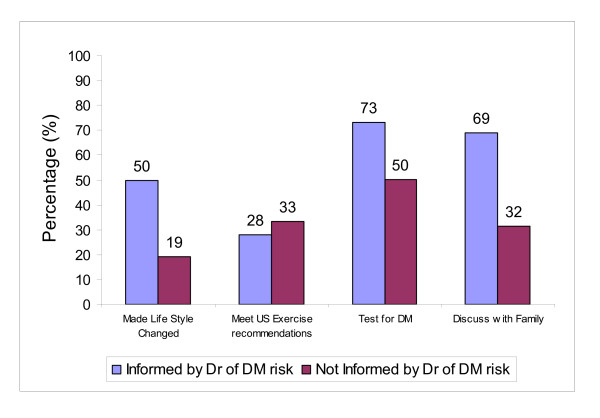
Forty-one percent (n = 616) of the question responders that had DM family histories were informed by their doctors of their familial risk; the chance of being informed increased with the number of relatives that had the disease. Members of the informed group were more likely than those in the non-informed group to report lifestyle changes to prevent DM (odds ratio [OR] 4.3, 95% confidence interval [CI] 3.5-5.2) and being tested for DM (OR 2.9, 95% CI 2.4-3.6), although no significant improvement occurred in their U.S.-recommended exercise activity (OR 0.9, 95% CI 0.7-1.1). Overall, informed responders recognised both their familial and personal DM risk; most discussed diabetes with their family (69%), though less so with friends (42%); however, 44% of them still did not consider themselves to be at risk.
Responders who were informed by their doctors of being at familial DM risk reported greater incidences of lifestyle changes, DM screening, and awareness of risk than non-informed responders. Doctors were more likely to inform patients with stronger DM family histories. Identifying this higher risk group, either in isolation or in combination with other recognised risk factors, offers doctors the opportunity to target limited health promotion resources efficiently for primary DM prevention.
2型糖尿病(DM)的家族病史强烈会增加患糖尿病的风险。本次调查分析确定了那些被医生告知有家族性糖尿病风险的患者是否承认这种风险并采取措施降低风险。
我们对2004年全国健康状况邮件调查进行了分析。比较了所有回答医生是否告知其家族性糖尿病风险问题的非糖尿病参与者(n = 3323)的降低风险行为和对糖尿病风险的态度。
有糖尿病家族史的问题回答者中,41%(n = 616)被医生告知了家族风险;被告知的可能性随着患该病亲属的数量增加而增加。与未被告知组相比,被告知组更有可能报告为预防糖尿病而改变生活方式(优势比[OR] 4.3,95%置信区间[CI] 3.5 - 5.2)以及接受糖尿病检测(OR 2.9,95% CI 2.4 - 3.6),尽管他们在美国推荐的体育活动方面没有显著改善(OR 0.9,95% CI 0.7 - 1.1)。总体而言,被告知的回答者认识到他们的家族性和个人糖尿病风险;大多数人与家人讨论过糖尿病(69%),但与朋友讨论的较少(42%);然而,其中44%的人仍然不认为自己有风险。
被医生告知有家族性糖尿病风险的回答者报告的生活方式改变、糖尿病筛查和风险意识的发生率高于未被告知的回答者。医生更有可能告知糖尿病家族病史更强的患者。识别这个高风险群体,无论是单独识别还是与其他公认的风险因素结合识别,都为医生提供了一个机会,以便有效地将有限的健康促进资源用于原发性糖尿病预防。