Van Rompaey Bart, Schuurmans Marieke J, Shortridge-Baggett Lillie M, Truijen Steven, Elseviers Monique, Bossaert Leo
University of Antwerp, Faculty of Medicine, Division of Nursing Science and Midwifery, Belgium, Universiteitsplein 1, 2610 Wilrijk, Belgium.
Crit Care. 2008;12(1):R16. doi: 10.1186/cc6790. Epub 2008 Feb 18.
Several reports indicate a high incidence of intensive care delirium. To develop strategies to prevent this complication, validated instruments are needed. The Confusion Assessment Method for the Intensive Care Unit (CAM-ICU) is widely used. A binary result diagnoses delirium. The Neelon and Champagne (NEECHAM) Confusion Scale recently has been validated for use in the ICU and has a numeric assessment. This scale allows the patients to be classified in four categories: non-delirious, at risk, confused, and delirious. In this study, we investigated the results of the NEECHAM scale in comparison with the CAM-ICU.
A consecutive sample of 172 non-intubated patients in a mixed ICU was assessed after a stay in the ICU for at least 24 hours. All adult patients with a Glasgow Coma Scale score of greater than 9 were included. A nurse researcher simultaneously assessed both scales once daily in the morning. A total of 599 paired observations were made.
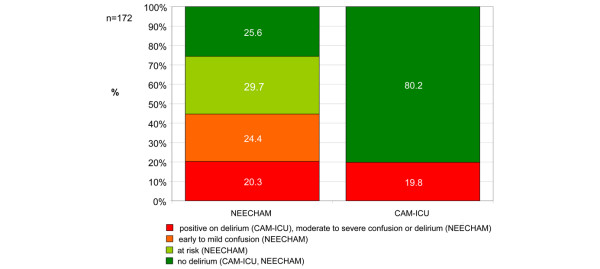
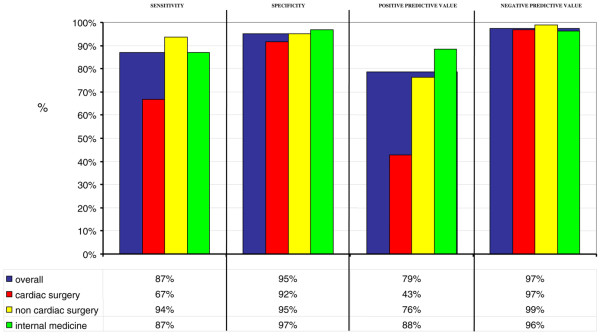
The CAM-ICU showed a 19.8% incidence of delirium. The NEECHAM scale detected incidence rates of 20.3% for delirious, 24.4% for confused, 29.7% for at risk, and 25.6% for normal patients. The majority of the positive CAM-ICU patients were detected by the NEECHAM scale. The sensitivity of the NEECHAM scale was 87% and the specificity was 95%. The positive predictive value and the negative predictive value were 79% and 97%, respectively. The diagnostic capability in cardiac surgery patients proved to be lower than in other patients.
In non-intubated patients, the NEECHAM scale identified most cases of delirium which were detected by the CAM-ICU. Additional confused patients were identified in the categorical approach of the scale. The NEECHAM scale proved to be a valuable screening tool compared with the CAM-ICU in the early detection of intensive care delirium by nurses.
多项报告指出重症监护病房谵妄的发生率很高。为制定预防该并发症的策略,需要经过验证的工具。重症监护病房意识模糊评估法(CAM-ICU)被广泛使用。其二元结果可诊断谵妄。尼隆和香槟(NEECHAM)意识模糊量表最近已被验证可用于重症监护病房,并采用数字评估。该量表可将患者分为四类:无谵妄、有风险、意识模糊和谵妄。在本研究中,我们调查了NEECHAM量表与CAM-ICU相比的结果。
对一家综合性重症监护病房中172例非插管患者进行连续抽样,这些患者在重症监护病房至少停留24小时后接受评估。纳入所有格拉斯哥昏迷量表评分大于9分的成年患者。一名护士研究人员每天上午同时对两个量表进行一次评估。共进行了599次配对观察。
CAM-ICU显示谵妄发生率为19.8%。NEECHAM量表检测到谵妄患者的发生率为20.3%,意识模糊患者为24.4%,有风险患者为29.7%,正常患者为25.6%。大多数CAM-ICU阳性患者被NEECHAM量表检测到。NEECHAM量表的敏感性为87%,特异性为95%。阳性预测值和阴性预测值分别为79%和97%。事实证明,心脏手术患者的诊断能力低于其他患者。
在非插管患者中,NEECHAM量表识别出了大多数被CAM-ICU检测到的谵妄病例。该量表的分类方法还识别出了更多意识模糊的患者。与CAM-ICU相比,NEECHAM量表在护士早期发现重症监护病房谵妄方面被证明是一种有价值的筛查工具。