Ryberg Martin, Nilsson R Henrik, Kristiansson Erik, Töpel Mats, Jacobsson Stig, Larsson Ellen
Department of Plant and Environmental Sciences, Göteborg University, Box 461, 405 30 Göteborg, Sweden.
BMC Evol Biol. 2008 Feb 18;8:50. doi: 10.1186/1471-2148-8-50.
The lack of reference sequences from well-identified mycorrhizal fungi often poses a challenge to the inference of taxonomic affiliation of sequences from environmental samples, and many environmental sequences are thus left unidentified. Such unidentified sequences belonging to the widely distributed ectomycorrhizal fungal genus Inocybe (Basidiomycota) were retrieved from GenBank and divided into species that were identified in a phylogenetic context using a reference dataset from an ongoing study of the genus. The sequence metadata of the unidentified Inocybe sequences stored in GenBank, as well as data from the corresponding original papers, were compiled and used to explore the ecology and distribution of the genus. In addition, the relative occurrence of Inocybe was contrasted to that of other mycorrhizal genera.
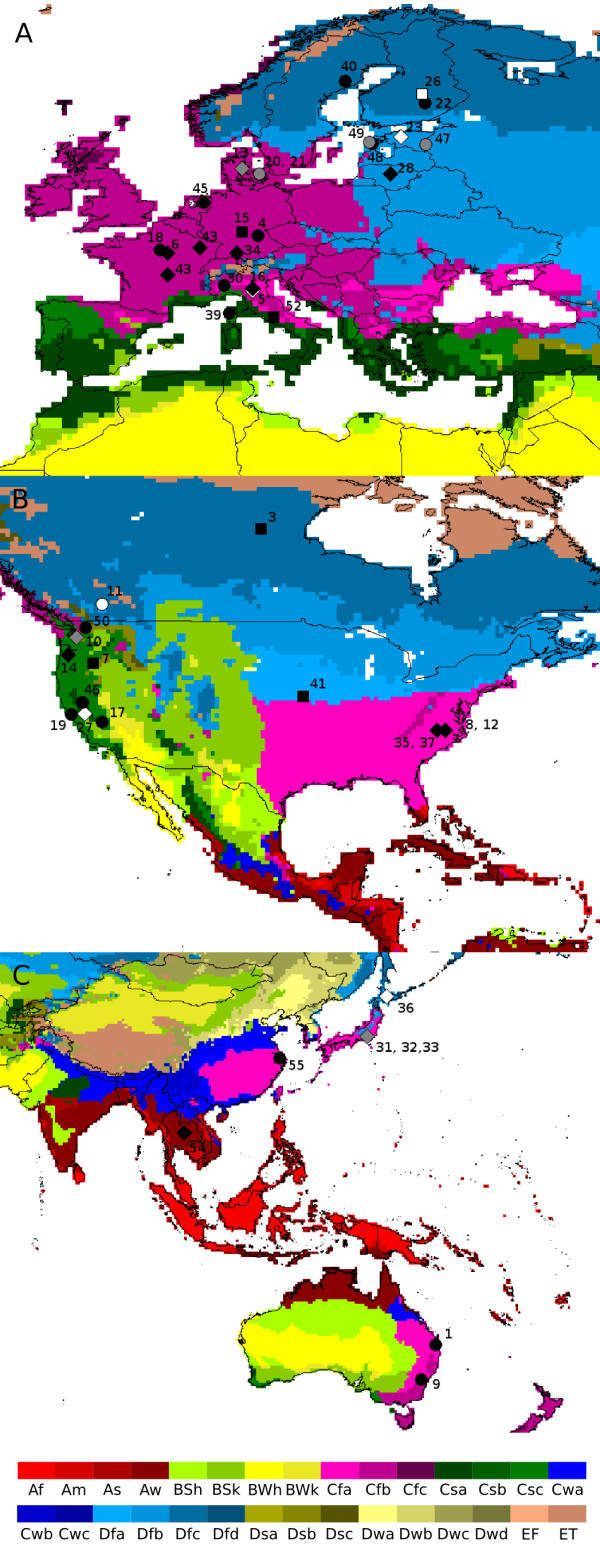
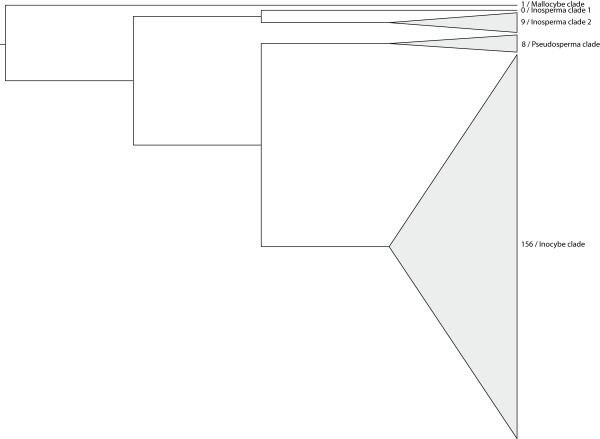
Most species of Inocybe were found to have less than 3% intraspecific variability in the ITS2 region of the nuclear ribosomal DNA. This cut-off value was used jointly with phylogenetic analysis to delimit and identify unidentified Inocybe sequences to species level. A total of 177 unidentified Inocybe ITS sequences corresponding to 98 species were recovered, 32% of which were successfully identified to species level in this study. These sequences account for an unexpectedly large proportion of the publicly available unidentified fungal ITS sequences when compared with other mycorrhizal genera. Eight Inocybe species were reported from multiple hosts and some even from hosts forming arbutoid or orchid mycorrhizae. Furthermore, Inocybe sequences have been reported from four continents and in climate zones ranging from cold temperate to equatorial climate. Out of the 19 species found in more than one study, six were found in both Europe and North America and one was found in both Europe and Japan, indicating that at least many north temperate species have a wide distribution.
Although DNA-based species identification and circumscription are associated with practical and conceptual difficulties, they also offer new possibilities and avenues for research. Metadata assembly holds great potential to synthesize valuable information from community studies for use in a species and taxonomy-oriented framework.
缺乏来自明确鉴定的菌根真菌的参考序列常常给从环境样本中推断序列的分类归属带来挑战,因此许多环境序列仍未得到鉴定。从GenBank中检索出属于广泛分布的外生菌根真菌类脐菇属(担子菌门)的此类未鉴定序列,并使用来自该属正在进行的一项研究的参考数据集,在系统发育背景下将其划分为已鉴定的物种。整理了GenBank中存储的未鉴定脐菇属序列的序列元数据以及来自相应原始论文的数据,并用于探索该属的生态和分布。此外,将脐菇属的相对出现情况与其他菌根属进行了对比。
发现大多数脐菇属物种在核糖体DNA的ITS2区域内种内变异性小于3%。该截止值与系统发育分析一起用于将未鉴定的脐菇属序列界定并鉴定到物种水平。共回收了177条对应于98个物种的未鉴定脐菇属ITS序列,其中32%在本研究中成功鉴定到物种水平。与其他菌根属相比,这些序列在公开可用的未鉴定真菌ITS序列中占比出人意料地大。有8种脐菇属物种被报道存在于多种宿主上,有些甚至存在于形成石楠状或兰花菌根的宿主上。此外,已在四大洲以及从寒温带至赤道气候的气候带中报道了脐菇属序列。在不止一项研究中发现的19个物种中,有6个在欧洲和北美均有发现,1个在欧洲和日本均有发现,这表明至少许多北温带物种分布广泛。
尽管基于DNA的物种鉴定和界定存在实际和概念上的困难,但它们也为研究提供了新的可能性和途径。元数据组装在从群落研究中合成有价值的信息以用于物种和分类学导向的框架方面具有巨大潜力。