Sodhi Navjot S, Bickford David, Diesmos Arvin C, Lee Tien Ming, Koh Lian Pin, Brook Barry W, Sekercioglu Cagan H, Bradshaw Corey J A
Department of Biological Sciences, National University of Singapore, Singapore, Singapore.
PLoS One. 2008 Feb 20;3(2):e1636. doi: 10.1371/journal.pone.0001636.
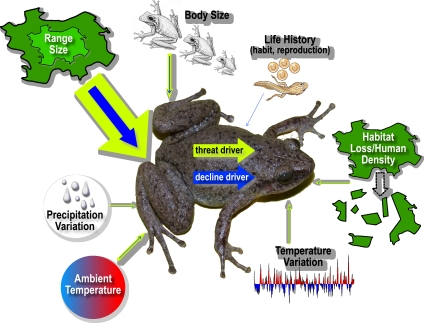
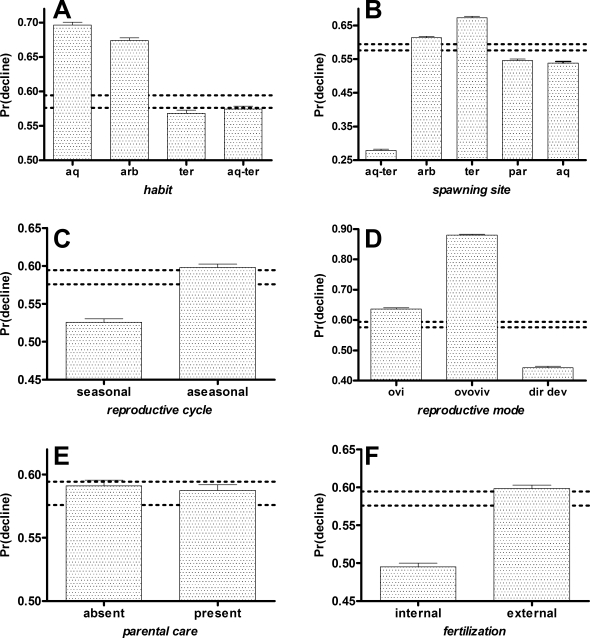
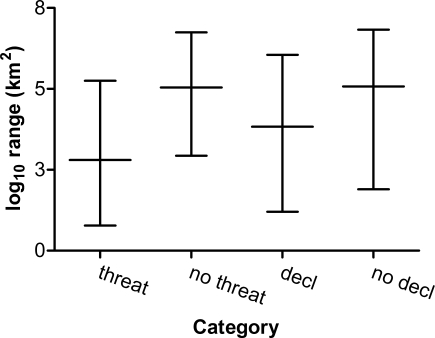
Habitat loss, climate change, over-exploitation, disease and other factors have been hypothesised in the global decline of amphibian biodiversity. However, the relative importance of and synergies among different drivers are still poorly understood. We present the largest global analysis of roughly 45% of known amphibians (2,583 species) to quantify the influences of life history, climate, human density and habitat loss on declines and extinction risk. Multi-model Bayesian inference reveals that large amphibian species with small geographic range and pronounced seasonality in temperature and precipitation are most likely to be Red-Listed by IUCN. Elevated habitat loss and human densities are also correlated with high threat risk. Range size, habitat loss and more extreme seasonality in precipitation contributed to decline risk in the 2,454 species that declined between 1980 and 2004, compared to species that were stable (n = 1,545) or had increased (n = 28). These empirical results show that amphibian species with restricted ranges should be urgently targeted for conservation.
栖息地丧失、气候变化、过度开发、疾病及其他因素被认为是导致全球两栖动物生物多样性下降的原因。然而,不同驱动因素的相对重要性及其协同作用仍未得到充分了解。我们对约45%的已知两栖动物(2583种)进行了全球范围内最大规模的分析,以量化生活史、气候、人类密度和栖息地丧失对两栖动物数量下降和灭绝风险的影响。多模型贝叶斯推断表明,地理分布范围小、温度和降水季节性明显的大型两栖动物最有可能被列入世界自然保护联盟(IUCN)的红色名录。栖息地丧失加剧和人类密度增加也与高威胁风险相关。与数量稳定(n = 1545)或增加(n = 28)的物种相比,在1980年至2004年间数量下降的2454个物种中,分布范围大小、栖息地丧失以及降水季节性更强是导致数量下降风险的因素。这些实证结果表明,分布范围有限的两栖动物物种应成为紧急保护目标。