Kalueff Allan V, Murphy Dennis L
Laboratory of Clinical Science, National Institute of Mental Health, Bethesda, MD 20892-1264, USA.
Neural Plast. 2007;2007:52087. doi: 10.1155/2007/52087.
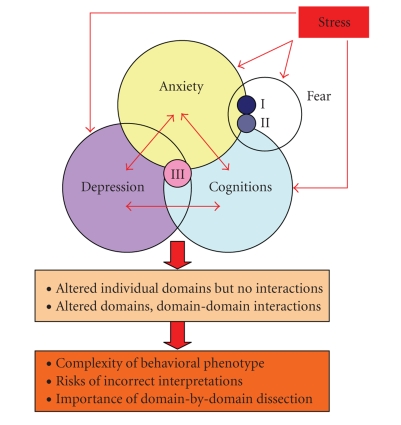
Cognitive dysfunctions are commonly seen in many stress-related disorders, including anxiety and depression-the world's most common neuropsychiatric illnesses. Various genetic, pharmacological, and behavioral animal models have long been used to establish animal anxiety-like and depression-like phenotypes, as well as to assess their memory, learning, and other cognitive functions. Mounting clinical and animal evidences strongly supports the notion that disturbed cognitions represent an important pathogenetic factor in anxiety and depression, and may also play a role in integrating the two disorders within a common stress-precipitated developmental pathway. This paper evaluates why and how the assessment of cognitive and emotional domains may improve our understanding of animal behaviors via different high-throughput tests and enable a better translation of animal phenotypes into human brain disorders.
认知功能障碍在许多与应激相关的疾病中很常见,包括焦虑症和抑郁症——世界上最常见的神经精神疾病。长期以来,各种遗传、药理学和行为学动物模型一直被用于建立动物的焦虑样和抑郁样表型,以及评估它们的记忆、学习和其他认知功能。越来越多的临床和动物证据有力地支持了这样一种观点,即认知障碍是焦虑症和抑郁症的一个重要致病因素,并且可能在将这两种疾病整合到一个共同的应激诱发的发展途径中也发挥作用。本文评估了为什么以及如何通过不同的高通量测试来评估认知和情感领域,可能会增进我们对动物行为的理解,并使动物表型更好地转化为人类脑部疾病。