Institute of Medical Psychology and Behavioral Neurobiology, University of Tübingen, Gartenstr. 29, 72074 Tübingen, Germany.
Comput Intell Neurosci. 2007;2007:82069. doi: 10.1155/2007/82069.
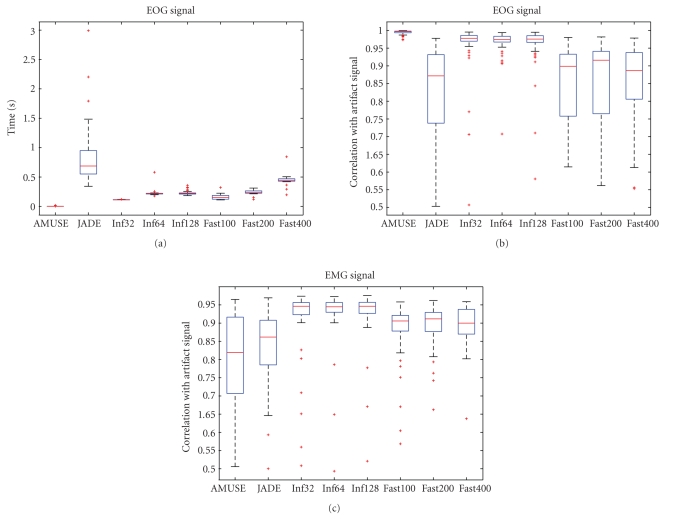
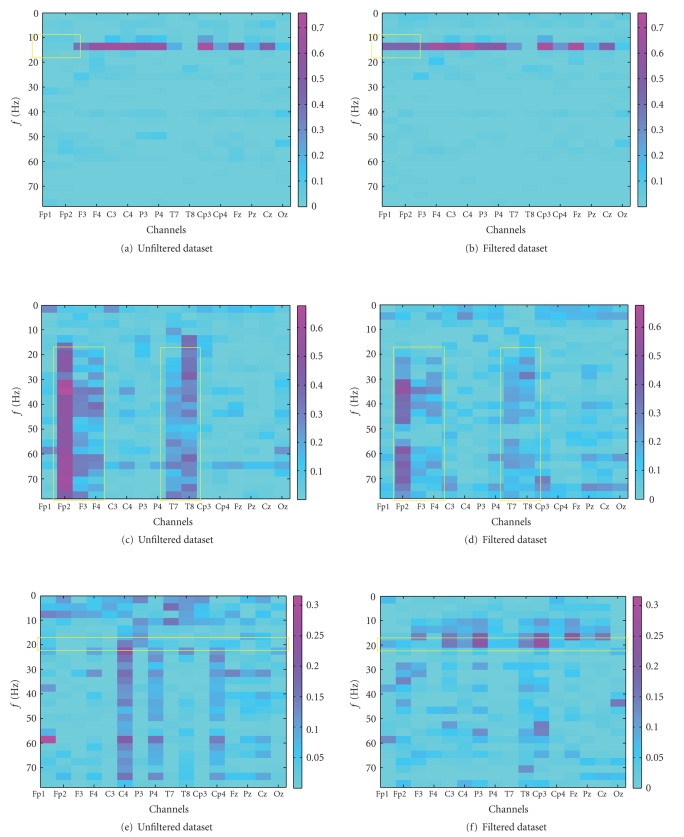
We propose a combination of blind source separation (BSS) and independent component analysis (ICA) (signal decomposition into artifacts and nonartifacts) with support vector machines (SVMs) (automatic classification) that are designed for online usage. In order to select a suitable BSS/ICA method, three ICA algorithms (JADE, Infomax, and FastICA) and one BSS algorithm (AMUSE) are evaluated to determine their ability to isolate electromyographic (EMG) and electrooculographic (EOG) artifacts into individual components. An implementation of the selected BSS/ICA method with SVMs trained to classify EMG and EOG artifacts, which enables the usage of the method as a filter in measurements with online feedback, is described. This filter is evaluated on three BCI datasets as a proof-of-concept of the method.
我们提出了一种盲源分离(BSS)和独立成分分析(ICA)(将信号分解为伪迹和非伪迹)与支持向量机(SVM)(自动分类)相结合的方法,旨在实现在线使用。为了选择合适的 BSS/ICA 方法,我们评估了三种 ICA 算法(JADE、Infomax 和 FastICA)和一种 BSS 算法(AMUSE),以确定它们将肌电图(EMG)和眼电图(EOG)伪迹分离成单个分量的能力。我们描述了一种使用 SVM 对选定的 BSS/ICA 方法进行分类的实现,该方法可以作为在线反馈测量中的滤波器使用。该滤波器在三个 BCI 数据集上进行了评估,以验证该方法的可行性。